

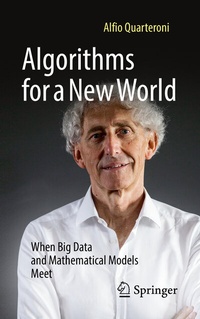
Algorithms for a New World
Description

Covid-19 has shown us the importance of mathematical and statistical models to interpret reality, provide forecasts, and explore future scenarios.
Algorithms, artificial neural networks, and machine learning help us discover the opportunities and pitfalls of a world governed by mathematics and artificial intelligence.
Reviews / Votes
"Alfio Quarteroni invites us to the stage of contemporary science and technology in which multidisciplinarity and transferability are combined to contribute to the construction of the wisdom of life . . A great master. Its access does not present difficulties beyond the decision to satisfy an intellectual and spiritual curiosity with a future edge: a book to be read with ease and understood with great quality." (Melio Sáenz, ResearchGate, researchgate.net, June, 2023)More details
Other editions
Additional editions
Person
Alfio Quarteroni is Professor of Numerical Analysis and Director of MOX at the Politecnico of Milan (Italy). Formerly he was Director of the Chair of Modelling and Scientific Computing at the EPFL (Swiss Federal Institute of Technology), Lausanne (Switzerland), from 1998 until the end of 2017. He is the founder (and first director) of MOX at Politecnico of Milan (2002) and MATHICSE at EPFL, Lausanne (2010). He is co-founder (and President) of MOXOFF, a spin-off company at Politecnico of Milan (2010).
He is the author of 25 books, editor of 9 books, author of more than 300 papers published in international Scientific Journals and Conference Proceedings, member of the editorial board of 25 International Journals and Editor in Chief of two book series published by Springer.
He has been an invited or plenary speaker in more than 300 International Conferences and Academic Departments, in particular he has been invited speaker at ICM 2002 in Beijing and plenary speaker at ICM 2006 in Madrid. Among his awards and honors are the NASA Group Achievement Award for the pioneering work in Computational Fluid Dynamics in 1992, the Fanfullino della Riconoscenza 2006, Città di Lodi, the Premio Capo D'Orlando 2006, the Ghislieri prize, 2013, the International Galileo Galilei prize for Sciences 2015, The Euler lecture in 2017. He is the Recipient of two ERC Advanced Grants: "MATHCARD", 2008, and "i-HEART", 2017, and of two ERC PoC (Proof of Concept) grants in 2012 and 2015, Recipient of the Galileian Chair from the Scuola Normale Superiore, Pisa, Italy ,2001, doctor Honoris Causa in Naval Engineering from Universi ty of Trieste, Italy, 2003, SIAM Fellow (first row) since 2009, IACM (International Association of Computational Mechanics) Fellow since 2004. He is a member of the Italian Academy of Science, the European Academy of Science, and the Academia Europaea, the IMU Circle, and the Lisbon Academy of Science.
His research interests concern Mathematical Modelling, Numerical Analysis, Scientific Computing, and Application to fluid mechanics, geophysics, medicine and the improvement of sports performance. His research Group at EPFL has contributed to the preliminary design of Solar Impulse, the Swiss long-range experimental solar-powered aircraft project; his research group at EPFL has carried out the mathematical simulation for the optimisation of performances of the Alinghi yacht, the winner of two editions (2003 and 2007) of the America's Cup.
