

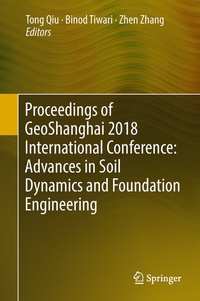
Proceedings of GeoShanghai 2018 International Conference: Advances in Soil Dynamics and Foundation Engineering
Description

This book is the sixth volume of the proceedings of the 4th GeoShanghai International Conference that was held on May 27 - 30, 2018. This volume, entitled "Advances in Soil Dynamics and Foundation Engineering", covers the recent advances and technologies in soil dynamics and foundation engineering. These papers are grouped into four categories: (1) soil dynamics and earthquake engineering, (2) deep excavations and retaining structures, (3) shafts and deep foundations, and (4) offshore geotechnics. It presents the state-of-the-art theories, experiments, methodologies and findings in the related areas. The book may benefit researchers and scientists from the academic fields of soil dynamics and earthquake engineering, geotechnical engineering, geoenvironmental engineering, transportation engineering, geology, mining and energy, as well as practical engineers from the industry.
Each of the papers included in this book received at least two positive peer reviews. The editorswould like to express their sincerest appreciation to all of the anonymous reviewers all over the world, for their diligent work.
More details
Other editions
Additional editions
Persons
Tong Qiu received his Ph.D. in Civil Engineering from the University of California - Los Angeles. His research interests include soil dynamics, landslides, and numerical analysis of geosystems. He is currently an Associate Professor in the Department of Civil and Environmental Engineering, The Pennsylvania State University - University Park.
Binod Tiwari received his Ph.D. from Niigata University, Japan. He got his Ph.D. in 2003 in geotechnical engineering and is expert in the field of slope stability and stabilization, landslide mitigation, applied GIS, soil behavior and characterization, and geotechnical earthquake engineering. He is currently an Associate Professor in the Civil and Environmental Engineering, Department of California State University, Fullerton.
Zhen Zhang received his Ph.D degree at the Department of Geotechnical Engineering in Tongji University. His research interests include ground improvement, geosynthetic reinforcement, and roadway engineering. He is currently an Associate Professor at the Department of Geotechnical Engineering in Tongji University.Content
- Intro
- Preface
- Organization
- International Advisory Committee
- Conference Steering Committee
- Technical Committee
- Organizing Committee
- Local Organizing Committee
- Contents
- About the Editors
- Probabilistic Assessment and Mapping of Liquefaction Hazard: From Site-Specific Analysis to Regional Mapping
- Abstract
- 1 Introduction
- 2 Site-Specific Probabilistic Assessment of Liquefaction Potential and Effects
- 2.1 Logistic Regression
- 2.2 Bayesian Methods
- 3 Regional Mapping of Liquefaction Hazard
- 3.1 Geology-Based Mapping of Liquefaction Susceptibility and Potential
- 3.2 Geostatistics and Random Field Model-Based Liquefaction Hazard Mapping
- 3.3 Integration of Geotechnical and Geological Data
- 4 Summary, Challenges and Future Research
- Acknowledgements
- References
- Soil Dynamics and Earthquake Engineering
- Effect of Initial Relative Density on Post-cyclic Stress-Strain Response of Liquefied Samples
- Abstract
- 1 Introduction
- 2 Material
- 3 Specimen Preparation Method and Multi-stage Soil Element Test
- 4 Post-liquefaction Stress-Strain Relation
- 5 Conclusion
- References
- Seismic Response of a Cross Transfer Subway Station in Soft Soil Subjected to Different Ground Motion Directions
- Abstract
- 1 Introduction
- 2 Project Background
- 3 Numerical Model Setup
- 3.1 Numerical Model
- 3.2 Boundary Conditions
- 3.3 Seismic Input
- 3.4 Properties of Materials
- 4 Numerical Results and Discussion
- 4.1 Structure Displacement
- 4.2 Soil Deformation Response Within the Height of Structure
- 4.3 Column Drifts
- 5 Conclusions
- Acknowledgement
- References
- A Study on the Natural Periods of Soil Site Based on Ground Motion Data from KiK-Net in Japan
- Abstract
- 1 Introduction
- 2 Data
- 3 Method
- 3.1 Method for Estimating Site Response
- 3.2 Method for Identifying Nature Frequencies
- 4 Results
- 4.1 Correlationships Between T0 and Different Influencing Factors
- 4.2 Relationships Between High-Order Natural Frequencies and f0
- 5 Conclusions
- References
- Multiscale Regional Liquefaction Hazard Mapping Accounting for Heterogeneous Data Sources
- Abstract
- 1 Introduction
- 2 Methodology
- 3 Data Characterization
- 3.1 Primary Data
- 3.2 Secondary Data
- 3.3 Spatial Correlation
- 4 Multiscale Sequential Simulation
- 5 Application
- 5.1 Random Field Realization
- 5.2 Monte Carlo Simulation
- 6 Conclusion
- Acknowledgement
- References
- Dynamic Response of Soil Around the Tunnel Under Subway Vibration Loading
- Abstract
- 1 Introduction
- 2 Tunnel-Soil Dynamic Interaction
- 3 Numerical Model
- 3.1 Model Size and Material Properties
- 3.2 Vibration Load and Boundary Conditions
- 4 Results and Discussion
- 5 Conclusions
- 5 Conclusions
- Acknowledgements
- References
- Liquefaction Characteristics of Four Ya-An Low-Plastic Silty Sands with Presence of Initial Static Shear Stress
- Abstract
- 1 Introduction
- 2 Testing Program
- 2.1 Testing Materials
- 2.2 Testing Program
- 3 Test Results
- 3.1 Failure Patterns
- 3.2 Cyclic Resistance
- 4 Effects of Initial Static Shear Stress
- 5 Conclusions
- Acknowledgement
- References
- Influence of Soil-Pile-Structure-Fluid Interaction on Seismic Behavior of a Liquid Storage Tank
- Abstract
- 1 Introduction
- 2 The Dynamic Equation of the Soil - Tank - Liquid System
- 3 Description of FEM Model for Soil - Tank - Liquid System
- 3.1 Geometry and Material Properties of the Tank
- 3.2 The Parameters of the Soil Site and Boundary Conditions
- 3.3 The FEM Model of the Tank
- 3.4 Selection of Seismic Waves for Dynamic Responses Analysis
- 4 Calculation Results and Analysis
- 4.1 Results of Dynamic Characteristics
- 4.2 The Stress Distribution Along the Height of the Tank Wall
- 4.3 Comparison of Peak Dynamic Response
- 5 Conclusion
- Acknowledgments
- References
- Influence of Soil Plugging on Dynamic Responses of Open-Ended Driven Pipe Pile
- Abstract
- 1 Introduction
- 2 Test Model and Procedures
- 2.1 Instruments
- 2.2 Test Procedure
- 3 Testing Results of Open-Ended Pile
- 3.1 Squeezing Effect
- 3.2 Dynamic Response Analysis
- 4 Testing Results of Fixed Soil Plug Lengths
- 4.1 Soil Squeezing Effect
- 4.2 Dynamic Response Analysis
- 5 Conclusion
- References
- Bi-objective Optimization of Site Investigation Program for Liquefaction Hazard Mapping
- Abstract
- 1 Introduction
- 2 Methodology
- 2.1 Liquefaction Potential Index (LPI)
- 2.2 Random Field Model
- 2.3 Procedure for Optimizing Site Investigation Programs
- 3 Numerical Results
- 3.1 Investigation Programs for Liquefaction Hazard Mapping
- 3.2 Accuracy Evaluation of Simulated LPI Random Field
- 3.3 Optimal Site Investigation Program
- 4 Conclusions
- Acknowledgements
- References
- Longitudinal Nonlinear Seismic Response of Shield Tunnel Based on Generalized Response Deformation Method
- Abstract
- 1 Introduction
- 2 Selection of Bedrock Ground Motions
- 3 Numerical Model of Free-Field Site
- 4 Generalized Response Displacement Method for Shield Tunnel
- 5 Longitudinal Seismic Response Characteristics of Shield Tunnel
- 6 Conclusions
- References
- Seismic Responses of the Large-Scale Deep Shaft in Shanghai Soft Soils
- Abstract
- 1 Introduction
- 2 Three Dimensional Dynamic Time History Analysis
- 2.1 Modelling and Material Parameters
- 2.2 Boundary Conditions
- 2.3 Ground Motion
- 2.4 Model Validation
- 3 Seismic Responses: Shaft Deformation
- 3.1 Lateral Deformation
- 3.2 Radial Deformation
- 4 Seismic Responses: Shaft Inner Forces
- 4.1 Vertical Inner Forces
- 4.2 Radial Inner Forces
- 5 Conclusions
- Acknowledgement
- References
- In-situ Measurement of Metro-Induced Building Vibrations over a Metro Station
- Abstract
- 1 Introduction
- 2 In-situ Measurement Process
- 2.1 Experimental Site
- 2.2 Underlying Soil Properties
- 2.3 Metro Train and Track
- 2.4 Measurement Arrangement
- 3 Characteristics of Metro-Induced Building Vibrations
- 3.1 Time Domain Characteristics of Vibration Acceleration
- 3.2 Frequency Domain Characteristics of Vibration Acceleration
- 3.3 Analysis of Amplitude and Vibration Level
- 4 Conclusions
- Acknowledgement
- References
- Characteristics of Surrounding Soils Influenced by High Frequency Vibratory Pile Pulling
- Abstract
- 1 Introduction
- 2 Description of the Test
- 2.1 Testing Site and Soil Conditions
- 2.2 Vibratory Equipment and the Pile
- 2.3 Instrumentation and Monitoring
- 3 Results and Analyses
- 3.1 Ground Displacements
- 3.2 Horizontal Deformation of Deep Soils
- 3.3 Pore Water Pressure
- 4 Conclusion
- References
- Observations on Model Uncertainty of Robertson-Wride Model for Liquefaction Potential Evaluation
- Abstract
- 1 Introduction
- 2 Method of Model Calibration
- 3 Calibration Database
- 4 Accuracy of the RM Model in Different Regions
- 5 Model Uncertainty of the RW Model
- 5.1 Impact of Earthquakes After 2010
- 5.2 Impact of Method for Interpreting the Liquefaction Case Histories
- 6 Summary and Conclusions
- Acknowledgement
- References
- Shaking Table Investigation of Seismic Performance of Micropiles
- Abstract
- 1 Introduction
- 2 Shaking Table Experiments
- 3 Results
- 4 Conclusion
- References
- Effects of Near-Fault Pulse-Like Ground Motion on Site Liquefaction and Settlement
- Abstract
- 1 Introduction
- 2 Modeling and the Selection of Ground Motions
- 2.1 Modeling
- 2.2 Selection of Ground Motions
- 3 The Influence of Pluse-like Ground Motion on Site Liquefaction and Settlement
- 3.1 Influence of Pulse-like and Non-pulse Ground Motions on Site Liquefaction and Settlement
- 3.2 Influence of Fault-Parallel and Fault-Normal Component of Pulse-like Motion on Site Liquefaction and Settlement
- 3.3 Influence of One-Side Pulse-like Ground Motion on Site Liquefaction and Settlement
- 4 Conclusions
- Aknowledgements
- References
- Influence of Consolidation Pressure on Cyclic and Post-cyclic Response of Fine-Grained Soils with Varying Mineralogical Compositions and Plasticity Characteristics
- Abstract
- 1 Introduction
- 2 Background on Locations of Natural Samples
- 2.1 Cyclic Failure Site at Lokanthali, Nepal
- 2.2 Montmorillonite Seam at Portuguese Bend Landslide, CA, USA
- 3 Soil Properties and Testing Procedures
- 3.1 Soil Properties
- 3.2 Simple Shear Testing Procedures
- 4 Results and Discussion
- 5 Conclusions
- References
- Dynamic Response of Lightweight Cellular Concrete MSE Walls
- Abstract
- 1 Background
- 2 Model and Testing Details
- 2.1 Casting of LCC Retaining Wall
- 2.2 Shake Table Testing
- 3 Results and Discussion
- 4 Conclusions
- References
- Experimental Evaluation of Encased Stone Column Technique for Liquefaction Mitigation
- Abstract
- 1 Introduction
- 2 Materials
- 2.1 Soil
- 2.2 Aggregates
- 2.3 Geotextile
- 3 Experimental Procedure
- 4 Results and Discussion
- 5 Conclusions
- Acknowledgement
- References
- Numerical Evaluation of Cyclic Response of Shallow Foundation Resting on Liquefiable Soil
- Abstract
- 1 Introduction
- 2 General Formulation
- 3 Verification of Numerical Code
- 4 Results and Discussion
- 4.1 Case 1 (Response of Foundations Without Spacing)
- 4.2 Case 2 (Response of Foundations with Spacing of 8 m)
- 5 Conclusion
- References
- Three-Dimensional Analysis of a Row of Holes as Active Wave Barrier in Saturated Soil
- Abstract
- 1 First Section
- 1.1 A Subsection Sample
- 2 Active Vibration Isolation of Foundations by a Row of Holes
- 2.1 Boundary Element Equations of Machine Foundation
- 2.2 Boundary Element Equations of a Row of Holes
- 2.3 The Screening Effectiveness of a Row of Holes
- 3 Active Vibration Isolation of Foundation by a Row of Holes
- 3.1 Effects of the Normalized Distance S_{{\rm d}}^{*}
- 3.2 Effects of Geometrical Parameters of a Row of Holes
- 4 Conclusions
- Acknowledgments
- References
- Topographic Effects on the Seismic Coefficient and Earthquake-Induced Permanent Displacement of Earth Slopes
- Abstract
- 1 Introduction
- 2 Analysis Methodology
- 2.1 Critical Slip Surface and Horizontal Yield Coefficient
- 2.2 Dynamic Response and Horizontal Seismic Coefficient of Sliding Mass
- 3 Topographic Effects on the Seismic Coefficient
- 3.1 Verification of Numerical Accuracy
- 3.2 Parametric Analysis of Slope Geometry
- 3.3 Parametric Analysis of Soil Layer
- 4 Topographic Effects on the Permanent Displacement
- 5 Conclusions
- Acknowledgements
- References
- Experimental Investigation on Liquefaction Resistance of Soil Mixtures Incorporating Intergrain Contact State
- Abstract
- 1 Introduction
- 2 Theory of Intergrain Contact State
- 3 Undrained Cyclic Triaxial Tests
- 4 Test Results and Discussion
- 5 Summary
- References
- The Influence of Bedrock Surface Depth on Seismic Site Response in Deep Sediment Layers
- Abstract
- 1 Introduction
- 2 Site Characterization
- 3 Selection of Seismic Bedrock Interface
- 4 Seismic Bedrock Motion
- 5 Results and Analysis
- 5.1 Surface PGAs
- 5.2 Surface Spectral Acceleration
- 6 Conclusions
- References
- Shaking Table Experimental Study on Time-Frequency Characteristics of Subway Stations Constructed in Different Materials
- Abstract
- 1 Introduction
- 2 Optimal Wavelet Packet Transformation
- 3 Design of the Two Shaking Table Tests
- 4 Time-Frequency Characteristics of Accelerations for the Two Soil-Structure Systems
- 5 Conclusion
- References
- Dynamic Responses of Saturated Transversely Isotropic Ground Subjected to High-Speed Train Load
- Abstract
- 1 Introduction
- 2 Mathematical Formulations
- 3 Numerical Results and Discussion
- 3.1 Mathematical Description of Calculation Model
- 3.2 Effects of Horizontal and Vertical Elastic Moduli
- 3.3 Effects of Horizontal and Vertical Poisson Ratio
- 3.4 Effects of Shear Modulus
- 4 Conclusions
- Acknowledgements
- References
- Numerical Study on Settlement of Building with Shallow Foundation Under Earthquake Loading
- Abstract
- 1 Introduction
- 2 Models and Parameters
- 2.1 Centrifuge Testing Overview
- 2.2 Numerical Model
- 3 Results and Discussions
- 3.1 Settlement and Pore Pressure in Free-Field (FF)
- 3.2 Response of Structure and Soil Adjacent to Foundation
- 4 Conclusions
- Acknowledgments
- References
- Seismic Response of Segmental Lining Tunnel by Using Shaking Table Test and Numerical Simulation
- Abstract
- 1 Introduction
- 2 Prototype
- 2.1 Engineering Geology
- 3 Seismic Study
- 3.1 Input of Earthquakes
- 3.2 Shaking-Table Tests
- 3.3 Numerical Simulation
- 4 Results
- 4.1 Acceleration
- 4.2 Extension of Joint
- 5 Summary
- References
- Study on Pounding Effect Between Long Span Suspension Bridge and Approach Bridge Under Earthquake
- Abstract
- 1 Introduction
- 2 Finite Element Model of Long - Span Suspension Bridge
- 2.1 Finite Element Model
- 2.2 Dynamic Characteristics and Anti-push Stiffening
- 2.3 Simulation of Pounding Element of Expansion Joint
- 3 Influence of Pounding Stiffness on Pounding Effect
- 4 Influence of Initial Width of Expansion Joint on Pounding Effect
- 5 Conclusions
- Acknowledgements
- References
- Effects of Pile Group Configuration on the Seismic Response of Buildings Considering Soil-Pile-Structure Interaction
- Abstract
- 1 Introduction
- 2 Adopted Numerical Soil-Pile-Structure Model
- 3 Results and Discussion
- 4 Conclusions
- References
- Deterministic Seismic Hazard Analysis of Central Gujarat Region
- Abstract
- 1 Introduction
- 2 Seismicity and Geology of the Study Region
- 3 Earthquake Catalogue Compilation
- 3.1 Homogenization of Earthquake Magnitude
- 3.2 Declustering of Earthquake Catalogue
- 4 Seismotectonic Model of the Study Region
- 5 Deterministic Seismic Hazard Analysis
- 6 Discussions and Conclusions
- References
- Investigation on the Reliquefaction Behaviors of Sand Using Shaking Table Tests
- Abstract
- 1 Introduction
- 2 Materials and Methods
- 2.1 Tested Sand
- 2.2 Experimental Apparatus
- 2.3 Preparation of the Model Ground
- 2.4 Procedure of Shaking Table Test
- 3 Test Results and Discussions
- 3.1 Input Acceleration, Pore Water Pressure and Settlement Response
- 3.2 Characteristics of Reliquefaction Times and Reliquefaction Resistance
- 4 Conclusions
- References
- Dynamic Properties of Mixtures of Waste Materials
- Abstract
- 1 Introduction
- 2 Laboratory Investigations
- 2.1 Materials
- 2.2 Specimen Preparation and Testing Program
- 3 Test Results
- 3.1 The Effects of {\varvec R}_{{\varvec b}} (%) and the Effective Confining Pressure
- 3.2 The Effects of Cyclic Loading Cycles
- 3.3 The Effects of Shear Strain Level
- 4 Conclusions
- Acknowledgements
- References
- Dynamic Flow Characteristics of Liquefied Sand Under the Extrema Large Deformation in the Cyclic Torsional Shear Tests
- Abstract
- 1 Introduction
- 2 Test Apparatus and Test Procedure
- 3 Analysis of the Test Results
- 3.1 Effect of the Effective Confining Pressure
- 3.2 Effect of the Cyclic Loading Amplitude
- 3.3 Effect of the Initial Shear Stress
- 4 Conclusions
- Acknowledgments
- References
- Seismic Responses Analysis of Base-Isolated LNG Storage Tank
- Abstract
- 1 Introduction
- 2 The Finite Element Model Establishment of LNG Tank
- 2.1 Dimensions of the LNG Tank
- 2.2 Modeling
- 2.3 Material Parameters
- 2.4 Boundary Conditions and Load
- 2.5 Base Isolation Layer
- 3 Modal Analysis of LNG Tank
- 4 Time History Analysis
- 4.1 Seismic Response Analysis of Different Liquid Levels
- 4.2 Seismic Analysis of Seismic Wave with Different Predominant Periods
- 5 Conclusions
- Acknowledgement
- References
- Seismic Response and Safety Evaluation of the Underground Slab-Wall Structure with Large Length
- Abstract
- 1 Introduction
- 2 Project Overview
- 3 Numerical Simulation
- 3.1 Structure Model
- 3.2 Soils Model
- 3.3 Selection of Seismic Waves
- 4 Dynamic Response Under the Medium Earthquake
- 4.1 Displacement Response
- 4.2 Safety Evaluation
- 5 Dynamic Response Under the Strong Earthquake
- 5.1 Displacement Response
- 5.2 Plasity Developing
- 6 Conclusions
- Acknowledgments
- References
- Evaluation of SPT-Based Liquefaction Assessment Methods in China
- Abstract
- 1 Introduction
- 2 Analysis of Liquefaction Data in China
- 3 SPT-Based Liquefaction Assessment Methods
- 4 Evaluation Results and Analysis
- 5 Conclusions
- References
- Experimental Research on Dynamic Characteristics of Rubber Model Soil
- Abstract
- 1 Introduction
- 2 The Preparation of Model Soils
- 3 Test Instruments and Principles
- 4 Test Results and Analysis
- 4.1 Analysis of the Dynamic Characteristics of the Soil Under Different Confining Pressures
- 4.2 Comparative Analysis of Model Soil and Pure Soil
- 5 Conclusions
- References
- Deep Excavations and Retaining Structures
- Limit Analysis of the Transient Stability of Slopes During Pile Driving with Nonlinear Failure Criterion
- Abstract
- 1 Introduction
- 2 Nonlinear Failure Criterion
- 3 Upper Bound Limit Analysis
- 3.1 Basic Model
- 3.2 Upper Bound Limit Analysis
- 3.3 Safety Factor
- 3.4 Rate of External Work and Internal Work
- 4 Results and Discussions
- 4.1 Effect of Nonlinearity Coefficient
- 4.2 Effect of Pile Diameter
- 4.3 Effect of Pile Location
- 5 Conclusions
- References
- Deformation Behavior of Foundation Pit Considering the Variation of Permeability Coefficient of Soil Mass
- Abstract
- 1 Introduction
- 2 Relationship Between Permeability Coefficient and Effective Stress
- 3 Numerical Simulation of Excavation Considering the Variation of Coefficient of Permeability
- 3.1 Engineering Example
- 3.2 Numerical Model
- 4 Result Analysis
- 4.1 Horizontal Displacement of Retaining Wall
- 4.2 Heave Deformation of Pit Base
- 4.3 Ground Settlement Around Foundation Pit
- 5 Conclusions
- References
- Responses of Two Buildings Located at the Corners of a Rectangular Excavation: A Case Study in Hangzhou
- Abstract
- 1 Introduction
- 2 Project Information
- 2.1 Project Background
- 2.2 Geological Condition
- 2.3 Instrumentations
- 2.4 Construction Procedure
- 3 Observed Excavation Behaviors
- 3.1 Lateral Movements of Diaphragm Walls
- 3.2 Excavation-Induced Ground Settlements
- 3.3 Analysis of Spatial Building Settlements
- 4 Conclusions
- References
- Braced Excavation Responses in BTG Residual Soils Under Significant Groundwater Drawdowns: DTL2 Case Study in Singapore
- Abstract
- 1 Introduction
- 2 General Project Description
- 2.1 Site Layout
- 2.2 Subsurface Conditions
- 2.3 Excavation Support System Description
- 2.4 Field Instrumentation
- 3 Observed Behavior of Field Instrumentations
- 3.1 Lateral Wall Movements
- 3.2 Ground Surface Settlements
- 3.3 Groundwater Level Changes
- 4 Characteristics of Braced Excavation Responses
- 4.1 Characteristics of Lateral Wall Movements
- 4.2 Characteristics of Ground Surface Settlement Values
- 5 Summary and Conclusions
- References
- The Discussion of Influential Factors on Tunnel Upheaval Deformation Induced by Deep Pit Excavations Above Metro Tunnels
- Abstract
- 1 Introduction
- 2 Project Background
- 3 Finite Element Analysis
- 3.1 Model Establishment
- 4 Approach and Discussion
- 4.1 Excavation Depth
- 4.2 Excavation Manner
- 4.3 Tunnel Shape
- 5 Conclusion
- References
- Numerical Analysis of Multi-tunnel Interaction in Clay
- Abstract
- 1 Introduction
- 2 Numerical Modeling of Tunnel Tests
- 2.1 Overview of the Centrifuge Tests
- 2.2 Numerical Model
- 2.3 Constitutive Model and Implementation
- 2.4 Method to Simulate the Ground Loss
- 2.5 Calculation Process
- 3 Results and Comparisons
- 3.1 Cases of Parallel Arrangement
- 3.2 Cases of Offset Arrangement
- 4 Conclusion
- Acknowledgment
- References
- Observed Performance of a Large-Scale Double Annular Arched Girders Structural System in Deep Excavation
- Abstract
- 1 Introduction
- 2 Project Overview
- 2.1 Foundation Pit Overview
- 2.2 Enclosure System Overview
- 2.3 Site Subsurface Conditions
- 2.4 Monitoring System
- 2.5 Construction Process
- 3 Monitoring Data and Analyze
- 3.1 Metro Pier Settlements
- 3.2 Lateral Wall Settlements
- 3.3 Annular Structure Axial Force
- 3.4 Subsurface Horizontal Displacement
- 4 Conclusions
- References
- Deformation of Subway Tunnels Affected by Adjacent Excavation: In-situ Monitoring and Centrifugal Model Test
- Abstract
- 1 Introduction
- 2 Engineering General Situation
- 2.1 Site Condition
- 2.2 Geology
- 2.3 Construction Procedure of the Excavation
- 3 Observed Tunnel Deflections
- 3.1 Additional Settlement
- 3.2 Additional Convergence
- 4 Centrifugal Model Test
- 4.1 Apparatus
- 4.2 Model
- 4.3 Procedure
- 4.4 Results
- 5 Conclusions
- References
- Evaluation of the Applicability of FEM to Simulate the Behaviour of Curtain Pile Walls in Tropical Soils
- Abstract
- 1 Introduction
- 2 Study Case
- 2.1 Soil Tests
- 2.2 Instrumentation Results
- 3 FEM Modeling
- 3.1 Properties of Piles and Nails
- 3.2 Soil Properties for the Mohr Coulomb Model
- 4 Results and Discussions
- 5 Conclusions
- References
- Effect of Pre-excavation Construction on Surrounding Historic Building Based on Field Measurements in Shanghai Soft Ground
- Abstract
- 1 Introduction
- 2 Project Background
- 2.1 The Position Relation of the Foundation Pit and the Historic Building
- 2.2 Ground Conditions
- 2.3 Protection and Control Measures
- 3 Monitoring Data Analysis
- 4 Conclusion
- Acknowledgements
- References
- Countermeasures to Retaining Wall Deflection Induced by Pre-excavation Dewatering
- Abstract
- 1 Introduction
- 2 In Situ Dewatering Tests: Installing Struts Before PED
- 3 Numerical Model and Verification
- 4 Effect of Segmental Dewatering
- 5 Concluding Remarks
- Acknowledgments
- References
- Estimation of Pile Set-up Effect in Clay Using Direct Shear Test
- Abstract
- 1 Introduction
- 2 Set-up Mechanism
- 3 Test Setup and Procedures
- 3.1 Direct Shear Apparatus
- 3.2 Test Materials
- 3.3 Test Procedures
- 4 Test Results and Discussion
- 4.1 Relationship Between Shear Forces and Displacement
- 4.2 Development of Ultimate Shear Forces with Interval Time
- 4.3 Distribution of Soil Particles
- 5 Conclusions
- Acknowledgments
- References
- Modified Pseudo-dynamic Method for Seismic Passive Earth Thrust of Submerged Backfill
- Abstract
- 1 Introduction
- 2 Method of Analysis
- 2.1 Calculation Hypothesis
- 2.2 Modified Pseudo-dynamic Method
- 3 Comparison
- 4 Results and Discussion
- 5 Conclusion
- References
- Effects of Foundation Pit Width on the Anti-overturn Stability of Its Support Structure Under Ground Load
- Abstract
- 1 Introduction
- 2 Analysis of Pit Support Structure Overturn Disability
- 3 Effects Analysis with Consideration of Pit Width
- 3.1 Classification of Pit Width Based on Earth Pressure Principle
- 3.2 Classification of Pits with Consideration of Ground Load
- 4 Calculation of Anti-overturn Stability of the Support Structure
- 4.1 Calculation of Passive Soil Pressure of the Support Structure
- 4.2 Calculation of the Overturn Torque of the Support Structure
- 4.3 Calculation of Anti-overturn Torque of the Support Structure
- 4.4 Calculation of Anti-overturn Safety Coefficient
- 5 Comparison and Analysis of the Results Calculated Using the Above-Mentioned 3 Methods
- 5.1 Analysis of Overturn Stability of Soil Subject to Different Ground Loads
- 5.2 Analysis of Anti-overturn Stability Under Different Load Acting Distances
- 5.3 Analysis of Anti-failure Stability Under Actions of Different Pit Width
- 5.4 Comparative Analysis of Embedded Depth
- 6 Conclusions
- References
- Study on the Force and Deformation Characteristics of Prefabricated Pile-Wall Compound Structure and Its Application in Foundation Pit Engineering
- Abstract
- 1 Introduction
- 2 Project Overview
- 3 Numerical Model
- 4 Calculation Results Analysis
- 4.1 Deformation Analysis
- 4.2 Analysis on the Internal Force of Structure
- 4.3 Analysis on Structure Stress
- 5 Conclusions
- Acknowledgments
- References
- Deformation Prediction of Excavated Slopes with a Neural Network Model Based on Nonlinear Numerical Analyses
- Abstract
- 1 Introduction
- 2 Finite Element Method for Analyzing Excavated Soil of Slopes
- 2.1 Constitutive Relations for Soils
- 2.2 The Method for Simulation of Excavation
- 2.3 Determination of Boundary Limits and Mesh Format
- 2.4 Key Features of Program FEASLOPE
- 3 Parametric Analyses of Deformation of Excavated Slopes
- 3.1 Influence of Soil Parameters on Results of Finite Element Analyses
- 3.2 The Influence of Geometry Parameters on Results of Finite Element Analyses
- 4 A BP Neural Network for Deformation Prediction
- 4.1 Back Propagation Neural Networks
- 4.2 Key Features of Program BPSLOPE
- 5 Prediction of Results from BPSLOPE
- 6 Conclusions
- Acknowledgement
- References
- Experimental Study on the Mechanical Properties and Deformation Characteristics of Prefabricated Concrete Square Pile
- Abstract
- 1 Introduction
- 2 Form of Pile Joints
- 3 Model Test Design
- 3.1 Design of Test Specimen
- 3.2 Design of Test Load and Monitoring Scheme
- 4 Test Results Analysis
- 4.1 Test Results Description
- 4.2 Mechanical Performance Comparison of Different Joints
- 5 Conclusions
- Acknowledgments
- References
- Influence Analysis of Frame Buildings Induced by Foundation Pit Excavation Considering Arbitrary Angle Between Longitudinal Wall and Foundation Pit
- Abstract
- 1 Introduction
- 2 Conclusions
- Acknowledgments
- Effect of Passive Zone Improvement on the Stability of a Double-Row Pile-Retained Excavation
- Abstract
- 1 Introduction
- 2 Project Description
- 3 Finite Element Model
- 4 Result Analysis
- 4.1 Effect of the Width of the Passive Improvement Zone
- 4.2 Effect of the Height of the Passive Improvement Zone
- 5 Conclusions
- References
- Permanent Displacement Based Seismic Design Chart for Cantilever Retaining Walls
- Abstract
- 1 Introduction
- 2 Double Wedge Model
- 2.1 Verification of the Earthquake Data Used for Developing Franklin and Chang's Chart
- 2.2 Methodology to Develop Design Chart Using Double Wedge Model for Cantilever Retaining Walls
- 3 Results and Discussions
- 4 Suggested Design Procedure for Cantilever Retaining Walls
- 5 Conclusion
- References
- Three-Dimensional Numerical Parametric Investigation of the Influence of Large-Scale Overexcavation on Deep Excavations
- Abstract
- 1 Introduction
- 2 Project Overview and Numerical Model
- 2.1 Project Overview
- 2.2 Numerical Model
- 3 Parametric Study of the Overexcavated Excavation
- 3.1 Length of the Steel-Pipe Pile Wall
- 3.2 Distance Between the Edge of Overexcavation and the Pile Wall
- 3.3 Overexcavation Depth
- 4 Conclusions
- References
- Mechanical Analysis of Supporting Struts for Special-Shaped Foundation Pits
- Abstract
- 1 Introduction
- 2 Design Methodology and Model of Full-Circle Foundation Pit
- 2.1 Determining the Equivalent Stiffness of Struts by Codes
- 2.2 Bar System Finite Element Methods
- 3 Analysis of the Special-Shaped Struts
- 3.1 Analysis Method and Bar System FEM
- 3.2 Methods Considering the Interaction Between the Ground and Structures
- 4 Conclusions
- Acknowledgements
- References
- Basal Stability Analysis of Braced Excavations with Embedded Walls in Non-homogeneous Clay by a Kinematic Approach
- Abstract
- 1 Introduction
- 2 Basal Stability Analysis with Upper Bound Method
- 2.1 Upper Bound Theorem
- 2.2 Failure Mechanism and Upper Bound Calculation
- 3 Results and Comparison
- 3.1 Effect of Wall Embedment
- 3.2 Effects of Non-homogeneous Strength
- 4 Cases Study
- 4.1 Field Excavation Cases in Isotropic and Homogeneous Clay
- 4.2 Numerical Excavation Cases in Non-homogeneous Clay
- 5 Conclusions
- Acknowledgement
- References
- Reliability-Based Assessment of Internal Stability for MSE Walls in Heavy Haul Railway
- Abstract
- 1 Introduction
- 2 Design for Reinforced Earth Retaining Wall Stability
- 2.1 Horizontal Pressure on Wall Facing Blocks
- 2.2 Vertical Pressure on the Steel Strips
- 3 Conventional FORM Procedure for Reliability-Based Design Considering Single Failure Mode
- 4 Reliability-Based Assessment of Reinforced Earth Retaining Walls Subjected to Heavy Haul Railway Load
- 4.1 Effect of Uncertain Material Property of Backfills
- 4.2 Effect of Uncertain Soil-Reinforcement Interface Friction
- 5 Comparison Between FORM and Monte Carlo Simulation
- 6 Conclusion
- Acknowledgment
- References
- Numerical Modelling of the Excavation Damaged Zone in Hollow Cylinder Experiment of Boom Clay
- Abstract
- 1 Introduction
- 2 Constitutive Model and the Aided Method
- 2.1 Constitutive Model
- 2.2 A Aided Method for Locating Slip Lines
- 3 EDZ in Hollow Cylinder Experiment
- 4 Conclusions
- Acknowledgments
- References
- Numerical Analysis About Influence of Protecting Wall on the Displacement Field Around the Pit
- Abstract
- 1 Introduction
- 2 Geotechnical Conditions and Parameters of Material
- 3 Analysis of the Numerical Results
- 4 Parametric Studies
- 4.1 The Distance Between the Excavation and the Protecting Wall
- 4.2 The Length of the Protecting Wall
- 5 Conclusions
- References
- Settlement Prediction of Large LNG Tanks Built in Beaumont Formation
- Abstract
- 1 Introduction
- 2 Historical Use, Subsurface Conditions, and Design Parameters
- 3 Tank Description and Loading
- 4 Analyses and Results
- 4.1 One-Dimensional Analysis
- 4.2 Axisymmetric Model in FEM Analysis
- 4.3 Three-Dimensional Model in FEM Analysis
- 4.4 Results
- 5 Conclusions
- Acknowledgement
- References
- Shafts and Deep Foundations
- Centrifugal Model Tests on the Bearing Capacity of Piles with Basement Construction Under the Existing Building
- Abstract
- 1 Introduction
- 2 Centrifuge Model Test
- 2.1 Design of Model Tests
- 2.2 Soil Property and Pile
- 2.3 Instrumentation
- 2.4 Testing Procedure
- 2.5 Test Results and Analyses
- 3 Conclusion
- Acknowledgements
- References
- Analysis of Bearing Capacity of Jacked PHC Pipe Piles in Double-Layered Ground Based on Data Mining
- Abstract
- 1 Introduction
- 2 Calculation Method
- 2.1 Grey Correlation Method
- 2.2 Partial Least Squares Regression Method
- 3 Impact Factor and Relevance Analysis
- 4 Derivation and Verification of Regression Equation
- 5 Conclusion
- References
- Full-Scale Loading Test on Pre-bored Precast Pile with Enlarged Base in Shanghai
- Abstract
- 1 Introduction
- 2 Description of Modified Pre-bored Precast Piling Method
- 3 Pile Test Program
- 3.1 Ground Conditions
- 3.2 Pile Installation and Instrumentation
- 3.3 Static Loading Test
- 4 Pile Test Results
- 4.1 Load-Displacement Response
- 4.2 Load Transfer Mechanism
- 5 Conclusions
- References
- Design of Drilled Shafts for Unusual High Mooring Forces
- Abstract
- 1 Introduction
- 2 Review of Design Provisions of Concrete-Filled Steel Tube (CFT)
- 2.1 D/t Ratio
- 2.2 Design Models for CFT
- 3 Design of Mooring Shaft
- 3.1 D/t Ratio
- 3.2 Subsurface Conditions and L-Pile Analysis
- 3.3 Available Moment and Shear Strength
- 3.4 Shear Rings and Center Bar
- 4 Conclusions
- References
- Prediction of Long-Term Settlements of Foundations Supporting High and Heavy Storage Tanks Based on Short-Term Field Measurements
- Abstract
- 1 Introduction
- 2 Background
- 3 Asaoka Method
- 4 Results and Discussion
- 5 Conclusions
- References
- Full-Scale Field Study on Large-Diameter Post-grouting Drilled Shafts
- Abstract
- 1 Introduction
- 2 Site and Test Shafts Conditions
- 3 Post-grouting Technique
- 4 Test Method
- 5 Analysis on Load-Test Results
- 5.1 Equivalent Load-Displacement Responses
- 5.2 Shaft Resistance
- 5.3 Mobilized Base Resistance
- 6 Discussion
- 7 Conclusions
- References
- A Reliability Study of a Pile Foundation Design in Soft Soils
- Abstract
- 1 Introduction
- 2 A Pile Foundation Design
- 2.1 Pile Capacity
- 2.2 Settlement
- 3 Reliability of Design
- 3.1 Performance Function
- 3.2 Reliability Index
- 4 Reliability of Pile Foundation
- 4.1 Pile Capacity
- 4.2 Pile Settlement
- 5 Conclusions
- References
- A Simplified Method for Nonlinear Analysis of Piled Raft
- Abstract
- 1 Introduction
- 2 Method of Analysis
- 2.1 Nonhomogeneity of Subsoil
- 2.2 Stiffness Matrix Analysis Method for the Piled Raft Foundation
- 3 Determination of the Flexibility Matrix of Pile Group-Soil System
- 4 Results of Analysis
- 5 Conclusions
- References
- A Comparative Study of New Pneumatic Caisson and Underground Diaphragm Wall Used in Deep Underground Space
- Abstract
- 1 Introduction
- 2 Overview of the NPC Method and Diaphragm Wall Method
- 3 Validation of Numerical Model
- 4 Numerical Simulation
- 5 Results and Discussions
- 5.1 Surface Settlements
- 5.2 Horizontal Displacements
- 5.3 Lateral Earth Pressure
- 6 Conclusions
- Acknowledgments
- References
- Analysis of Load Distribution Characteristics in Piled Raft Foundation
- Abstract
- 1 Introduction
- 2 Non-linear Analysis of Rigid Pile Raft
- 3 Case Validation
- 4 Parametric Study
- 5 Conclusions
- Acknowledgement
- References
- Physical and Numerical Modelling of Grouting Induced Enlarged-Base Pile
- Abstract
- 1 Introduction
- 2 Model Test
- 2.1 Model Test Scheme
- 2.2 Test Results
- 3 Numerical Modelling
- 4 Summary and Conclusions
- Acknowledgement
- References
- Predicting the Drained Capacity of Skirted Foundations Under Uniaxial Loads
- Abstract
- 1 Introduction
- 2 Finite Element Model
- 3 Validation of the Numerical Model
- 4 Vertical Capacity
- 5 Horizontal Capacity
- 6 Moment Capacity
- 7 Conclusion
- References
- Offshore Geotechnics
- Numerical Study on the Performance of Bio-inspired Bridge Attachments as Local Scour Countermeasures with Attack Angles
- Abstract
- 1 Introduction
- 2 Numerical Method
- 2.1 Governing Equations for Flow
- 2.2 Erosion Mechanisms
- 3 Simulation of Bio-Inspired Bridge Attachments with Attack Angle
- 3.1 Simulation of Free Surface Flow Around Circular Cylinder
- 3.2 Simulation of Flow Around Bio-Inspired Bridge Attachments
- 4 Conclusions
- Acknowledgements
- References
- Simulating the Caisson Penetration in Sand Using a Critical State Based Soil Model
- Abstract
- 1 Introduction
- 2 Introduction of the SIMSAND Model
- 2.1 Mathematical Description
- 2.2 Model Parameters
- 3 Numerical Modelling
- 3.1 Experimental Campaign
- 3.2 Lagrangian and Combined Lagrangian - SPH Model
- 3.3 Simulation Sequences
- 3.4 Simulation Results for CPT
- 3.5 Simulation Results for Caisson Penetration
- 4 Conclusions
- Acknowledgment
- References
- Modelling of Spudcan Foundation Penetrations Using an Improved Hypoplastic Model for Soft Clays
- Abstract
- 1 Introduction
- 2 Constitutive Model Formulation
- 2.1 Hypoplastic Model for Soft Clays
- 2.2 Model Improvements
- 2.3 Parameter Calibration
- 3 Model Evaluation and Numerical Model Results
- 4 Summary and Conclusions
- Acknowledgment
- References
- Experimental Analysis on Interfacial Shear Strength in Penetration of Super-Long Piles in Ocean Engineering
- Abstract
- 1 Introduction
- 2 Test Equipment and Methods
- 2.1 Soil Specimens
- 2.2 Experiment Apparatuses
- 2.3 Experiment Approaches
- 3 Test Results
- 3.1 Direct Shear Tests
- 3.2 Ring Shear Tests
- 4 Conclusions
- References
- Numerical Analysis of Current-Induced Local Scour Under a Vibrating Pipeline
- Abstract
- 1 Introduction
- 2 Numerical Model
- 3 Model Validation
- 4 Numerical Results and Discussion
- 5 Conclusions
- References
- Simulation and Prototype Measurements Analysis of Loading and Overflow Process of TSHD Hopper
- Abstract
- 1 Introduction
- 2 Loading Process Description
- 3 Basic Equations of the Model
- 3.1 Equations of Water Flow
- 3.2 Equations of Sediment Movements
- 4 Comparison of the Model with Camp
- 4.1 Introduction
- 4.2 Comparison
- 5 Simulation of Prototype Loading Process
- 6 Conclusions and Suggestions
- Acknowledgments
- References
- Novel Methods for Characterizing Pipe Walking Behaviours in Situ in Deep Water
- Abstract
- 1 Introduction
- 2 New Framework Interpretation of the Axial Sliding Response
- 2.1 New Framework for Axial Pipe-Soil Interaction
- 2.2 Modelling the Axial Soil Resistance on Deep Water Pipelines
- 3 Summary and Recommendation for the New Framework Used for Design
- References
- Experimental Set-up of the Toroid and Hemi-ball Penetrometers
- Abstract
- 1 Introduction
- 1.1 Backgrounds
- 1.2 Aims and Objectives
- 2 Experimental Facilities
- 2.1 Centrifuge and 1 g Modelling
- 2.2 Robotic Actuation and Control
- 2.3 Data Acquisition
- 2.4 Instrumented Loading Arm
- 2.5 Model Toroid, Hemi-Ball and Pipe
- 3 Preparation of Clay Specimens
- 3.1 Preparation of Kaolin Slurry
- 3.2 Preparation of Kaolin Clay for 1 g and Centrifuge Spinning
- 4 Testing Program
- 4.1 Testing Program in 1 g Conditions
- 4.2 Testing Program in Centrifuge Conditions
- 5 Interpretation Methods of Model Test Results
- 5.1 Data Correction
- 5.2 Presentation of Results
- References
- Centrifugal Model Test Study of Five-Pile Foundations for Offshore Wind Turbine
- Abstract
- 1 Introduction
- 2 Test Configurations
- 2.1 Test Equipment and Model
- 2.2 Experiment Scheme
- 3 Results
- 3.1 Development of Pile Displacement
- 3.2 Distribution of Pile Moment
- 3.3 Soil Response Around Pile
- 4 Conclusion
- Acknowledgements
- References
- Sample Disturbance of Onsøy Clay Due to Gas Exsolution
- Abstract
- 1 Introduction
- 2 Tested Clay, Test Program and Procedures
- 2.1 Description of Clay Tested
- 2.2 Testing Program
- 2.3 Test Procedures for Specimens with Gas
- 3 Test Result
- 3.1 DSS Tests
- 3.2 CRSC Tests
- 3.3 Sample Quality
- 4 Conclusion
- Acknowledgment
- References
- In-situ Tests on Behaviour of Breakwater with Bucket Foundation Under Wave Loading
- Abstract
- 1 Introduction
- 2 Overview of the In-situ Tests
- 3 Monitoring of Earth Pressures on Buckets During Operation Period
- 4 Behaviour of Buckets During Operation Period
- 4.1 Analysis of Effective Stress and Pore Water Pressure
- 4.2 Analysis of Earth Pressures on Bucket Wall
- 5 Conclusions
- References
- The Effect of Truss Rigidity on the Deformation of Three-Pile Foundation
- Abstract
- 1 Background
- 2 Numerical Model
- 2.1 Model Introduction
- 3 Simulation Results Discussed
- 3.1 Influence of the Young Modulus of the Truss on the Three-Pile Foundation
- 3.2 Influence of Truss Size on Three-Pile Foundation
- 4 Conclusion
- Acknowledgements
- References
- Author Index
