

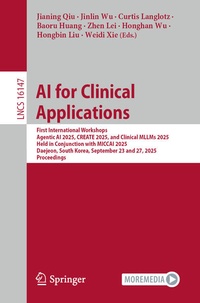
AI for Clinical Applications
Description

This book constitutes the proceedings of the First International Workshop on Agentic AI for Medicine, Agentic AI 2025, the First International Workshop on Clinical-Driven Robotics and Embodied AI Technology, CREATE 2025, and the First International Workshop on Multimodal Large Language Models in Clinical Practice, CMLLMs 2025, held in conjunction with MICCAI 2025 in Daejeon, South Korea, during September 2025.
The 12 papers included from Agentic AI have been accepted from 16 submissions to the Workshop. For CREATE 2025, 10 papers have been accepted from 12 submissions; and for Multimodal LLMs, 11 papers have been accepted from 19 submissions. They deal with arfiticial intelligence applications for clinical purposes.
More details
Other editions
Additional editions
Content
.- Proceedings of the MICCAI Workshop on Agentic AI 2025.
.- An Explainable Multimodal Framework with LLM Agents for Intracranial Hemorrhage Detection.
.- Agentic Surgical AI: Surgeon Style Fingerprinting and Privacy Risk Quantification via Discrete Diffusion in a Vision-Language-Action Framework.
.- AD Agent: LLM Agent for Alzheimer's Disease Analysis with Collaborative Coordinator.
.- MedPAO: A Protocol-Driven Agent for Structuring Medical Reports.
.- Scan-do Attitude: Towards Autonomous CT Protocol Management Using a Large Language Model Agent.
.- MedXpert-CAD: A Multimodal Multi-Agentic System for Clinical Imaging Analysis via Model Context Protocol LLM-Driven Agentic Workflows.
.- Agentic Hypergraph Search for Ontology-Grounded Medical Reasoning.
.- Beyond Engagement: A Multidimensional Framework to Evaluate the Safe Development of Agentic AI in Mental Health.
.- LIFE-CRAFT: A Multi-Agentic Conversational RAG Framework for Lifestyle Medicine Coaching with Context Traceability and Case-Based Evidence Synthesis.
.- Harmony.
.- AURA: A Multi-Modal Medical Agent for Understanding, Reasoning & Annotation.
.- M 3 Builder: A Multi-Agent System for Automated Machine Learning in Medical Imaging.
.- Proceedings of the Clinical-Driven Robotics and Embodied AI Technology (CREATE 2025).
.- Harnessing Foundation Models for Robust and Generalizable 6-DOF Bronchoscopy Localization.
.- Embodied Surgical Intelligence via Digital Twins: Autonomous Trocar Insertion.
.- Neural Ultrasound Shape Reconstruction via Gated Fusion and Sampson Distance.
.- ReCAP: Recursive Cross Attention Network for Pseudo-Label Generation in Robotic Surgical Skill Assessment.
.- MM2CT: MR-to-CT translation for multi-modal image fusion with mamba.
.- Can DeepSeek Reason Like a Surgeon? An Empirical Evaluation for Vision-Language Understanding in Robotic-Assisted Surgery.
.- Anti-Forgetting Test-time Adaptation for Robust Medical Image Analysis under Distribution Shift.
.- Enhancing 3D Medical Vision-Language Models with Slice-wise Visual Prompt.
.- Application of CoTNet-50 in the Classification of Alzheimer's Disease.
.- MoViS: Motion-guided Video Generation for Laparoscopic Surgery.
.- Proceedings of the First Workshop on Multimodal Language Models (MLLMs 2025).
.- RadFig-VQA: A Multi-Imaging-Modality Radiology Benchmark for Evaluating Vision-Language Models in Clinical Practice.
.- Trustworthy clinical thinking in MLLMs: Hierarchical Energy-based Reasoning for interpretable MEdical Scans (HERMES).
.- MedDual: A Practical Dual-Decoding Framework for Mitigating Hallucinations in Medical Vision-Language Models.
.- Beyond One Size Fits All: Customization of Radiology Report Generation Methods.
.- Predictive Multimodal Modeling of Diagnoses and Treatments in EHR.
.- Adapting and Evaluating Multimodal Large Language Models for Adolescent Idiopathic Scoliosis Self-Management: A Divide and Conquer Framework.
.- MedM-VL: What Makes a Good Medical VLM?.
.- KokushiMD-10: Benchmark for Evaluating Large Language Models on Ten Japanese National Healthcare Licensing Examinations.
.- DuEL-Med: A Dual-path Enhanced Language Model for Clinically-Aware Radiology Report Generation.
.- On the Risk of Misleading Reports: Diagnosing Textual Biases in Multimodal Clinical AI.
.- Aligning Multimodal Large Language Models with Patient-Physician Dialogues for AI-Assisted Clinical Support.
