

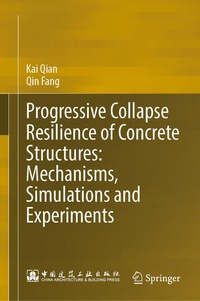
Progressive Collapse Resilience of Concrete Structures: Mechanisms, Simulations and Experiments
Description

The book introduces the comprehensive analysis methodology regarding progressive collapse, and the critical issues may happen in concrete structures. Main topics include: the influential parameters of the development of the main load-resisting mechanisms; the dynamic effects with sudden column removal scenarios; the contribution of non-structural components to improve the resilience of concrete structures; uncertainties in progressive collapse analysis. Based on the empirical research of the author and his team, the book provides valuable knowledge in the field of progressive collapse and bridges the gap between academic research and practice.
More details
Other editions
Additional editions
Persons
Dr. Kai Qian is Professor in the College of Civil Engineering and Architecture at Guilin University of Technology. He received his Ph.D. in civil engineering in 2013 from Nanyang Technological University, Singapore. Then, he worked as Post-doctoral Researcher at Nanyang Technological University during 2013-2015. He was granted by the National Outstanding Youth Fund of China since 2020.
Prof. Kai Qian is Vice President of the Youth Committee of China Seismological Society for Infrastructure Earthquake Prevention and Disaster Reduction, Director in American Society of Civil Engineers (ASCE), Singapore branch, Member in ASCE/SEI Disproportionate Collapse Tech. Committee, Member in ASCE/SEI Multihazard Mitigation (MHM) Committee, etc.; he is on the editorial board of several international journals.
Prof. Kai Qian has been teaching and conducting research on design of concrete structures including precast concrete and prestressing concrete structures. His research interest focuses on progressive collapse mitigation of concrete structures, seismic strengthening, and retrofitting of existing structures. He is PI of 3 projects supported by National Science Foundation of China. He has authored over 90 research articles. In addition, he served as Adviser to many Ph.D. and master's students.
Dr. Qin Fang is Professor of Civil Engineering at the Army Engineering University of PLA, China. He earned his Ph.D. in civil engineering from PLA University of Science and Technology, China.
Currently, he is a fellow of the International Association of Protective Structures and served as a member of the executive board of International Association of Protective Structures and vice chairman of the Protective Engineering Division of China Civil Engineering Society.
