

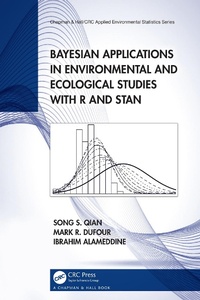
Bayesian Applications in Environmental and Ecological Studies with R and Stan
1st Edition
Published on 29. August 2022
415 pages
978-1-351-01877-7 (ISBN)
Description

Modern ecological and environmental sciences are dominated by observational data. As a result, traditional statistical training often leaves scientists ill-prepared for the data analysis tasks they encounter in their work. Bayesian methods provide a more robust and flexible tool for data analysis, as they enable information from different sources to be brought into the modelling process. Bayesian Applications in Evnironmental and Ecological Studies with R and Stan provides a Bayesian framework for model formulation, parameter estimation, and model evaluation in the context of analyzing environmental and ecological data.
Features:
An accessible overview of Bayesian methods in environmental and ecological studies
Emphasizes the hypothetical deductive process, particularly model formulation
Necessary background material on Bayesian inference and Monte Carlo simulation
Detailed case studies, covering water quality monitoring and assessment, ecosystem response to urbanization, fisheries ecology, and more
Advanced chapter on Bayesian applications, including Bayesian networks and a change point model
Complete code for all examples, along with the data used in the book, are available via GitHub
The book is primarily aimed at graduate students and researchers in the environmental and ecological sciences, as well as environmental management professionals. This is a group of people representing diverse subject matter fields, who could benefit from the potential power and flexibility of Bayesian methods.
Features:
An accessible overview of Bayesian methods in environmental and ecological studies
Emphasizes the hypothetical deductive process, particularly model formulation
Necessary background material on Bayesian inference and Monte Carlo simulation
Detailed case studies, covering water quality monitoring and assessment, ecosystem response to urbanization, fisheries ecology, and more
Advanced chapter on Bayesian applications, including Bayesian networks and a change point model
Complete code for all examples, along with the data used in the book, are available via GitHub
The book is primarily aimed at graduate students and researchers in the environmental and ecological sciences, as well as environmental management professionals. This is a group of people representing diverse subject matter fields, who could benefit from the potential power and flexibility of Bayesian methods.
More details
Series
Edition
1. Auflage
Language
English
Place of publication
London
United Kingdom
Publishing group
Taylor & Francis Ltd
Target group
Professional and scholarly
Illustrations
13 Tables, black and white; 108 Line drawings, black and white; 108 Illustrations, black and white
ISBN-13
978-1-351-01877-7 (9781351018777)
Copyright in bibliographic data and cover images is held by Nielsen Book Services Limited or by the publishers or by their respective licensors: all rights reserved.
Schweitzer Classification
Other editions
Additional editions
Song S. Qian | Mark R. DuFour | Ibrahim Alameddine
Bayesian Applications in Environmental and Ecological Studies with R and Stan
Book
08/2024
1st Edition
Chapman & Hall/CRC
€72.60
Shipment within 10-20 days
Song S. Qian | Mark R. DuFour | Ibrahim Alameddine
Bayesian Applications in Environmental and Ecological Studies with R and Stan
Book
08/2022
1st Edition
CRC Press
€167.10
Shipment within 10-20 days
Persons
Song S. Qian is a professor at The University of Toledo, Department of Environmental Sciences. He earned a PhD in environmental sciences and an MS in statistics from Duke University. He has worked in both environmental consulting and academia for more than 25 years. His work is focused on the application of statistics in environmental and ecological data analysis and modeling. His publication of such applications cover a wide range of topics, including wetland nutrient retention, lake eutrophication, water quality compliance assessment, drinking water safety, fisheries management, effects of climate change, and quantitative chemistry. He has taught graduate-level applied statistics to students in environmental science and ecology for 25 years. He authored and co-authored more than 115 research papers in peer-reviewed journals and a book in environmental and ecological statistics (currently in its second edition).
Mark R. DuFour earned a PhD in biology with a focus in ecology from The University of Toledo. He has worked in the fisheries field for more than 15 years, including periods with the New York State Department of Environmental Conservation and Ohio Department of Natural Resources. He is currently a fisheries biologist with the U.S. Geological Survey - Great Lakes Science Center. Dr. DuFour focuses on the quantitative aspects of fisheries science, seeks opportunities to apply Bayesian hierarchical modeling, and has contributed to 23 peer-reviewed publications. His quantitative training includes a combination of course work, diligent advisement, and on-the-job training through application. In contributing to this book, he hopes to encourage other science practitioners to look behind the statistical analysis curtain when developing ecological and environmental models.
Ibrahim Alameddine is an associate professor at the American University of Beirut, Department of Civil and Environmental Engineering. He earned his PhD in environmental sciences from Duke University. His research interests focus on advancing environmental monitoring and assessment, particularly in freshwater systems suffering from anthropogenic eutrophication and harmful algal blooms. His work concentrates on advancing the use of statistics for the effective monitoring, modeling, and management of environmental systems. Dr. Alameddine has taught several graduate courses on environmental statistics, water quality modeling, and geospatial analysis. He has published more than 60 peer-reviewed manuscripts and scientific reports. In addition to his academic position, he serves as a consultant to several local and regional governmental bodies as well as international organizations working in the environmental field.
Mark R. DuFour earned a PhD in biology with a focus in ecology from The University of Toledo. He has worked in the fisheries field for more than 15 years, including periods with the New York State Department of Environmental Conservation and Ohio Department of Natural Resources. He is currently a fisheries biologist with the U.S. Geological Survey - Great Lakes Science Center. Dr. DuFour focuses on the quantitative aspects of fisheries science, seeks opportunities to apply Bayesian hierarchical modeling, and has contributed to 23 peer-reviewed publications. His quantitative training includes a combination of course work, diligent advisement, and on-the-job training through application. In contributing to this book, he hopes to encourage other science practitioners to look behind the statistical analysis curtain when developing ecological and environmental models.
Ibrahim Alameddine is an associate professor at the American University of Beirut, Department of Civil and Environmental Engineering. He earned his PhD in environmental sciences from Duke University. His research interests focus on advancing environmental monitoring and assessment, particularly in freshwater systems suffering from anthropogenic eutrophication and harmful algal blooms. His work concentrates on advancing the use of statistics for the effective monitoring, modeling, and management of environmental systems. Dr. Alameddine has taught several graduate courses on environmental statistics, water quality modeling, and geospatial analysis. He has published more than 60 peer-reviewed manuscripts and scientific reports. In addition to his academic position, he serves as a consultant to several local and regional governmental bodies as well as international organizations working in the environmental field.
Content
1. Overview
2. Bayesian Inference and Monte Carlo Simulation
3. An Overview of Bayesian Inference
4. Environmental Monitoring and Assessment - Normal Response Models
5. Population and Community: Count Variables
6. Hierarchical Modeling and Aggregation
7. Bayesian Applications
8. Concluding Remarks
2. Bayesian Inference and Monte Carlo Simulation
3. An Overview of Bayesian Inference
4. Environmental Monitoring and Assessment - Normal Response Models
5. Population and Community: Count Variables
6. Hierarchical Modeling and Aggregation
7. Bayesian Applications
8. Concluding Remarks
