

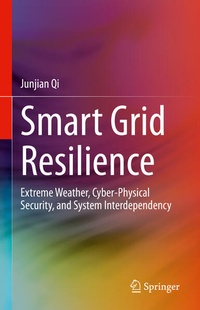
Smart Grid Resilience
Description

This book provides a comprehensive overview and in-depth discussion of smart grid resilience. It covers the three most critical resilience problems facing smart grids-resilience against extreme weather, resilience against cyber-physical attacks, and resilience under system inter-dependency. Each of these topics increases the risk of large-scale system-wide cascading failures. In-depth chapters allow the reader to define and quantify the smart grid's ability to deal with extreme events and the critical infrastructures systems that connect it. Methods for improving system design are introduced along with effective strategies for protecting the system with minimal disruption of power supply and economic and social losses in extreme conditions.
Smart Grid Resilience: Extreme Weather, Cyber-Physical Security, and System Interdependency is an essential guide for a broad audience of practicing professionals, including policymakers, electric utility engineers, and transmission and distribution system operators. It will also be a valuable reference for students and researchers.
More details
Other editions
Additional editions
Person
Dr. Junjian Qi is an Assistant Professor in the Department of Electrical and Computer Engineering at Stevens Institute of Technology. He obtained his Ph.D. in Electrical Engineering from Tsinghua University, Beijing, China, in July 2013. He was a Research Associate with the Min H. Kao Department of Electrical Engineering and Computer Science, University of Tennessee, Knoxville, TN, USA from 2013 to 2015, a Postdoctoral Appointee with the Energy Systems Division, Argonne National Laboratory, Lemont, IL, USA from 2015 to 2017, and an Assistant Professor with the Department of Electrical and Computer Engineering, University of Central Florida, Orlando, FL, USA from 2017 to 2020. He was the recipient of the NSF CAREER award in 2020. His research interests include cascading blackouts, microgrid control, cyber-physical system security, and synchrophasors.
