

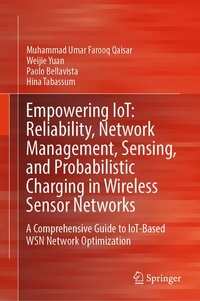
Empowering IoT: Reliability, Network Management, Sensing, and Probabilistic Charging in Wireless Sensor Networks
Description

This book provides a comprehensive exploration of both fundamental principles and practical engineering techniques. It places a strong emphasis on several key areas, including load balancing for IoT sensor devices through effective network management to ensure robust communication reliability among these sensor devices. It also delves into the intricacies of efficient charging scheduling for sensor devices, using probabilistic approaches and integrated sensing and communication technologies to enhance network optimization.
Central to the book's goals is its comprehensive and systematic treatment of practical challenges in IoT network optimization. This focus makes it particularly suitable for readers seeking practical solutions in this area. The book's target audience includes researchers, engineers, graduate students, and IoT industry professionals interested in areas such as reliability improvement, load balancing, charging scheduling, and network management.
By providing both theoretical foundations and practical insights, this book serves as a valuable resource for those seeking to navigate the complexities of IoT network optimization.
More details
Other editions
Additional editions
Persons
Muhammad Umar Farooq Qaisar is an Associate Professor at Northwestern Polytechnical University, holding a Ph.D. in Computer Science and Technology from the University of Science and Technology of China (2022). With a postdoctoral fellowship at the Southern University of Science and Technology, his research focuses on IoT, WSN, SDN, VANETs, ISAC, UAVs, and communication security.
Weijie Yuan is an Assistant Professor at the Southern University of Science and Technology. He holds a Ph.D. from the University of Technology Sydney (2019) and has been a Stanford Top 2% Scientist since 2021. He serves as an Associate Editor for multiple IEEE journals and leads the IEEE ComSoc OTFS Special Interest Group. Recognized for his work, he has received Best Paper Awards at IEEE ICC 2023 and IEEE GlobeCom 2024, among others.
Paolo Bellavista is a Full Professor at the University of Bologna, where he earned his Ph.D. in computer science engineering in 2001. His research focuses on mobile computing middleware, cloud continuum QoS, big data infrastructures, and performance optimization. He serves on editorial boards for IEEE and ACM journals and is the Scientific Coordinator of the H2020 IoTwins Project.
Hina Tabassum is an Associate Professor and York Research Chair at York University, focusing on 5G/6G mobility. A Stanford Top 2% Researcher (2021-2024) with 100+ publications (6500+ citations, h-index 38), she is an IEEE ComSoc Distinguished Lecturer (2025-2026) and editor for multiple IEEE journals. She chairs the IEEE THz Communications group and has received the Lassonde Innovation Award (2023) and N2Women Rising Star (2022).
Content
Introduction.- IoT and Wireless Sensor Networks (WSNs).- Wireless Sensor Networks Empowered by SDN: Reliable and Resilient Communication.- Securing Sensor Routes: Trustworthy and Load-Balanced Strategies.- Navigating the Energy Spectrum: Probabilistic Cluster Routing for Efficiency.- Revolutionizing IoT Sensor Charging: The ISAC-Probabilistic Paradigm.- Summary and Future Perspective.
