

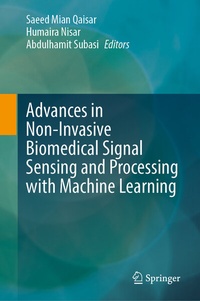
Advances in Non-Invasive Biomedical Signal Sensing and Processing with Machine Learning
Description

More details
Other editions
Additional editions
Persons
Saeed Mian Qaisar obtained his M.S and Ph.D. degrees in Electrical and Computer Engineering from the Grenoble Alpes University, France in 2005 and 2009 respectively. Subsequently, he did a postdoctoral stay at the University of Bordeaux, France. Afterward, he worked at different R&D positions in France. Currently, he is working as an Associate Professor & Researcher of the Electrical and Computer Engineering Department, Effat University, Jeddah, Saudi Arabia. He has been awarded with the Queen Effat Award for Excellence in Teaching , May 2016. He has two patents to his credit and has more than 200 published journal articles, book chapters and conference papers. He is serving as an editor of several international journals and is also on the technical and review committees of several international journals and conferences. His current area of research interest includes Signal processing, Event-driven systems, Circuits and systems, Machine learning, Deep Learning, Sampling theory, and Embedded Systems.
Humaira Nisar has a B.S (Honours) in Electrical Engineering from the University of Engineering and Technology, Lahore, Pakistan, M.S in Nuclear Engineering from Quaid-i-Azam University, Islamabad, Pakistan, another M.S in Mechatronics, and Ph.D. in Information and Mechatronics from Gwangju Institute of Science and Technology, Gwangju, South Korea.
She has more than twenty years of research experience. Currently, she is working as a Full Professor in the Department of Electronic Engineering, Universiti Tunku Abdul Rahman, Kampar, Malaysia. Her research interests include signal and image processing, biomedical imaging, neuro-signal processing and analysis, Brain-Computer Interface, and Neurofeedback. She has published more than 200 international journal and conference papers. She is a senior member of IEEE.Abdulhamit Subasi is specialized in Artificial Intelligence,Machine Learning, Biomedical Signal and Image Analysis. Concerning application of machine learning to different fields, he wrote more than 30 book chapters and more than 200 published journal and conference papers. He is also author of the books, " Practical Guide for Biomedical Signals Analysis Using Machine Learning Techniques" and "Practical Machine Learning for Data Analysis Using Python". Moreover, he is the Editor of the book "Applications of Artificial Intelligence in Medical Imaging". He worked at many institutions as an academician and Georgia Institute of Technology, Georgia, USA, as a researcher. He has been awarded with the Queen Effat Award for Excellence in Research , May 2018. He worked as a professor of computer science at Effat University, Jeddah, Saudi Arabia between 2015 and 2020. Since 2020, he has been working as a Professor at Faculty of Medicine, University of Turku, Turku, Finland.
