

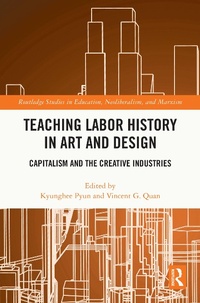
Teaching Labor History in Art and Design
Capitalism and the Creative Industries
1st Edition
Published on 14. June 2024
276 pages
978-1-040-04119-2 (ISBN)
Description

Drawing from American history, fashion design, history of luxury, visual culture, museum studies, and women's history, among others, this book explores the challenges, rewards and benefits of teaching business and the labor history of art and design professions to those in higher education.
Recognizing that artists and designers are no longer just creatives, but bosses, employees, members of professional associations, and citizens of nations that encourage and restrain their creative work in various ways, the book identifies a crucial need for art and design students to be taught the intricacies of these other roles, as well as how to navigate or challenge them. This empirically driven study features case studies in various pedagogical contexts, including museum exhibitions, group projects, lesson plans, discussion topics, and long-term assignments. The chapters also explore how the roles of designing and making became separated, how new technologies and the rise of mass production affected creative careers, the shifts back and forth between direct employment and freelancing, and the evolution of government interventions in creative fields.
With a diverse and experienced range of contributors, and providing a unique set of conceptual tools to interpret, cope with, and react to the ever-changing conditions of capitalism, this volume will appeal to educators and researchers across education, history, art history, and sociology, with interests in experiential learning, capitalism, equity, social justice and neoliberalism.
Recognizing that artists and designers are no longer just creatives, but bosses, employees, members of professional associations, and citizens of nations that encourage and restrain their creative work in various ways, the book identifies a crucial need for art and design students to be taught the intricacies of these other roles, as well as how to navigate or challenge them. This empirically driven study features case studies in various pedagogical contexts, including museum exhibitions, group projects, lesson plans, discussion topics, and long-term assignments. The chapters also explore how the roles of designing and making became separated, how new technologies and the rise of mass production affected creative careers, the shifts back and forth between direct employment and freelancing, and the evolution of government interventions in creative fields.
With a diverse and experienced range of contributors, and providing a unique set of conceptual tools to interpret, cope with, and react to the ever-changing conditions of capitalism, this volume will appeal to educators and researchers across education, history, art history, and sociology, with interests in experiential learning, capitalism, equity, social justice and neoliberalism.
Reviews / Votes
"With the rebellion of creative workers in museums, design studios, newsrooms, and Hollywood, this collection on the teaching of labor history comes just in time. In offering innovative pedagogy with fascinating case studies and powerful critique, Pyun, Quan, and their contributors break down that old dichotomy between art and labor. Luxury has come with a cost to those who make beauty possible. Chapters address the place of art and design in the history of capitalism, the example of the Bauhaus in exploring the tension between style and staging, the extracurricular commemoration as a way to deploy art for evoking memory around the Triangle Shirtwaist Fire, and the role of intermediaries in the selling of goods."- Eileen Boris, Hull Professor of Feminist Studies, University of California Santa Barbara, author of Art and Labor: Ruskin, Morris, and the Craftsman Ideal in America and Making the Woman Worker: Precarious Labor and the Fight for Global Standards, 1919-2019.
More details
Series
Edition
1. Auflage
Language
English
Place of publication
London
United Kingdom
Publishing group
Taylor & Francis Ltd
Target group
College/higher education
Professional and scholarly
Product notice
Reflowable
Illustrations
22 Halftones, color; 7 Halftones, black and white; 29 Illustrations, black and white
ISBN-13
978-1-040-04119-2 (9781040041192)
Copyright in bibliographic data and cover images is held by Nielsen Book Services Limited or by the publishers or by their respective licensors: all rights reserved.
Schweitzer Classification
Other editions
Additional editions
Kyunghee Pyun | Vincent G. Quan
Teaching Labor History in Art and Design
Capitalism and the Creative Industries
Book
10/2025
1st Edition
Routledge
€62.70
Shipment within 10-20 days
Kyunghee Pyun | Vincent G. Quan
Teaching Labor History in Art and Design
Capitalism and the Creative Industries
Book
06/2024
1st Edition
Routledge
€194.00
Shipment within 10-20 days
Persons
Kyunghee Pyun is Associate Professor of History of Art at the Fashion Institute of Technology, State University of New York, USA.
Vincent G. Quan is Associate Professor in the Fashion Business Management Department at the Fashion Institute of Technology, State University of New York, USA.
Vincent G. Quan is Associate Professor in the Fashion Business Management Department at the Fashion Institute of Technology, State University of New York, USA.
Content
1. Addressing the History of Capitalism for Artists and Designers Part 1: Professionalism 2. The Peculiarities of Teaching a Course on Luxury 3. Whose Design History Matters? The Hidden History of the Fashion Intermediaries Behind Everyday Products 4. Negotiating Capitalism on the Silver Screen for Film Students Part 2: Compensation 5. "War Stories": Labor Conditions in the Apparel Industry from 1980 to 2010 6. Working Women: A Case for Teaching Critiques of Racial Capitalism to Fashion Students 7. How We Get the Work Done: Helping Students Understand Labor and Costs in Art & Design Schools Part 3: Equality 8. Extracurricular Commemoration of the Triangle Shirtwaist Factory Fire 9. Industry without Industry: Seeing Labor in the Fashion and Garment Industries in Postwar New York City 10. Analyzing the Bauhaus in Business and Labor History for American Art and Design Students Part 4: Adaptability 11. Can Mindfulness and Compassion Coincide with Capitalism? 12. Notes from a Black Professor Teaching Fashion, Racial Justice, and Equity 13. The Ruth Finley Collection: Teaching the Labor of Fashion with Digital Humanities
