

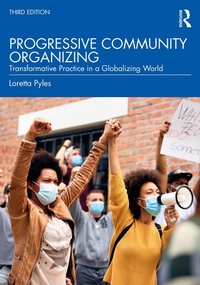
Progressive Community Organizing
Transformative Practice in a Globalizing World
3rd Edition
Published on 29. December 2020
334 pages
978-1-000-32803-5 (ISBN)
Description

Now in its third edition, Progressive Community Organizing: Transformative Practice in a Globalizing World introduces readers to the rich practice of progressive community organizing for social change while also providing concrete tools geared toward practitioner skill building.
Drawing from social movement scholarship and social theory, this book articulates a transformative approach to organizing that embraces emergent strategies and healing justice. It emphasizes framing processes and the power of stories using story-based strategy and digital activism. Embracing intersectional organizing, the book addresses topics such as identity politics, microagressions, internalized oppression, and horizontal hostility with attention to recentering and allyship as a growth-oriented journey of solidarity and liberation. Readers will engage with case studies focused on issues such as poverty, racial justice, immigration, housing, health and mental health, and climate crisis. This new edition includes:
Expanded content on transformative change approaches including healing justice
New content on the role of digital technology and social media in organizing
Case studies of the Poor People's Campaign and Extinction Rebellion
Emphasis on the power of stories and story-based strategy for organizing and issue framing
Transformative organizations with attention to feminist and decolonized organizational structures and cultures
Expanded chapters on strategies and tactics focusing on power analysis and a range of tactics from direct action to resilience-based organizing
The book will be of interest to students and practitioners who want to become more skilled in structural analysis, praxis, and self-reflexivity through critical and transformative engagement with historical and current social problems, social movements, and social welfare.
Drawing from social movement scholarship and social theory, this book articulates a transformative approach to organizing that embraces emergent strategies and healing justice. It emphasizes framing processes and the power of stories using story-based strategy and digital activism. Embracing intersectional organizing, the book addresses topics such as identity politics, microagressions, internalized oppression, and horizontal hostility with attention to recentering and allyship as a growth-oriented journey of solidarity and liberation. Readers will engage with case studies focused on issues such as poverty, racial justice, immigration, housing, health and mental health, and climate crisis. This new edition includes:
Expanded content on transformative change approaches including healing justice
New content on the role of digital technology and social media in organizing
Case studies of the Poor People's Campaign and Extinction Rebellion
Emphasis on the power of stories and story-based strategy for organizing and issue framing
Transformative organizations with attention to feminist and decolonized organizational structures and cultures
Expanded chapters on strategies and tactics focusing on power analysis and a range of tactics from direct action to resilience-based organizing
The book will be of interest to students and practitioners who want to become more skilled in structural analysis, praxis, and self-reflexivity through critical and transformative engagement with historical and current social problems, social movements, and social welfare.
Reviews / Votes
This edition of Progressive Community Organizing is far-ranging and timely. In a world of unprecedented and sustained social upheaval, Pyles provides necessary history, theory, practical wisdom, and case studies. This moment for climate, health, racial, and housing organizing represents the convergence of many organizing traditions. For a nuanced overview of a range of organizing traditions in the pursuit of justice, this book is definitive. It takes many hands to bend the moral arc of justice. After reading this book, you will add yours.Alethia Jones, PhD, Director, Open Society Foundations
. . . Drawing on her considerable experience as a community organizer, Loretta Pyles has provided such a model for action. Her transformative approach to organizing, one that is embedded in the lessons of social movements and human rights campaigns, addresses the whys and hows of anti-oppressive mobilization with marginalized groups and communities . . . The result is a comprehensive and holistic framework that encompasses recruitment, consensus building, leadership development, issue framing, communication, power analyses, and more . . . Loretta Pyles guides us in what is necessary to transform our communities and in the process, transform ourselves.
Cheryl A. Hyde, PhD, MSW, Temple University School of Social Work, USA
In this latest addition of Progressive Community Organizing, Pyles expands and develops further her vision and model for a transformative approach to practice that addresses human rights and social justice. She carefully and clearly integrates a strong theoretical perspective with the tools for social change and action. This method integrates internal and individual healing and change with methods to build community and organizational change. It is a call to action for creating a more sustainable, just, and compassionate world.
Lorraine M. Gutierrez, PhD, Associate Dean for Educational Programs, Professor of Social Work, and Arthur F. Thurnau Professor, Professor of Psychology, University of Michigan School of Social Work, USA "This edition of Progressive Community Organizing is far-ranging and timely. In a world of unprecedented and sustained social upheaval, Pyles provides necessary history, theory, practical wisdom, and case studies. This moment for climate, health, racial, and housing organizing represents the convergence of many organizing traditions. For a nuanced overview of a range of organizing traditions in the pursuit of justice, this book is definitive. It takes many hands to bend the moral arc of justice. After reading this book, you will add yours.
Alethia Jones, PhD, Director, Open Society Foundations, USA
"... As countries and communities grapple with global pandemics and other public health crises, economic loss and rampant inequality, state brutality against people of color and everyday racial microaggressions, there is a critical need for strategic frameworks that offer sound tactics and authentic processes. The [book offers] a comprehensive and holistic framework that encompasses recruitment, consensus building, leadership development, issue framing, communication, power analyses, and more ... She deftly addresses the challenges of working cross-culturally and becoming authentic allies, and demands that each of us immerse ourselves in critically self-reflective work in order to engage in liberatory praxis. She guides us in what is necessary to transform our communities and in the process, transform ourselves."
Cheryl A. Hyde, PhD, MSW, Temple University School of Social Work, USA
"In this latest addition of Progressive Community Organizing, Pyles expands and develops further her vision and model for a transformative approach to practice that addresses human rights and social justice. She carefully and clearly integrates a strong theoretical perspective with the tools for social change and action. This method integrates internal and individual healing and change with methods to build community and organizational change. It is a call to action for creating a more sustainable, just, and compassionate world."
Lorraine M. Gutierrez, PhD, Associate Dean for Educational Programs, Professor of Social Work, and Arthur F. Thurnau Professor, Professor of Psychology, University of Michigan School of Social Work, USA
More details
Edition
3rd edition
Language
English
Place of publication
London
United Kingdom
Publishing group
Taylor & Francis Ltd
Target group
College/higher education
Product notice
Reflowable
Illustrations
3 Tables, black and white; 4 Line drawings, black and white
ISBN-13
978-1-000-32803-5 (9781000328035)
Copyright in bibliographic data and cover images is held by Nielsen Book Services Limited or by the publishers or by their respective licensors: all rights reserved.
Schweitzer Classification
Other editions
Additional editions
Book
01/2021
Taylor & Francis
Unfortunately, price unknown
Available (delivery time upon request)
Book
12/2020
3rd Edition
Routledge
€66.00
Shipment within 15-20 days

Book
12/2020
3rd Edition
Routledge
€183.50
Shipment within 15-20 days
Person
Loretta Pyles, PhD, is Professor at the School of Social Welfare at the University at Albany, State University of New York, USA. Her work focuses on environmental disasters, community organizing, and body-mind-spirit social work practice.
Content
Part I. Foundations of Community Organizing Introduction 1. The Bedrock of Community Organizing 2. Transformative Practice 3. Theories and Praxis 4. Learning from Social Movements 5. Community Organizing Frameworks Part II. Tools for Community Organizing 6. Organizing People 7. Transformative Organizations 8. Communication for Social Change: Issue Framing, Storytelling, and Social Media 9. Strategy and Power 10. Tactics for Change Part III. Enduring and Emerging Issues in Organizing 11. Intersectionality, Solidarity, and Liberation 12. Religion and Spiritual Aspects of Organizing 13. Global Justice Amidst Climate Crisis
