

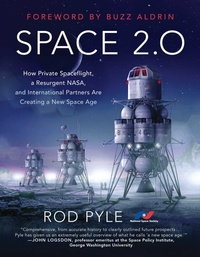
Space 2.0
How Private Spaceflight, a Resurgent NASA, and International Partners are Creating a New Space Age
Published on 26. February 2019
336 pages
978-1-946885-74-6 (ISBN)
Description

We're on the cusp of new era in the great adventure of space exploration.
More than a half-century ago, humanity first hurled objects into space, and almost 50 years ago, astronauts first walked on the moon. Since then, we have explored Earth's orbit with shuttles, capsules, and space stations; sent robots to Mars, Venus, Mercury, Jupiter, Saturn, and Uranus; sampled a comet; sent telescopes into orbit; and charted most of our own planet.
What does the future hold?
In Space 2.0, space historian Rod Pyle, in collaboration with the National Space Society, will give you an inside look at the next few decades of spaceflight and long-term plans for exploration, utilization, and settlement.
No longer the exclusive domain of government entities such as NASA and other national agencies, space exploration is rapidly becoming privatized, with entrepreneurial startups building huge rocket boosters, satellites, rocket engines, asteroid probes, prospecting craft, and even commercial lunar cargo landers to open this new frontier. Research into ever more sophisticated propulsion and life support systems will soon enable the journey to Mars and destinations deeper in our solar system. As these technologies continue to move forward, there are virtually no limits to human spaceflight and robotic exploration.
While the world has waited since the Apollo lunar program for the next "giant leap," these critical innovations, most of which are within our grasp with today's technology, will change the way we live, both in space and on Earth. A new space age?and with it, a new age of peace and prosperity on Earth, and settlement beyond our planet?can be ours.
Speaking with key leaders of the latest space programs and innovations, Pyle shares the excitement and promise of this new era of exploration and economic development. From NASA and the Russian space agency Roscosmos, to emerging leaders in the private sector such as SpaceX, Blue Origin, Moon Express, Virgin Galactic, and many others, Space 2.0 examines the new partnerships that are revolutionizing spaceflight and changing the way we reach for the stars.
More than a half-century ago, humanity first hurled objects into space, and almost 50 years ago, astronauts first walked on the moon. Since then, we have explored Earth's orbit with shuttles, capsules, and space stations; sent robots to Mars, Venus, Mercury, Jupiter, Saturn, and Uranus; sampled a comet; sent telescopes into orbit; and charted most of our own planet.
What does the future hold?
In Space 2.0, space historian Rod Pyle, in collaboration with the National Space Society, will give you an inside look at the next few decades of spaceflight and long-term plans for exploration, utilization, and settlement.
No longer the exclusive domain of government entities such as NASA and other national agencies, space exploration is rapidly becoming privatized, with entrepreneurial startups building huge rocket boosters, satellites, rocket engines, asteroid probes, prospecting craft, and even commercial lunar cargo landers to open this new frontier. Research into ever more sophisticated propulsion and life support systems will soon enable the journey to Mars and destinations deeper in our solar system. As these technologies continue to move forward, there are virtually no limits to human spaceflight and robotic exploration.
While the world has waited since the Apollo lunar program for the next "giant leap," these critical innovations, most of which are within our grasp with today's technology, will change the way we live, both in space and on Earth. A new space age?and with it, a new age of peace and prosperity on Earth, and settlement beyond our planet?can be ours.
Speaking with key leaders of the latest space programs and innovations, Pyle shares the excitement and promise of this new era of exploration and economic development. From NASA and the Russian space agency Roscosmos, to emerging leaders in the private sector such as SpaceX, Blue Origin, Moon Express, Virgin Galactic, and many others, Space 2.0 examines the new partnerships that are revolutionizing spaceflight and changing the way we reach for the stars.
More details
Other editions
Additional editions
Rod Pyle
Space 2.0
How Private Spaceflight, a Resurgent NASA, and International Partners are Creating a New Space Age
Book
02/2019
Benbella Books
€21.00
Shipment within 3-4 weeks
Person
Rod Pyle
Content
- Intro
- Title Page
- Copyright
- Dedication
- Contents
- Foreword
- Chapter 1: Space 1.0, the Final Act
- Chapter 2: A Dark and Forbidding Place
- Chapter 3: Why Space?
- Chapter 4: The First Space Age
- Chapter 5: Destinations
- Chapter 6: The Human Factor
- Chapter 7: Space Entrepreneurs
- Chapter 8: Space Exploration Technologies Corp.
- Chapter 9: A New Space Race
- Chapter 10: Investing in Space
- Chapter 11: The Space Between Nations
- Chapter 12: The Russian Juggernaut
- Chapter 13: The China Wildcard
- Chapter 14: Truck Stops in Space
- Chapter 15: Defending Earth
- Chapter 16: Settling the Final Frontier
- Chapter 17: A New Age Dawns
- Chapter 18: Your Place in Space 2.0
- Acknowledgments
- Special Thanks To
- Notes
- Glossary
- Index
- About the Author
- Join the National Space Society
