

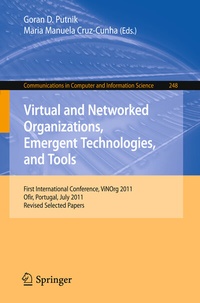
Virtual and Networked Organizations, Emergent Technologies and Tools
First International Conference, ViNOrg 2011, Ofir, Portugal, July 6-8, 2011. Revised Selected Papers
Published on 25. July 2012
380 pages
978-3-642-31800-9 (ISBN)
Description

This book constitutes the thoroughly refereed post-conference proceedings of the First International Conference on Virtual and Networked Organizations, Emergent Technologies, and Tools, ViNOrg 2011,
held in Ofir, Portugal, in July 2011.
The 35 revised full papers presentedwere carefully reviewed and selected from over 60 initial submissions. The papers cover a wide range of topics, such as ubiquitous computing and organizations, cloud computing
and architectures, grid computing, human-computer interfaces, serious games, data mining, Web services, cognitive systems, social networks and other emergent IT/IS approaches in various function domains, such as
decision support systems, planning, design, control, negotiation, marketing, management and many other, in the context of virtual and networked enterprises and organizations.
More details
Other editions
Additional editions
Goran D. Putnik | Maria Manuela Cruz-Cunha
Virtual and Networked Organizations, Emergent Technologies and Tools
First International Conference, ViNOrg 2011, Ofir, Portugal, July 6-8, 2011. Revised Selected Papers
Book
08/2012
Springer
€53.49
Shipment within 7-9 days
Content
- Title
- Preface
- Table of Contents
- Cloud-Based Contextually Aware Adaptive Systems for Enterprise Transformation
- Introduction
- Enterprises as Adaptive Systems in Context
- Cloud-Based Contextually-Aware Adaptive Enterprises
- Cloud-Based Enterprise Adaptation Strategy Model
- Cloud-Based Contextually Aware Enterprise Adaptation Lifecycle Model
- Cloud-Based Contextually Aware Adaptive Systems Framework
- Cloud-Based Contextually Aware Adaptive Systems Architecture
- Conclusion
- References
- Toward a Centrality Index for Computing Grids
- Introduction
- The Urban Grid of Walter Christaller
- Foster's Grid Checklist
- Toward a k-Index to Characterize a Computational Grid
- Final Remarks toward Centrality Indexes for Computing Grids
- References
- Towards Agent-Based Models for Synthetic Social Network Generation
- Introduction
- Agent-Based Simulations for Social Sciences
- Analysis of Selected Models
- Towards Agent-Based Models
- Design of an Agent-Based Social Network Generation System
- Engineering the Agent-Based Social Network Generation System
- Conclusions and Future Work
- References
- MMORPG - Towards a Sustainable Livelihood Model for Africa and Beyond
- Introduction
- Making a Living in MMORPGs
- Developing Real World Skills in MMORPGs
- MMORPGs as Economic Opportunity
- Low- Skilled Character (LSC)
- Social-Skilled Character (SSC)
- Luck-Based Characters (LBC)
- High-Skills Character (HSC)
- Towards a Model for Generating a Basic Livelihood Online
- Conclusion
- References
- Model of a Game for Improving Integrated Decisions in Production Management
- Introduction
- Method
- The Virtual Market Business Game
- Use of Business Games
- Model Characteristics
- Findings
- Conclusion
- References
- A Serious Game for Supporting Training in Risk Management through Project-Based Learning
- Introduction
- Risk Management
- PBL Applied to Software Engineering
- Persistent Browser-Based Games
- Intelligent Agents in Computer Games
- Related Works
- eRiskGame
- Scenario and Storyline Game
- Multiagent System
- Evaluation Module
- Final Remarks
- References
- Assessing the Performance of Virtual Teams with Intelligent Agents
- Introduction
- Related Work
- The Promus Agent System and the Beer Game Experiment
- Experiment Results
- Analysis
- Evaluation
- Limitations
- Conclusions
- References
- Combining Real and Virtual Research Environments through the Internet of Things
- Introduction and Problem Statement
- Virtual Research Environments
- Technical Requirements
- Conclusion
- References
- The Relevance of Results in Interpretive Research in Information Systems and Technology
- Introduction
- IST, a Scientific and Technological Knowledge
- IST, a Knowledge Network
- The Interpretivism in IST Research
- The Generalization of the Results in Interpretive Research
- Conclusion
- References
- Computer-Assisted Rehabilitation Program - Virtual Reality (CARP-VR): A Program for Cognitive Rehabilitation of Executive Dysfunction
- The Neuropsychology of Executive Functions: From Cognitive Assessment to Cognitive Rehabilitation
- The Advantages of VR in the Assessment and Rehabilitation of Executive Dysfunction
- Computer-Assisted Rehabilitation Program - Virtual Reality (CARP-VR)
- The Development Process
- General Features
- System Architecture and Technical Specifications
- Maps and Levels
- Simulation
- Storing Information
- Usability Testing
- Ongoing Developments and Conclusion
- References
- Recommendation of Learning Objects in an Ubiquitous Learning Environment through an Agent-Based Approach
- Introduction
- Use of Agents in Learning Support Systems
- Learning Objects
- Ubiquitous Learning Environment
- Related Work
- An Agent-Based Approach for Recommending Context- Aware Learning Objects
- Agent Model
- Student Agent (SAg)
- Recommender Agent (RAg)
- Interface Agent (IAg)
- Final Remarks
- References
- A Survey of Student Satisfaction with Distance Learning at Faculty of Organizational Sciences, University of Belgrade
- Introduction
- Bases for Research
- Analysis of Results
- Interpretation of Results and Conclusions
- References
- Proposal of a Computing Model Using GRID Resources for the JEM-EUSO Space Mission
- Introduction
- The JEM-EUSO Mission
- The JEM-EUSO Instrument
- Computational R Requirements
- The Software Re epository
- The Data Repository
- Administrative O Organization and Virtual Organization
- References
- Cloud Computing: Concepts, Technologies and Challenges
- Cloud Computing
- What Is Cloud Computing?
- Related Technologies
- Characteristics
- Availability Models
- Deployment Models
- Challenges
- Cloud Computing Adoption
- Conclusion
- References
- Orchestrating Inter-organisational Logistics Workflows on the Cloud
- Introduction
- Cloud Infrastructure for Logistics Processes Management
- Naming and Identification Services
- Virtual Message Exchanges
- Authentication and Authorisation Services
- Role Management Services
- Workflow Management Services
- Messaging and Message Routing Services
- Domain Specific Services
- A Cloud-Based Inter-organisational Workflow Scenario
- Discussion
- References
- A Planning System Using a Four Level Approach for the Planning of Production in a Networked Organization
- Introduction
- Problem Statement
- State of the Art
- Solution Methods for Dimension Planning
- Hierarchical Planning
- Concept
- Models for the Individual Levels
- Hierarchical Overall Process
- Results
- Conclusion and Further Work
- References
- Resilience of Virtual and Networked Organizations: An Assessment
- Introduction
- Problem Statement
- Notation
- Modeling of Indicators' Weights
- Fuzzy Delphi Method
- Modeling of Components' Values
- The Proposed Fuzzy Algorithm for the Management of the Keystone Vulnerabilities Assessment of the VO
- Case Study
- Discussion
- Conclusion
- References
- Integration of Virtual and Networked Organization Using Server Oriented Architecture
- Introduction
- Business Process Integration in Virtual and Networked Organizations
- Methods for Development of Service Oriented Architecture for Application Integration
- Configuration Case Tool for Virtual Enterprise Integration Based on SOA
- Conclusion
- References
- New Perspectives of Virtual Teams' Collaboration
- Introduction - Definitions Overview of Virtual Teams
- Virtual Teams for Virtual Product Design
- Virtual Teams as Virtual Network - Information Technology Support of Virtual Teams
- Comparison of Some Virtual Team Collaboration Tools
- Conclusion
- References
- Design of a Multi Agent Based Virtual Enterprise Framework for Sustainable Production
- Introduction
- Related Works
- Proposed Concept VE Architecture
- Virtual Enterprise Phases
- Conclusion
- References
- A Flexibility Reference Model to Achieve Leagility in Virtual Organizations
- Introduction
- Flexibility Definition
- Leagile Concept
- Dynamic Virtual Organizations
- Requirements Model for Flexibility
- Factory Templates Framework
- Conclusions
- References
- Effective Service Dynamic Packages for Ubiquitous Manufacturing System
- Introduction
- Related Research Work
- Effective Service Dynamic Packages
- ESDP Architecture
- Conclusions and Future Research
- References
- Experimental Platform for Collaborative Inter and Intra Cellular Fuzzy Scheduling in an Ubiquitous Manufacturing System
- Introduction
- Ubiquitous Manufacturing System
- Inter and Intra Cellular Manufacturing Scheduling
- The Importance of Collaboration
- The Importance of Fuzzy Decision-Making
- Illustration of Platform Usage
- Conclusions
- References
- P2P Decision Support System for Cooperative Electrical Energy Distribution Network Management
- Introduction
- Electrical Energy Distribution Network
- Systems Integra ation and Cooperative Network nt Managemen
- P2P System Archite ecture and Integration with Sub-systems
- Electrical Energy Network Management
- System Functionalities
- Conclusion
- References
- Prototype Multiplex Communication System for Remote Control of Machine Tools
- Introduction
- Communication Systems for Manufacturing Environment
- Communication in a Distributed Manufacturing Environment
- Semiotics as an Instrument for Communication System in Manufacturing Operations
- UMS Architecture and Functionality of Remotely Controlling Machine Tool
- UMS Network Communication Architecture
- A Remote Client Perspective
- Manufacturing Cell in the UMS
- Remote Controlling Functionality
- Communication System as Integrated in the Remote Machining
- Human to Machine Communication
- Human to Human/Machine Multiplex Communication between Client and Manufacturing Cell
- Conclusion
- References
- Process Reuse in Product Development with 5D Models: Concepts, Similarity Measures and Querying Techniques
- Introduction
- The Motivation for Process Reuse
- Related Work
- Formal Definitions for Process Reuse
- Explicit Process Reuse
- Implicit Process Reuse
- Analysis of Content Enabling Process Reuse in CPD with 5D
- Product Model Data
- Process Model Data
- Finding Candidate Processes for Reuse
- Process Comparison through Mining
- Querying for Similar Processes
- Conclusions
- References
- A Critiquing Mechanism in Engineering Machine Design
- Introduction
- Overview of Engineering Design Critiquing
- MEDE: A Framework for Engineering Design Process
- Scenario of Critiquing Facilities in MEDE
- Related Research
- Concluding Remark
- References
- Modelling Languages Restrictions: A Comparative Study of ArchiMate and SOMF
- Introduction
- Problem
- Related Work
- ArchiMate
- SOMF
- Case Study
- Experiments
- Simultaneous Representation of Different Evolutionary Stages
- Representation of Different Levels of Services
- Representation of Software Assets Ownership
- Service Workflows
- Evaluations
- Simultaneous Representation of Different Evolutionary Stages
- Representation of Different Levels of Services
- Representation of Software Assets Ownership
- Service Workflows
- Lessons Learned
- Conclusion
- References
- Profiling and Framing Structures for Pervasive Information Systems Development
- Introduction
- Related Work
- Profiling and Framing Structures
- The USE-ME-GOV Case Study
- Conclusion
- References
- Seamless Information Integration in Network Enterprises Using MENTOR: Development of a Reference Ontology in Metrological Domain
- Introduction
- Information Flow in Inspection Phases
- MENTOR: Methodology for Reference Ontology Development
- A Metrological Case Study
- Conclusions
- References
- Smart Communities and Networked Organizations
- Introduction
- Introducing Smart Communities
- Operational Smart Communities
- Tournament-Style Innovation Communities
- A Facilitated Innovation Community
- Internal Innovation Communities
- Mixed Internal-External Innovation Communities
- Internal
- External Innovation Communities
- Unleashing Tacit Interactions
- Conclusion
- References
- A Platform for Agile Virtual Enterprise Synthesis
- Introduction
- Agile/ Virtual Enterprise Model
- Platform for Virtual Enterprise Synthesis
- Previous Work
- Proposed AVESP
- Proposed AVESP M Main Functionalities
- Conclusion
- References
- Supplier Selection Using Multiobjective Evolutionary Algorithm
- Introduction
- Supplier Selection
- Multiobjective Optimization
- Genetic Algorithm
- Strength Pareto Evolutionary Algorithm (SPEA)
- Supplier Selection Using SPEA
- Conclusions
- References
- Technologies Integration for Distributed Manufacturing Scheduling in a Virtual Enterprise
- Introduction
- Real-Time Collaborative Management in a Virtual Enterprise
- Distributed Manufacturing Scheduling
- Scheduling Technologies Integration
- Excel Solver
- Interfaces Implementation on Visual Basic
- Arena-Based Simulation
- Approaches Integration
- Conclusion
- References
- Linked Architects and Urban Planners: Using Social Network Analysis to Capture Connections
- Introduction
- Architects in the Colonies
- The 1948 Congress
- Conclusion
- References
- Social Networks as Vital Resources for Adults' Learning
- Introduction to Social Networks Today
- Social Networks and Virtual Spaces Meet Higher Education
- Social Networks as Professional Learning Contexts
- Social Networks as Innovative 21st Century Learning
- Critical Thinking and Problem Solving
- Creativity and Innovation
- A Model: The Social Media Web of 21st Century Learning
- Recommendations
- Future Research
- Conclusion
- References
- Author Index
