

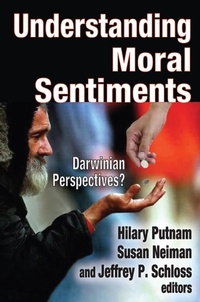
Understanding Moral Sentiments
Darwinian Perspectives?
Published on 8. September 2017
280 pages
978-1-351-29627-4 (ISBN)
Description

This volume brings together leading scholars to examine Darwinian perspectives on morality from widely ranging disciplines: evolutionary biology, anthropology, psychology, philosophy, and theology. They bring not only varied expertise, but also contrasting judgments about which, and to what extent, differing evolutionary accounts explain morality. They also consider the implications of these explanations for a range of religious and non-religious moral traditions.
The book first surveys scientific understandings of morality. Chapters by Joan Silk and Christopher Boehm ask what primatology and anthropology tell us about moral origins. Daniel Batson and Stephen Pinker provide contrasting accounts of how evolution shapes moral psychology, and Jeffrey Schloss assesses a range of biological proposals for morality and altruism. Turning to philosophical issues, Martha Nussbaum argues that recognizing our animal nature does not threaten morality. Stephen Pope and Timothy Jackson explore how Darwinian accounts of moral goodness both enrich and require understandings outside the sciences. Hilary Putnam and Susan Neiman ask whether Darwin is truly useful for helping us to understand what morality actually is and how it functions.
The book is a balanced effort to assess the scientific merits and philosophical significance of emerging Darwinian perspectives on morality.
The book first surveys scientific understandings of morality. Chapters by Joan Silk and Christopher Boehm ask what primatology and anthropology tell us about moral origins. Daniel Batson and Stephen Pinker provide contrasting accounts of how evolution shapes moral psychology, and Jeffrey Schloss assesses a range of biological proposals for morality and altruism. Turning to philosophical issues, Martha Nussbaum argues that recognizing our animal nature does not threaten morality. Stephen Pope and Timothy Jackson explore how Darwinian accounts of moral goodness both enrich and require understandings outside the sciences. Hilary Putnam and Susan Neiman ask whether Darwin is truly useful for helping us to understand what morality actually is and how it functions.
The book is a balanced effort to assess the scientific merits and philosophical significance of emerging Darwinian perspectives on morality.
More details
Language
English
Place of publication
London
United Kingdom
Publishing group
Taylor & Francis Ltd
Target group
College/higher education
File size
10,91 MB
ISBN-13
978-1-351-29627-4 (9781351296274)
Copyright in bibliographic data and cover images is held by Nielsen Book Services Limited or by the publishers or by their respective licensors: all rights reserved.
Schweitzer Classification
Other editions
Additional editions
Book
09/2017
1st Edition
Routledge
€72.70
Shipment within 10-20 days
Book
06/2014
1st Edition
Routledge
€193.50
Shipment within 10-15 days
Person
Hilary Putnam
Content
Introduction
The Roots of Prosocial Preferences
Joan B. Silk
Defining the Evolutionary Conscience: Finishing a Job that Darwin Started
Christopher Boehm
Are the "Principles in His Nature, Which Interest Him in the Fortune of Others," Moral?
C. Daniel Batson
The Moral Instinct
Steven Pinker
Darwinian Explanations of Morality: Accounting for the Normal but Not the Normative
Jeffrey P. Schloss
Compassion: Human and Animal
Martha C. Nussbaum
Moral Decision Making: Interpreters of Darwin and Thomas Aquinas
Stephen J. Pope
Thirty-Five Years among the Genes: A Twainian Take on Moral Anthropology and Reductive Biology
Timothy P. Jackson
Not Very Much
Hilary Putnam
Setting Aside Facts
Susan Neiman
On the Partnership between Natural and Moral Philosophy
David C. Lahti
List of Contributors
Index
The Roots of Prosocial Preferences
Joan B. Silk
Defining the Evolutionary Conscience: Finishing a Job that Darwin Started
Christopher Boehm
Are the "Principles in His Nature, Which Interest Him in the Fortune of Others," Moral?
C. Daniel Batson
The Moral Instinct
Steven Pinker
Darwinian Explanations of Morality: Accounting for the Normal but Not the Normative
Jeffrey P. Schloss
Compassion: Human and Animal
Martha C. Nussbaum
Moral Decision Making: Interpreters of Darwin and Thomas Aquinas
Stephen J. Pope
Thirty-Five Years among the Genes: A Twainian Take on Moral Anthropology and Reductive Biology
Timothy P. Jackson
Not Very Much
Hilary Putnam
Setting Aside Facts
Susan Neiman
On the Partnership between Natural and Moral Philosophy
David C. Lahti
List of Contributors
Index
