

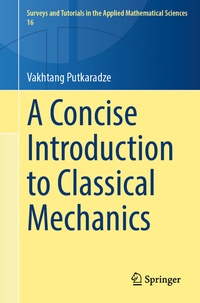
A Concise Introduction to Classical Mechanics
Description

Mechanics is one of the oldest and most foundational subjects in undergraduate curricula for mathematicians, physicists, and engineers. Traditionally taught through a classical, or "analytical," approach, modern advancements have introduced a "geometric" perspective that has found applications in diverse fields such as machine learning, climate research, satellite navigation, and more.
This book bridges the gap between classical mechanics and its modern, geometric counterpart. Designed for students and educators, it presents the essential topics typically required in mechanics courses while integrating a geometric approach to deepen understanding.
Key features include:
*Clear explanations of core concepts, including Lagrangian mechanics, variational methods, canonical transformations, and systems with constraints.
*Numerous solved problems and real-world examples to solidify understanding.
*Sample midterms and final exams to help students prepare for coursework and assessments.
*Every chapter includes a 'looking forward' section outlining modern applications of the material.
The book minimizes mathematical abstraction, introducing only the necessary concepts to make the material accessible and practical. Whether you're a student looking to master the essentials or an instructor seeking a fresh perspective, this book provides a comprehensive, approachable, and modern exploration of mechanics.
More details
Other editions
Additional editions
Person
Prof Vakhtang Putkaradze received his PhD from the University of Copenhagen, Denmark, and held faculty positions in New Mexico, Colorado State University, and, most recently, at the University of Alberta, where he was a Centennial Professor between 2012-2019. From 2019 to 2022, he led the science and tech part of the Transformation Team at ATCO Ltd, first as a Senior Director and then Vice-President. After returning back to the University of Alberta, he is studying applications of geometric mechanics to neural networks, in particular, efficient computations of Hamiltonian systems using data-based techniques. His overall main topic of interest is using geometric methods in mechanics and various applications. He has received numerous prizes and awards for research and teaching, including Humboldt Fellowship, Senior JSPS fellowship, CAIMS-Fields industrial math prize and G. I. Zaslavsky prize.
Content
Chapter1: Newton's Laws of MotionNewton's Laws of Motion.- Chapter2: From Newton to Euler-lagrange Equations.-Chapter3: Euler-lagrange Equations With Examples.-Chapter4: Noether's Theorem and Conservation Laws.-Chapter5: Linear Stability.-Chapter6: Hamiltonian Systems.-Chapter7: Exterior Calculus and Differential Forms.-Chapter8: Canonical Transformations.-Chapter9: Hamilton-jacobi Equation.-Chapter10: Rigid Body Dynamics.-Chapter11: Nonholonomic Constraints.-Chapter12: Euler-poincare variational Theory.-Chapter13: Sample Midterm and Final Exams.
