

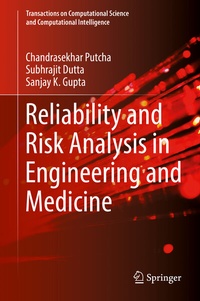
Reliability and Risk Analysis in Engineering and Medicine
Description

- Explains concepts of reliability and risk estimation techniques in the contextof medicine and engineering;
- Elucidates the interplay between reliability and risk from design to operation phases;
- Uses real world examples from engineering structures and medical devices and protocols;
- Adopts a lucid yet rigorous presentation of reliability and risk calculations;
- Reinforces students understanding of concepts covered with end-of-chapter exercises.
More details
Other editions
Additional editions
Persons
Dr. Chandrasekhar Putcha is a Professor in the Department of Civil and Environmental Engineering at California State University, Fullerton. He has been at this place since 1981. Before that he was on the research faculty at West Virginia University, Morgantown, WV and a post-doctoral fellow at the University of Sherbrooke in Canada. His research areas of interest are Reliability, Risk Analysis, Optimization and Mathematical Modeling.
Dr. Subhrajit Dutta is an Assistant Professor in the Department of Civil Engineering at National Institute of Technology Silchar. He completed his PhD in Civil Engineering from Indian Institute of Technology Bombay in 2017. Subhrajit is also an external/invited researcher in the Department of Civil Engineering (Structural Division), Faculty of Engineering, University of Porto, Portugal. He was working as a visiting scholar in the Department of Civil Engineering at Aalto University, Finland during December, 2019. He has published more than 50 research articles and is a recipient of few national and international sponsored projects in the field of reliability and risk analysis. Subhrajit is the Associate Editor of ASCE Practice Periodical on Structural Design and Construction and a Guest Editor for various reputed journals.
Dr. Sanjay Gupta is an Associate Professor of Civil Engineering at IIT/BHU, Varanasi, India.
