

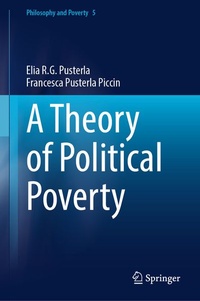
A Theory of Political Poverty
Description

This book presents an innovative and thought-provoking argument regarding the foundations of politics and its ethical implications, exploring the difference between what politics is (and/or can be) and what it is not (and/or cannot be). It distinguishes between two fundamental forms of political poverty, namely ontological poverty and theoretical poverty. Ontological poverty depicts the negative foundation upon which the political relies-an absence that, paradoxically, underpins the political existence. In contrast, theoretical poverty emerges when this ontological datum is self-delusively denied by politics itself, leading to the loss of political properties of politics, or political poverty, and the resulting dehumanisation of the political subject. Drawing on Aristotelian logic, the volume discloses the aporetic condition of political ontology, deploying phenomenological inquiry through deconstruction. Through close readings of Kafka, Agamben, Derrida, Levinas, and Schmitt among others, it maps the porous threshold between the political and the non-political, illuminating how this tension-between being and becoming-is conditional to politics itself and simultaneously the site of its potential impoverishment. In this context, theoretical poverty is recognised as the prodromic moment when politics ceases to carry its own name, severing its ties to the ethical and ontological relations that sustain it. This work makes a significant contribution to contemporary debates in political philosophy, political theory, political ontology, and ethics. It will particularly appeal to scholars engaged with continental philosophy and literary theory. It opens a new avenue of inquiry into the political foundations by questioning what politics is and what it risks not becoming.
More details
Other editions
Additional editions
Persons
Elia R.G. Pusterla is a postdoctoral researcher at the Free University of Bozen-Bolzano, where he leads a project in political philosophy that investigates the heuristic potential of postmodern thought in addressing the challenges posed by post-truth politics. He has previously held postdoctoral positions at the University of Applied Sciences and Arts of Southern Switzerland (SUPSI), the European Institute and the Centre for International Studies of the London School of Economics and Political Science (LSE), and the European University Institute (EUI). He also served as a Teaching Assistant at the University of Geneva and was a Visiting Researcher at LSE's Department of International Relations. His research interests lie in political philosophy and political theory, with a particular focus on their application to international relations and European studies. He focuses on the concept of sovereignty and its entanglements with political ontology, engaging with authors from the continental tradition, including Derrida, Agamben, Arendt, Levinas, and Esposito. He is the author of 'The Credibility of Sovereignty-The Political Fiction of a Concept' (Springer, 2016) and several peer-reviewed articles. He currently serves as Associate Editor of the journal Political Research Exchange.
Francesca Pusterla Piccin is a postdoctoral researcher at the Free University of Bozen-Bolzano, where she has developed two research projects that focus on the European Union's humanitarian aid and a narrative approach to aid research. Additionally, she serves as a Visiting Senior Fellow at the European Institute of the London School of Economics and Political Science (LSE). Previously, she held positions as a Visiting Researcher at the Università della Svizzera italiana (USI), Research Associate at the School of Oriental and African Studies (SOAS), a Teaching Assistant at the University of Geneva, and a Visiting Researcher at St Antony's College, University of Oxford. Her research interests primarily encompass humanitarian aid, development, and migration. Currently, she is examining the European Union's narratives as persuasive stories and accounts that are crafted and deployed to convey its understanding of humanitarian aid and to influence beliefs, attitudes, and decisions related to humanitarian efforts at both national and international levels. She is the author of the monograph 'The European Union and Humanitarian Crises-Patterns of Intervention' (Routledge, 2015) and has published several peer-reviewed scientific articles.
Content
Introduction - Politics and Poverty or the Foundations of an Enriching Relation.- Chapter 1 The Law Before - From Kafka to Politics.- Chapter 2. The Moving Animal - Aristotle's Political Desire.- Chapter 3. Two Sovereignties, one Choice - From Schmitt to Decision.- Chapter 4. Fiction and Impoverishment - Derrida, Agamben and Political Poverty.- Chapter 5. Two Poverties, One Challenge - On Poverty and Levinas.
