

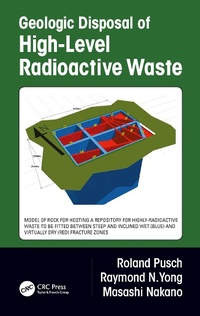
Geologic Disposal of High-Level Radioactive Waste
1st Edition
Published on 6. August 2018
234 pages
978-1-351-25679-7 (ISBN)
Description

Geologic Disposal of High-Level Radioactive Waste examines the fundamental knowledge and conditions to be considered and applied by planners and other professionals when establishing national repository concepts, and constructing repositories for the long-term isolation of highly radioactive waste from surrounding crystalline rock. It emphasizes the important roles of structural geology, hydrogeology, hydrochemistry, and construction techniques. It specifically examines the disposal of steel canisters with spent reactor fuel in mined repositories (MR) at medium-depth, and in very deep boreholes (VDH).
While disposal in mined repositories has been widely tested, the option of placing high-level radioactive waste in deep boreholes has been considered in the US, UK, and elsewhere in Europe, but has not yet been tested on a broad scale. This book examines the possibility of safe disposal for very long periods, proposing that the high salt content and density of groundwater at large depths are such that potentially contaminated water would not rise high enough to affect the more shallow biosphere.
Features:
Presents the best practices for disposal of spent fuel from nuclear reactors.
Assesses waste isolation capacities in short- and long-term perspectives, and the associated risks.
Describes site selection principles and the economics of construction of different types of repositories.
Includes an appendix which provides the latest international recommendations and guidelines concerning the disposal of highly radioactive waste.
While disposal in mined repositories has been widely tested, the option of placing high-level radioactive waste in deep boreholes has been considered in the US, UK, and elsewhere in Europe, but has not yet been tested on a broad scale. This book examines the possibility of safe disposal for very long periods, proposing that the high salt content and density of groundwater at large depths are such that potentially contaminated water would not rise high enough to affect the more shallow biosphere.
Features:
Presents the best practices for disposal of spent fuel from nuclear reactors.
Assesses waste isolation capacities in short- and long-term perspectives, and the associated risks.
Describes site selection principles and the economics of construction of different types of repositories.
Includes an appendix which provides the latest international recommendations and guidelines concerning the disposal of highly radioactive waste.
More details
Edition
1. Auflage
Language
English
Place of publication
London
United Kingdom
Publishing group
Taylor & Francis Ltd
Target group
Professional and scholarly
Illustrations
37 Tables, black and white; 41 Halftones, black and white; 69 Illustrations, color; 84 Illustrations, black and white
File size
25,99 MB
ISBN-13
978-1-351-25679-7 (9781351256797)
Copyright in bibliographic data and cover images is held by Nielsen Book Services Limited or by the publishers or by their respective licensors: all rights reserved.
Schweitzer Classification
Other editions
Additional editions
Roland Pusch | Raymond N Yong | Masashi Nakano
Geologic Disposal of High-Level Radioactive Waste
Book
08/2018
1st Edition
CRC Press
€279.30
Shipment within 15-20 days
Persons
Dr. Pusch received his PhD in soil mechanics (KTH) and a PhD in geology (Stockholm University), and was appointed as chief engineer and head of the research division of the Swedish Geotechnical Institute from 1963 to 1967. He then served as an associate professor at Chalmers University of Technology, and as professor at the Technical University at Lulea. He is presently professor emeritus and engaged as adjunct professor at this university since 2012. He coordinated two EU projects "Microstructure and chemical parameters of bentonite as determinants of waste isolation efficiency" (1995-1998) and "Low Risk Disposal Technology" (2000-2003), and was associate coordinator of the EU project "Cluster Repository Project" (CROP), 2000-2003, summarizing the experience from national projects concerning disposal of HLW and long-lived species in LLW and MLW. He has authored five geoscientific books: Waste disposal in rock, Rock mechanics on a geological base both for Elsevier, Microstructure of smectite clays and engineering performance (together with R N Yong) for Taylor & Francis, Geological storage of radioactive waste for Springer, and High-level radioactive waste disposal for WIT Press. The latest was Bentonite Clay for Taylor & Francis, published in 2015. The total number published technical and scientific papers is about 200.
Dr. Masashi Nakano received a PhD in Agriculture from the University of Tokyo. He has been a Member of the Science Council of Japan, President of Japanese Society of Agricultural Engineering, and Chairman of Technical Advisory Committee on Environmental Remediation of Closed Uranium Mine (JAEA). He has won numerous awards for his work, including Science and Engineering Award, Japanese Society of Irrigation, Drainage and Reclamation, the Yomiuri Award, Japan Agriculture Science Union Award, Distinguished service medal from the Japanese Geotechnical Society, Distinguished paper award from the Clay Science Society of Japan. He is also a member emeritus of both Japanese Society of Irrigation, Drainage and Reclamation and the Japanese Geotechnical Society. He is Professor Emeritus, The University of Tokyo.
Raymond Yong (Distinguished Research Professor), was trained both in the United States and Canada. He received his BA in Mathematics/Physics at Washington and Jefferson College, his BSc in Civil Engineering at the Massachusetts Institute of Technology, his MSc in Material Sciences at Purdue University, and his MEng and PhD at McGill University. He has won many awards and prizes in the US and Canada. Amongst these is the KILLAM Prize, Canada's highest and most prestigious Scientific Prize. He has been conferred the title of "Chevalier de l'Ordre National du Quebec" by the government of Quebec, and is a Fellow the Royal Society of Canada [FRS(C)]. Other significant awards include the Canadian Environmental Achievement certificate of Honour, awarded by the Canadian Government (Environment Canada); the LEGGET prize - which is the highest prize awarded by the Canadian Geotechical Society, and the ASTM DUDLEY prize.
Dr. Masashi Nakano received a PhD in Agriculture from the University of Tokyo. He has been a Member of the Science Council of Japan, President of Japanese Society of Agricultural Engineering, and Chairman of Technical Advisory Committee on Environmental Remediation of Closed Uranium Mine (JAEA). He has won numerous awards for his work, including Science and Engineering Award, Japanese Society of Irrigation, Drainage and Reclamation, the Yomiuri Award, Japan Agriculture Science Union Award, Distinguished service medal from the Japanese Geotechnical Society, Distinguished paper award from the Clay Science Society of Japan. He is also a member emeritus of both Japanese Society of Irrigation, Drainage and Reclamation and the Japanese Geotechnical Society. He is Professor Emeritus, The University of Tokyo.
Raymond Yong (Distinguished Research Professor), was trained both in the United States and Canada. He received his BA in Mathematics/Physics at Washington and Jefferson College, his BSc in Civil Engineering at the Massachusetts Institute of Technology, his MSc in Material Sciences at Purdue University, and his MEng and PhD at McGill University. He has won many awards and prizes in the US and Canada. Amongst these is the KILLAM Prize, Canada's highest and most prestigious Scientific Prize. He has been conferred the title of "Chevalier de l'Ordre National du Quebec" by the government of Quebec, and is a Fellow the Royal Society of Canada [FRS(C)]. Other significant awards include the Canadian Environmental Achievement certificate of Honour, awarded by the Canadian Government (Environment Canada); the LEGGET prize - which is the highest prize awarded by the Canadian Geotechical Society, and the ASTM DUDLEY prize.
Content
Introduction. Role of Host Rock. Comparison of MR and VDH Concepts. Discussion and Conclusions. Appendix. Index.
