

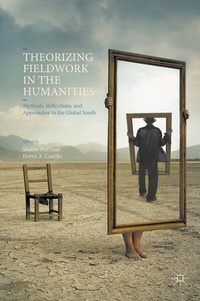
Theorizing Fieldwork in the Humanities
Description

This volume, the first of its kind, launches a conversation amongst humanities scholars doing fieldwork on the global south. It both offers indispensable tools and demonstrates the value of such work inside and outside of the academy. The contributors reflect upon their experiences of fieldwork, the methods they improvised, their dilemmas and insights, and the ways in which fieldwork shifted their frames of analysis. They explore how to make fieldwork legible to their disciplines and how fieldwork might extend the work of the humanities. The volume is for both those who are already deeply immersed in fieldwork in the humanities and those who are seeking ways to undertake it.
Reviews / Votes
"This volume offers timely intervention for a humanities in crisis. Fieldwork in the humanities is conceptualized in these essays as more than a methodology--it is an epistemology and an ethics. These absorbing accounts from expert practitioners in the field are sure to generate excitement and interest among a wide range of readers in the academy. Theorizing Fieldwork is required reading." (Rajeswari Sunder Rajan, Global Distinguished Professor of English, NYU, USA)
"This volume signals the ways that humanities scholars seeking connections between their work and the world might shift the mediums of encounter at that very boundary. Alive to the geopolitics of fieldwork, the contributors are determined to specify new methods for making visible the materialities of literature and culture-offering rigorous and vigorous redefinitions of 'the field' and its archives in the process." (Antoinette Burton, Professor of History and Bastian Professor of Global and Transnational Studies, University of Illinois, USA)
"This pioneering collection invites us to reflect on how fieldwork can 'surprise' humanistic scholarship by destabilizing theoretical givens and restoring a conceptual and very human thickness to texts, problematizing what we claim as literature and whom we claim as authors, as well as bridging the distances created by digitized sources and transnational scholarship. In the process, the authors also reveal how humanistic fieldwork has the potential to transcend traditional anthropological practice." (Joanne Rappaport, Professor of Anthropology, Georgetown University, USA)
More details
Other editions
Additional editions
Persons
Shalini Puri is Professor of English at the University of Pittsburgh, USA. She is the author of The Grenada Revolution in the Caribbean Present: Operation Urgent Memory and the award-winning The Caribbean Postcolonial: Social Equality, Post-Nationalism, and Cultural Hybridity . Her edited collections include The Legacies of Caribbean Radical Politics , Marginal Migrations: The Circulation of Cultures within the Caribbean , and (with Lara Putnam) Caribbean Military Encounters.
Debra A. Castillo is Stephen H. Weiss Presidential Fellow, Emerson Hinchliff Professor of Hispanic Studies, and Professor of Comparative Literature at Cornell University, USA. Her most recent books include Mexican Public Intellectuals (with Stuart Day) and Despite all Adversities: Spanish American Queer Cinema (with Andrés Lema Hincapié).
Content
1. Debra A. Castillo and Shalini Puri, Introduction: Conjectures on Undisciplined Research.- 2. Shalini Puri, Finding the Field: Notes on Caribbean Cultural Criticism, Area Studies, and the Forms of Engagement.- 3. Naminata Diabate, Women's Naked Protest in Africa: Comparative Literature and its Futures.- 4. Kavita Panjabi, Aesthetics in the Making of History: The Tebhaga Women's Movement in Bengal.- 5. Jennifer Lynn Kelly, Locating Palestine within American Studies: Transitory Field Sites and Borrowed Methods.- 6. Neil Doshi, Absent Performances: Distant Fieldwork on Social Movement Theater of Algeria and India.- 7. Tori Holmes, Ethical Dilemmas in Studying Blogging by Favela Residents in Brazil.- 8. Rashmi Sadana, Reading Delhi, Writing Delhi: An Ethnography of Literature.- 9. Lara Putnam, Daily Life and Digital Reach: Place-Based Research and History's Transnational Turn.- 10. Renato Rosaldo, Lessons from the Space between Languages: Notes on Poetry and Ethnography.- 11. Stephanie Newell, Researching the Cultural Politics of Dirt in Urban Africa.- Paul Youngquist, Accidental Histories: Among the Maroons of Jamaica.- Debra A. Castillo, Engagement and Pedagogy: Traveling with students in Chiapas, Mexico.
