

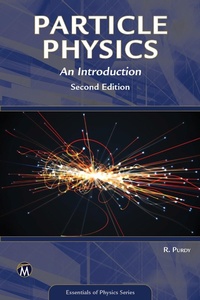
Particle Physics
An Introduction
2nd Edition
Published on 12. January 2023
500 pages
978-1-68392-876-8 (ISBN)
Description

This updated edition is designed as a brief introduction to the fundamental particles that make up the matter in our universe. Numerous examples, figures, and simple explanations enable general readers and physics students to understand complex concepts related to the universe. Selected topics include atoms, quarks, accelerators, detectors, colliders, string theory, and more. Features: - Explores the fundamental particles that make up the matter in our universe
- Topics include atoms, quarks, accelerators, detectors, colliders, string theory, and more
- Topics include atoms, quarks, accelerators, detectors, colliders, string theory, and more
More details
Series
Edition
2nd Revised edition
Language
English
Place of publication
Herndon, VA
United States
Target group
Professional and scholarly
US School Grade: College Graduate Student
Edition type
Revised edition
File size
12,82 MB
ISBN-13
978-1-68392-876-8 (9781683928768)
Copyright in bibliographic data and cover images is held by Nielsen Book Services Limited or by the publishers or by their respective licensors: all rights reserved.
Schweitzer Classification
Other editions
Additional editions
Book
02/2023
2nd Edition
Mercury Learning & Information
€74.95
Article not available at the moment
E-Book
01/2023
2nd Edition
Mercury Learning and Information
€92.49
Available for download
Person
Purdy Robert :
Robert Purdy, PhD is a lecturer in Physics at the University of Leeds. He has taught modules in classical mechanics, Lagrangian and Hamiltonian mechanics, nuclear physics, particle physics, quantum field theory, and mathematics for physicists.
Robert Purdy, PhD is a lecturer in Physics at the University of Leeds. He has taught modules in classical mechanics, Lagrangian and Hamiltonian mechanics, nuclear physics, particle physics, quantum field theory, and mathematics for physicists.
Content
- Cover
- Half-Title
- Title
- Copyright
- Dedication
- Contents
- Introduction
- Chapter 1: A History of Particle Physics
- 1.1 Atomic Theory
- 1.2 Atomic Structure
- 1.3 Forces and Interactions
- 1.4 Strange and Unexpected Developments
- 1.5 Strangeness
- 1.6 Quarks and Symmetries
- 1.7 The Standard Model of Particle Physics
- 1.8 The Current State of the Field
- 1.9 Exercises
- Chapter 2: Special Relativity
- 2.1 Lorentz Transformations
- 2.1.1 Scalars, Vectors, and Reference Frames
- 2.1.2 Special Relativity
- 2.1.3 Minkowski Space
- 2.2 Energy and Momentum in Minkowski Space
- 2.2.1 Example Calculation
- 2.2.2 Invariant Mass
- 2.3 Exercises
- Chapter 3: Quantum Mechanics
- 3.1 States and Operators
- 3.2 The Schrödinger Equation
- 3.3 Probability Current
- 3.4 Angular Momentum and Spin
- 3.5 Spin 1/2 Particles and the Pauli Matrices
- 3.6 The Hamiltonian
- 3.6.1 The Lagrangian
- 3.7 Quantum Mechanics and Electromagnetism: The Schrödinger Approach
- 3.8 Quantum Mechanics and Electromagnetism: The Pauli Equation
- 3.9 Exercises
- Chapter 4: Symmetries and Groups
- 4.1 The Importance of Symmetry in Physics
- 4.2 Discrete Symmetries
- 4.2.1 Mathematical Structure of Discrete Symmetries
- 4.2.2 Discrete Symmetries in Particle Physics
- 4.3 Continuous Symmetries
- 4.3.1 Mathematical Structure of Continuous Symmetries
- 4.3.2 Continuous Symmetries in Particle Physics
- 4.4 Exercises
- Chapter 5: Experimental Particle Physics
- 5.1 Detectors
- 5.1.1 Interactions of Particles with Matter
- 5.1.2 Early Detectors
- 5.1.3 Modern Detectors
- 5.2 Accelerators
- 5.2.1 Linear Accelerators
- 5.2.2 Cyclotrons
- 5.2.3 Synchrotrons
- 5.3 Measurable Quantities in Particle Physics: Matching Theory to Experiment
- 5.3.1 Cross-Sections
- 5.3.2 Lifetimes
- 5.4 Exercises
- Chapter 6: Particle Classification
- 6.1 The Spin-Statistics Theorem
- 6.2 The Strong Force
- 6.2.1 Isospin
- 6.2.2 Flavor SU (3)
- 6.3 Color
- 6.4 Building Hadrons
- 6.4.1 Quark Content
- 6.4.2 Mass
- 6.4.3 Resonances
- 6.4.4 Larger Flavor Symmetries
- 6.5 Exercises
- Chapter 7: Relativistic Quantum Mechanics
- 7.1 The Klein-Gordon Equation
- 7.1.1 A Relativistic Schrödinger Equation
- 7.1.2 Solutions of the Klein-Gordon Equation
- 7.1.3 Conserved Current
- 7.2 The Maxwell and Proca Equations
- 7.2.1 Derivation of the Maxwell Equation
- 7.2.2 Solutions of the Maxwell Equation
- 7.2.3 Including Mass: The Proca Equation
- 7.2.4 Spin of Vector Particles
- 7.3 Combining Equations: How Do Particles Interact?
- 7.3.1 Quantum Field Theory Without the Maths
- 7.3.2 Feynman Rules
- 7.4 Exercises
- Chapter 8: The Dirac Equation
- 8.1 A Linear Relativistic Equation
- 8.2 Representations of the Gamma Matrices
- 8.2.1 The Dirac Representation
- 8.2.2 The Weyl Representation
- 8.3 Spinors and Lorentz Transformations
- 8.4 Solutions of the Dirac Equation
- 8.4.1 Basis Spinors
- 8.4.2 Spin
- 8.4.3 Antiparticles
- 8.4.4 Helicity
- 8.4.5 Chirality
- 8.5 Massless Particles
- 8.6 Charge Conjugation
- 8.7 Dirac, Weyl, and Majorana Spinors
- 8.8 Bilinear Covariants
- 8.9 Exercises
- Chapter 9: Quantum Electrodynamics
- 9.1 U(1) Symmetry in Wave Equations
- 9.2 Localizing the U(1) Symmetry
- 9.3 The Link with Classical Physics
- 9.4 A Well-Tested Theory
- 9.5 Calculations in QED
- 9.5.1 Feynman Rules for QED
- 9.5.2 Calculating Amplitudes
- 9.5.3 Calculating the Differential Cross-Section
- 9.6 Beyond Leading Order: Renormalization
- 9.7 Form Factors and Structure Functions
- 9.7.1 Electromagnetic Form Factors
- 9.7.2 Structure Functions and the Quark Model
- 9.8 Exercises
- Chapter 10: Non-Abelian Gauge Theory and Color
- 10.1 Non-Abelian Symmetry in the Dirac Equation
- 10.1.1 SU(3) and Color
- 10.1.2 Localizing the SU(3) Symmetry
- 10.2 Gluon Self-Interactions
- 10.3 Strong Force Interactions
- 10.3.1 Quantum Chromodynamics
- 10.3.2 Scale-Dependence
- 10.4 High-Energy QCD
- 10.4.1 Asymptotic Freedom
- 10.4.2 Perturbative QCD
- 10.5 Low-Energy QCD
- 10.5.1 Quark Confinement
- 10.5.2 The Residual Nuclear Force
- 10.5.3 Perturbative and Lattice QCD
- 10.6 Exotic Matter
- 10.6.1 Pentaquarks and Tetraquarks
- 10.6.2 Glueballs
- 10.6.3 Quark-Gluon Plasma
- 10.7 Exercises
- Chapter 11: Symmetry Breaking and The Higgs Mechanism
- 11.1 The Weak Force as a Boson-Mediated Interaction
- 11.1.1 P Violation
- 11.1.2 C Violation
- 11.2 Renormalizability and the Need for Symmetry
- 11.3 Hidden Symmetry
- 11.3.1 Toy Model 1: Z2 Symmetry Breaking
- 11.3.2 Toy Model 2: U(1) Symmetry Breaking
- 11.3.3 Local U(1) Symmetry Breaking
- 11.3.4 The Higgs Mechanism: SU(2) x U(1) Breaking
- 11.4 Electroweak Interactions
- 11.4.1 Hypercharge and Weak Isospin
- 11.5 Exercises
- Chapter 12: The Standard Model of Particle Physics
- 12.1 Putting It All Together
- 12.2 Fermion Masses
- 12.3 Quark Mixing and the CKM Matrix
- 12.3.1 The Cabibbo Hypothesis
- 12.3.2 Neutral Mesons
- 12.3.3 More General Quark Mixing
- 12.4 CP Violation in the Weak Sector
- 12.4.1 The Electron Electric Dipole Moment
- 12.5 Successes of the Standard Model
- 12.5.1 Anomaly Cancelation
- 12.6 Problems with the Standard Model
- 12.6.1 Baryogenesis
- 12.6.2 The Hierarchy Problem
- 12.6.3 The Muon Anomalous Magnetic Moment
- 12.6.4 The Strong CP Problem
- 12.7 Exercises
- Chapter 13: Beyond the Standard Model
- 13.1 Neutrino Oscillations and the PMNS Matrix
- 13.2 The See-Saw Mechanism
- 13.3 Grand Unification
- 13.3.1 SU(5) as an Example GUT
- 13.3.2 Magnetic Monopoles
- 13.4 Supersymmetry
- 13.5 Problems with Standard Model Extensions
- 13.6 Gravitons
- 13.6.1 Can We Go Further Than Spin-2?
- 13.6.2 Problems with Gravity
- 13.7 Axions
- 13.8 Dark Matter
- 13.8.1 Axions
- 13.8.2 Sterile Neutrinos
- 13.8.3 Lightest Supersymmetric Particle
- 13.8.4 Something New
- 13.9 Dark Energy and Inflation
- 13.9.1 Inflation
- 13.9.2 Dark Energy
- 13.10 The Future of Particle Physics
- 13.11 Exercises
- Appendix A: Elementary Particle Properties and Other Useful Quantities
- Appendix B: Feynman Rules
- Appendix C: Gamma Matrix Identities
- Bibliography
- Index
