

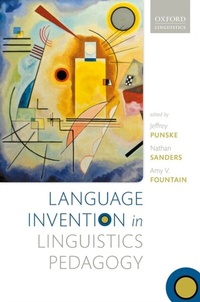
Language Invention in Linguistics Pedagogy
1st Edition
Published on 12. August 2020
320 pages
978-0-19-256543-3 (ISBN)
Description

This book is the first to explore the varied ways in which invented languages can be used to teach languages and linguistics in university courses. There has long been interest in invented languages, also known as constructed languages or conlangs, both in the political arena (as with Esperanto) and in the world of literature and science fiction and fantasy media - Tolkien's Quenya and Sindarin, Dothraki in Game of Thrones, and Klingon in the Star Trek franchise, among many others. Linguists have recently served as language creators or consultants for film and television, with notable examples including Jessica Coons work on the film Arrival Christine Schreyers Kryptonian for Man of Steel, David Adgers contributions to the series Beowulf, and David J. Peterson's numerous languages for Game of Thrones and other franchises.
The chapters in this volume show how the use of invented languages as a teaching tool can reach a student population who might not otherwise be interested in studying linguistics, as well as helping those students to develop the fundamental core skills of linguistic analysis. Invented languages encourage problem-based and active learning; they shed light on the nature of linguistic diversity and implicational universals; and they provide insights into the complex interplay of linguistic patterns and social, environmental, and historical processes. The volume brings together renowned scholars and junior researchers who have used language invention and constructed languages to achieve a range of pedagogical objectives. It will be of interest to graduate students and teachers of linguistics and those in related areas such as anthropology and psychology.
More details
Other editions
Additional editions
Jeffrey Punske | Nathan Sanders | Amy V. Fountain
Language Invention in Linguistics Pedagogy
Book
08/2020
Oxford University Press
€120.10
Shipment within 15-20 days
Jeffrey Punske | Nathan Sanders | Amy V. Fountain
Language Invention in Linguistics Pedagogy
Book
08/2020
Oxford University Press
€43.50
Shipment within 15-20 days
Persons
Jeffrey Punske is Assistant Professor in the Department of Linguistics at Southern Illinois University. His primary research focus is in morphosyntax with a secondary specialization in linguistics pedagogy and outreach. He has presented on issues of language at workshops hosted by the European Space Agency and METI and works to cross disciplinary boundaries and to advance the methodologies and discourses around linguistic pedagogy and outreach.
Nathan Sanders is Assistant Professor, Teaching Stream, at the Department of Linguistics, University of Toronto. He works on innovations in linguistics pedagogy and on addressing equity, diversity, and inclusion in the linguistics classroom. His linguistic research centers on biomechanics and perception, for both speech and sign languages. He also works on phonological theory, computational and statistical models of linguistic phenomena, language change, and linguistic typology.
Amy V. Fountain is Associate Professor, Career Track, in the Department of Linguistics at the University of Arizona. She has taught introductory linguistics and a range of other courses at the University of Arizona since 2004. Her research focuses on language reclamation, revitalization, and endangerment, particularly with reference to Native American languages; she is also interested in prosodic phonology and the relationship between morphology and phonology.
Content
- 1: Jeffrey Punske, Nathan Sanders, and Amy V. Fountain: Introduction
- 2: Nathan Sanders: A primer on constructed languages
- 3: Arika Okrent: Budding linguists and how to find them
- 4: Jessica Coon: The linguistics of Arrival: Heptapods, field linguistics, and Universal Grammar
- 5: David Adger and Coppe van Urk: Three conlang projects at three educational levels
- 6: Grant Goodall: The design(ing) of language
- 7: Matt Pearson: Using language invention to teach typology and cross-linguistic universals
- 8: Angela C. Carpenter: Teaching invented languages to the undergraduate major: A capstone course
- 9: James A. Berry: Teaching invented languages as an introductory course: Unfamiliar territory
- 10: Carrie Gillon, Edward Delmonico, Randi Martinez, and Spencer Morrell: Bringing language construction from the classroom to the community
- 11: Nathan Sanders and Christine Schreyer: The interdisciplinarity of conlangs: Moving beyond linguistics
- 12: Brenna Reinhart Byrd and Andrew Miles Byrd: Teaching Proto-Indo-European as a constructed language
- 13: Skye J. Anderson, Shannon T. Bischoff, Jeffrey Punske, and Amy V. Fountain: Learning about language through language invention: "I was really proud of the language I created"
- 14: Sheri Wells-Jenson and Kimberly Spallinger: Extraterrestrial message construction: Guidelines for the use of xenolinguistics in the classroom
- 15: David J. Peterson: Artistry in language invention: Conlang pedagogy and the instructor as authority
