

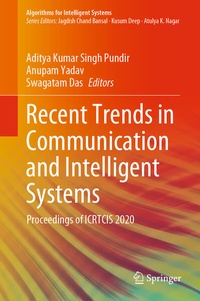
Recent Trends in Communication and Intelligent Systems
Proceedings of ICRTCIS 2020
1st Edition
Published on 15. March 2021
XX, 220 pages
978-981-16-0167-5 (ISBN)
Description

This book presents best selected research papers presented at the International Conference on Recent Trends in Communication and Intelligent Systems (ICRTCIS 2020), organized by Arya College of Engineering and IT, Jaipur, on 20-21 November 2020. It discusses the latest technologies in communication and intelligent systems, covering various areas of communication engineering, such as signal processing, VLSI design, embedded systems, wireless communications, and electronics and communications in general. Featuring work by leading researchers and technocrats, the book serves as a valuable reference resource for young researchers and academics as well as practitioners in industry.
More details
Series
Language
English
Place of publication
Singapore
Singapore
Publishing group
Springer Singapore
Target group
Professional and scholarly
Product notice
Reflowable
Illustrations
XX, 220 p. 147 illus., 118 illus. in color.
File size
11,64 MB
ISBN-13
978-981-16-0167-5 (9789811601675)
DOI
10.1007/978-981-16-0167-5
Schweitzer Classification
Other editions
Additional editions
Aditya Kumar Singh Pundir | Anupam Yadav | Swagatam Das
Recent Trends in Communication and Intelligent Systems
Proceedings of ICRTCIS 2020
Book
03/2021
Springer
€213.99
Shipment within 3-4 weeks
Persons
Dr. Aditya Kumar Singh Pundir (B.E., M.Tech., and Ph.D.) is currently working as Professor, Mentor Incubation & IPR Activities in Department of Electronics and Communication Engineering at Arya College of Engineering & IT, Jaipur. His current research interests include IOT-based memory testing, built-in self-test using embedded system design, machine learning, algorithms for CAD and signal processing. He has published three patents, several book chapters, and three books to his credit and also authored more than 20 research papers in peer-reviewed refereed journals and conferences. Dr. Pundir was Organizing Chair, Convener and Member of the steering committee of several international conferences. Dr. Pundir is Life Member of the Indian Society for Technical Education (ISTE), Computer Society of India (CSI), and Professional Member of Association for Computing Machinery (ACM) and IEEE.
Dr. Anupam Yadav, is Assistant Professor, Department of Mathematics, Dr. B. R. Ambedkar National Institute of Technology Jalandhar, India. His research area includes numerical optimization, soft computing, and artificial intelligence. He has more than ten years of research experience in the areas of soft computing and optimization. Dr. Yadav has done a Ph.D. in soft computing from the Indian Institute of Technology Roorkee, and he had worked as Research Professor at Korea University. He has published more than twenty-five research articles in journals of international repute and has published more than fifteen research articles in conference proceedings. Dr. Yadav has authored a textbook entitled An introduction to neural network methods for differential equations . He has edited three books which are published by AISC, Springer Series. Dr. Yadav was General Chair, Convener, and Member of the steering committee of several international conferences. He is Member of various research societies.
Dr. Swagatam Das received theB.E. Tel. E., M.E. Tel. E (Control Engineering specialization) and Ph.D. degrees, all from Jadavpur University, India, in 2003, 2005, and 2009, respectively. Swagatam Das is currently serving as Associate Professor at the Electronics and Communication Sciences Unit of the Indian Statistical Institute, Kolkata, India. His research interests include evolutionary computing, pattern recognition, multi-agent systems, and wireless communication. Dr. Das has published more than 300 research articles in peer-reviewed journals and international conferences. He is the founding co-editor-in-chief of Swarm and Evolutionary Computation, an international journal from Elsevier. He has also served as or is serving as the associate editor of the Pattern Recognition (Elsevier), Neurocomputing (Elsevier), Information Sciences (Elsevier), IEEE Trans. on Systems, Man, and Cybernetics: Systems, IEEE Computational Intelligence Magazine, IEEE Access, and so on. He is Editorial Board Member of Progress in Artificial Intelligence (Springer), Applied Soft Computing (Elsevier), Engineering Applications of Artificial Intelligence (Elsevier), and Artificial Intelligence Review (Springer). Dr. Das has 16,500+ Google Scholar citations and an H-index of 62 till date. He has been associated with the international program committees and organizing committees of several regular international conferences including IEEE CEC, IEEE SSCI, SEAL, GECCO, and SEMCCO. He has acted as the guest editor for special issues in journals like IEEE Transactions on Evolutionary Computation and IEEE Transactions on SMC, Part C. He is the recipient of the 2012 Young Engineer Award from the Indian National Academy of Engineering (INAE). He is also the recipient of the 2015 Thomson Reuters Research Excellence India Citation Award as the highest cited researcher from India in Engineering and Computer Science category between 2010 and 2014.
Dr. Anupam Yadav, is Assistant Professor, Department of Mathematics, Dr. B. R. Ambedkar National Institute of Technology Jalandhar, India. His research area includes numerical optimization, soft computing, and artificial intelligence. He has more than ten years of research experience in the areas of soft computing and optimization. Dr. Yadav has done a Ph.D. in soft computing from the Indian Institute of Technology Roorkee, and he had worked as Research Professor at Korea University. He has published more than twenty-five research articles in journals of international repute and has published more than fifteen research articles in conference proceedings. Dr. Yadav has authored a textbook entitled An introduction to neural network methods for differential equations . He has edited three books which are published by AISC, Springer Series. Dr. Yadav was General Chair, Convener, and Member of the steering committee of several international conferences. He is Member of various research societies.
Dr. Swagatam Das received theB.E. Tel. E., M.E. Tel. E (Control Engineering specialization) and Ph.D. degrees, all from Jadavpur University, India, in 2003, 2005, and 2009, respectively. Swagatam Das is currently serving as Associate Professor at the Electronics and Communication Sciences Unit of the Indian Statistical Institute, Kolkata, India. His research interests include evolutionary computing, pattern recognition, multi-agent systems, and wireless communication. Dr. Das has published more than 300 research articles in peer-reviewed journals and international conferences. He is the founding co-editor-in-chief of Swarm and Evolutionary Computation, an international journal from Elsevier. He has also served as or is serving as the associate editor of the Pattern Recognition (Elsevier), Neurocomputing (Elsevier), Information Sciences (Elsevier), IEEE Trans. on Systems, Man, and Cybernetics: Systems, IEEE Computational Intelligence Magazine, IEEE Access, and so on. He is Editorial Board Member of Progress in Artificial Intelligence (Springer), Applied Soft Computing (Elsevier), Engineering Applications of Artificial Intelligence (Elsevier), and Artificial Intelligence Review (Springer). Dr. Das has 16,500+ Google Scholar citations and an H-index of 62 till date. He has been associated with the international program committees and organizing committees of several regular international conferences including IEEE CEC, IEEE SSCI, SEAL, GECCO, and SEMCCO. He has acted as the guest editor for special issues in journals like IEEE Transactions on Evolutionary Computation and IEEE Transactions on SMC, Part C. He is the recipient of the 2012 Young Engineer Award from the Indian National Academy of Engineering (INAE). He is also the recipient of the 2015 Thomson Reuters Research Excellence India Citation Award as the highest cited researcher from India in Engineering and Computer Science category between 2010 and 2014.
Content
Exploring Feature Selection Using Supervised Machine Learning Algorithms for Establishing a Link between Pulmonary Embolism and Cardiac-Arrest.- Speech Signal Compression and Reconstruction using Compressive Sensing Approach.- Breast Cancer Prediction using Enhanced CNN based Image Classıfıcatıon Mechanism.- Dual Band- Notched Microstrip Patch Antenna with Three Split Ring Resonator Slots.- Effective RF Coverage Planning for WMAN Network Using 5 Ghz Backhaul.- Security Enhancement of E-Healthcare System in Cloud using Efficient Cryptographic Method.
