

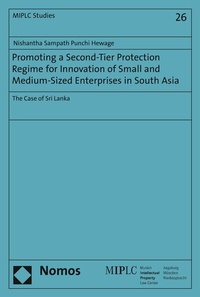
Promoting a Second-Tier Protection Regime for Innovation of Small and Medium-Sized Enterprises in South Asia
The Case of Sri Lanka
1st Edition
Published on 26. March 2015
331 pages
978-3-8452-5950-5 (ISBN)
Description

Intellectual Property law is a dynamic field; its ever-changing landscape challenges us to constantly revisit the existing laws and policies. Although ideological currents of a second-tier patent (STP) regime are sweeping through the South Asian region in recent years, the concept of utility model or petty patent remains a largely unexplored option in Sri Lanka and in other parts of the South Asian region. Against this backdrop, this book offers an alternative approach to incentivise minor and incremental innovations of SMEs. It also explores whether Sri Lanka and other developing economies in the South Asian region can benefit from such an STP regime if it is tailored to the specific characteristics of the innovation landscape of the country.
Nishantha Sampath Punchi Hewage, LL.B. (Hons.), LLM in IP (MIPLC), is a Lecturer in the Faculty of Law, University of Colombo, Sri Lanka. He is also an Attorney-at-Law of the Supreme Court of Sri Lanka. He conducts research in the field of intellectual property (IP), innovation, competition, and human rights.
More details
Other editions
Additional editions
Nishantha Sampath Punchi Hewage
Promoting a Second-Tier Protection Regime for Innovation of Small and Medium-Sized Enterprises in South Asia
The Case of Sri Lanka
Book
04/2015
1st Edition
Nomos
€89.00
Shipment within 5-7 days
Person
Content
- Cover
- 1. Introduction and Background
- 1.1. Research Statement
- 1.1.1. Objectives
- 1.1.2. Research Problem
- 1.1.3. Hypothesis and Research Questions
- 1.1.4. Research Methodology
- 1.1.5. How does this Research contribute to the Legal Science?
- 1.1.6. Limitations
- 1.2. Preliminary Thoughts and Definitions
- 1.2.1. Invention and Innovation
- 1.2.2. Second-Tier Protection
- 1.2.3. A Developing Country
- 1.2.4. SMEs
- 1.3. Sri Lankan Innovation Landscape
- 1.3.1. Specific Characteristics of the Sri Lankan Innovation Landscape
- 1.3.2. The Statistical Story
- 1.3.3. A Lack of Incentives for Innovation?
- 1.4. TK-based Innovation
- 1.4.1. What is it?
- 1.4.2. A particular Need for Protection?
- 1.5. The South Asian Scenario
- 1.6. Overview of Second-Tier Protection
- 1.6.1. Common Elements and Divergence
- 1.6.2. The Rationale for STP Systems
- 1.6.3. Pros and Cons of an STP Regime
- 1.6.4. Policy Considerations to be applied by Legislators
- 1.7. International Legal Framework
- 1.7.1. Obligations under the Paris Convention
- 1.7.2. Obligations under TRIPS Agreement
- 1.7.3. Other Patent Treaties and Agreements
- 1.7.4. Flexibilities and Policy Space
- 1.8. Conclusion
- 2. Incremental Innovations and the Existing IPR System in Sri Lanka
- 2.1. Introduction
- 2.1.1. Philosophical Underpinnings of IP
- 2.2. Patent Protection in Sri Lanka
- 2.2.1. A Brief Overview
- 2.2.2. The Origin of the Patent System
- 2.2.3. The Introduction of Patent Law in Sri Lanka
- 2.2.4. Which Inventions are Patentable?
- 2.2.5. Conditions of Patentability
- 2.2.6. The Concept of Novelty
- 2.2.7. Inventive Step
- 2.2.8. Industrial Applicability
- 2.2.9. The Rights of the Owner of a Patent
- 2.2.10. Empirical Analysis of Sri Lankan Patent System
- 2.2.11. Use of the Patent System
- 2.2.12. Adequacy of the Existing Patent Regime
- 2.3. Design Protection in Sri Lanka
- 2.3.1. Introduction
- 2.3.2. Overview of Sri Lankan Law
- 2.3.3. Empirical Analysis
- 2.3.4. Is Design Protection an Alternative to a Second-Tier Protection Regime?
- 2.4. Comparative view of Different IPRs in Sri Lanka
- 2.5. Conclusion
- 3. Incentive Mechanisms for Incremental and Minor Innovations under Unfair Competition Law and Trade Secrets Law in Sri Lanka
- 3.1. Unfair Competition Law
- 3.1.1. Introduction
- 3.1.2. The International Dimension
- 3.1.3. Current Legal Regime against Unfair Competition in Sri Lanka
- 3.1.4. Development of the Case-Law
- 3.1.5. How Effective is Unfair Competition Law to Protect Sub-patentable Innovation?
- 3.1.6. Passing-off Action
- 3.1.7. Current Status of Passing-off Action in Sri Lanka
- 3.1.8. Conclusion
- 3.2. Trade Secrets Protection
- 3.2.1. Background and the Emergence of Trade Secret Law
- 3.2.2. What is a Trade Secret?
- 3.2.3. Current Protection of Trade Secrets in the IP Act
- 3.2.4. Common Law Action for Breach of Confidence
- 3.2.5. Other Legal Regimes: Contract and Labour Law
- 3.2.6. Empirical Evidence
- 3.2.7. Why is Trade Secrets Protection so Attractive?
- 3.2.8. Difficulties and Challenges for SMEs
- 3.2.9. Conclusion
- 4. Second-Tier Patent Protection in other Jurisdictions: Legislative Examples from outside South Asia
- 4.1. Experience from Developed Countries
- 4.1.1. Germany
- 4.1.1.1. A Brief Historical Overview
- 4.1.1.2. Main Features of the Current UM System
- 4.1.1.3. Empirical Analysis and Policy Implications
- 4.1.1.4. Lessons from Germany
- 4.1.2. Australia
- 4.1.2.1. Main Features of Current Innovation Patents
- 4.1.2.2. Empirical Analysis and Policy Implications
- 4.1.2.3. Lessons from Australia
- 4.2. Experience from Emerging and Developing Economies
- 4.2.1. China
- 4.2.1.1. Current System of Utility Model Protection
- 4.2.1.2. Empirical Analysis and Policy Implications
- 4.2.1.3. Critique and New Developments
- 4.2.1.4. Lessons from China
- 4.2.2. Malaysia
- 4.2.2.1. Main Features of the UM System
- 4.2.2.2. Empirical Analysis of the UI System
- 4.2.2.3. Lessons from Malaysia
- 4.2.3. Kenya
- 4.2.3.1. Protection under the Current System
- 4.2.3.2. Empirical Analysis
- 4.2.3.3. Lessons from Kenya
- 5. South Asian Region and Second-Tier Protection
- 5.1. Indian Perspectives
- 5.1.1. Empirical Analysis of the Indian Patent System
- 5.1.2. Protection of Incremental Innovations in India
- 5.1.3. DIPP Discussion Paper
- 5.1.4. Does India need such a System?
- 5.1.5. What happens Next?
- 5.2. Pakistani Perspectives
- 5.2.1. The Statistical Story
- 5.2.2. Protection for Incremental Innovations in Pakistan
- 5.2.3. Recent Initiatives
- 5.3. Whether and to what extent are these Experiences applicable to Sri Lanka?
- 5.3.1. Conclusion
- 6. Designing a Second-Tier Protection Regime for Sri Lanka
- 6.1. Arguments for introducing an STP in Sri Lanka
- 6.2. Arguments against such an STP Regime
- 6.3. Design and Structure
- 6.4. Core Elements
- 6.4.1. Protected Subject-Matter/Scope of Protection
- 6.4.2. Standard of Novelty
- 6.4.3. Inventive Step Requirement
- 6.4.4. Elevated Utility Requirement
- 6.4.5. Granting Procedure
- 6.4.6. Duration of Protection
- 6.4.7. Exceptions and Limitations
- 6.5. Prosecution and Enforcement
- 6.6. Interface with other IPR Systems
- 6.7. Guarding against Abuse
- 6.8. Domestic IP Infrastructure (IP Office, Courts, Professionals)
- 6.9. TK-based Innovation and Second-Tier Protection
- 6.9.1. Why is such a Form of Protection Important?
- 6.9.2. Herbal and Cosmetic Product Sector
- 6.9.3. Traditional Medicines: a Potential Candidate for Protection?
- 6.10. Conclusion
- 7. Recommendations and Policy Options for the South Asian Region
- 7.1. Policy Options
- 7.1.1. Sri Lanka
- 7.1.2. India and Pakistan
- 7.1.3. Other South Asian Countries
- 7.2. General Recommendations and Observations
- 7.3. Conclusion
- 7.4. Outlook
- 8. Summary (in German)
- Teil 1: Einleitung und Hintergrund
- Teil 2: Inkrementelle Innovationen und das bestehende Immaterialgüterschutzsystem in Sri Lanka
- Teil 3: Anreizmechanismen für inkrementelle und kleinere Innovationen im Lauterkeitsrecht und im Recht der Geschäftsgeheimnisse in Sri Lanka
- Teil 4: Mehrstufige Schutzrechtssysteme in anderen Jurisdiktionen: Gesetzgebungsbeispiele aus Ländern von außerhalb Südasiens
- Erfahrungen aus entwickelten Ländern
- Erfahrungen aus Deutschland
- Erfahrungen aus Australien
- Erfahrungen aus aufstrebenden Ländern und aus Entwicklungsländern
- Erfahrungen aus China
- Erfahrungen aus Malaysia
- Erfahrungen aus Kenia
- Teil 5: Die Region Südostasien und zweistufige Schutzsysteme
- Die Perspektive Indiens
- Die Perspektive Pakistans
- Die Übertragbarkeit dieser Erfahrungen auf Sri Lanka
- Teil 6: Der Entwurf eines zweistufigen Schutzrechtsregimes für Sri Lanka
- Teil 7: Empfehlungen und rechtspolitische Optionen für die Region Südostasien
- Ausblick
- Bibliography
