

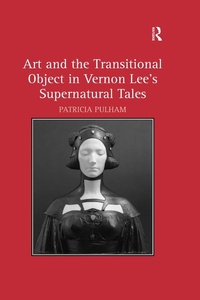
Art and the Transitional Object in Vernon Lee's Supernatural Tales
Published on 2. March 2017
188 pages
978-1-351-95711-3 (ISBN)
Description

In her persuasively argued study, Patricia Pulham astutely combines psychoanalytic theory with socio-historical criticism to examine a selection of fantastic tales by the female aesthete and intellectual Vernon Lee (Violet Paget, 1856-1935). Lee's own definition of the supernatural in the preface to Hauntings questions the nature of the 'genuine ghost', and argues that this figure is not found in the Society of Psychical Research but in our own psyches, where it functions as a mediator between past and present. Using D.W. Winnicott's 'transitional object' theory, which maintains that adults transfer their childhood engagement with toys to art and cultural artifacts, Pulham argues that the prevalence of the past in Lee's tales signifies not only an historical but a psychic past. Thus the 'ghosts' that haunt Lee's supernatural fiction, as well as her aesthetic, psychological, and historical writings, held complex meanings for her that were fundamental to her intellectual development and allowed her to explore alternative identities that permit the expression of transgressive sexualities.
Reviews / Votes
'...Pulham's close study of Lee's horror stories is most welcome, for she provides a fresh look at Lee's considerable talents as a creator of psychological studies of monomania. Through the lens of D. W. Winnicott's psychoanalytic theory of the transitional object, she provides illuminating close readings of Lee's tales, as well as several of her other works.' Review of English Studies 'An elegant and insightful critique of Lee's supernatural writing, Pulham's study makes a major contribution to the continued critical resurrection of this Victorian woman of letters.' English Literature in Transition 'Pulham's study has real strength, notably its promotion of a wide range of Lee's fiction, its close and often rich textual engagement, and its careful analysis of Lee's Aesthetic creed and gender politics...' English Studies '... there is much in Pulham's text to recommend. She strengthens her arguments through extended comparative analyses of fantastical stories by Lee's contemporaries and antecedents: Hoffman, Henry James, Balzac, Poe, etc. She draws upon an impressive array of secondary texts that illuminate aspects of art history, aesthetics, and various and varying psychoanalytical ideas that support her thesis. There is enough fascinating detail in each chapter to spark the scholarly imagination into pursuing, perhaps in very different ways, some of Pulham's often ingenious ideas.' Journal of the Fantastic in the ArtsMore details
Language
English
Place of publication
London
United Kingdom
Publishing group
Taylor & Francis Ltd
Target group
College/higher education
File size
1,82 MB
ISBN-13
978-1-351-95711-3 (9781351957113)
Copyright in bibliographic data and cover images is held by Nielsen Book Services Limited or by the publishers or by their respective licensors: all rights reserved.
Schweitzer Classification
Other editions
Additional editions
Book
06/2019
1st Edition
Routledge
€73.80
Shipment within 10-20 days
Book
05/2008
1st Edition
Routledge
€231.30
Shipment within 10-20 days
Person
Patricia Pulham is Senior Lecturer in Victorian Literature at the University of Portsmouth, UK.
Content
Contents: Introduction; Castrato cries and wicked voices; A white and ice-cold world; Painted dolls and virgin mothers; Madonna portraits and Medusan mirrors; Coda; Select bibliography; Index.
