

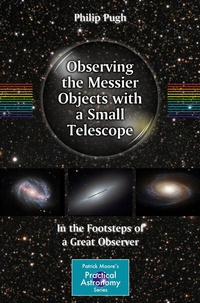
Observing the Messier Objects with a Small Telescope
Description

Observing the Messier Objects with a Small Telescope contains descriptions and photographs of the 103 Messier objects, with instructions on how to find them without a computerized telescope or even setting circles. The photographs show how the objects appear through a 127mm Maksutov (and other instruments, where applicable). The visual appearance of a Messier object is often very different from what can be imaged with the same telescope, and a special feature of this book is that it shows what you can see with a small telescope.
It will also contain binocular descriptions of some objects.
Messier published the final version of his catalog in 1781 (it contains 103 different objects), a catalog so good that it is still in common use today, well over two centuries later. In making a catalog of all the 'fixed' deep-sky objects that observers might confuse with comets, Messier had succeeded in listing all the major interesting deep-sky objects that today are targets for amateur astronomers.
Messier's telescope (thought to be a 4-inch) was, by today's amateur standards, small. It also had rather poor optics by modern standards. Thus - and despite the fact that he was a master observer - all the things Messier saw can be found and observed by any observer using a commercial 127 mm (5-inch) telescope. Observing the Messier Objects with a Small Telescope lets the reader follow in Messier's footsteps by observing the Messier objects more or less as the great man saw them himself!
More details
Other editions
Additional editions
Person
Philip Pugh is a mathematician, member of the Institute of Technical and Scientific Communicators, and travels the world as a freelance trainer in science and business. He has had his articles published in Sky & Telescope, Astronomy, and Astronomy Now, and is the author/editor of Springer's forthcoming book, Observing the Sun with CoronadoT Telescopes.
Content
Preface.- Acknowledgements.- Charles Messier: His Life, Discoveries, and Legacy.- Introduction to the Messier Objects.- Part I: M1 - M22.- Part II: M23 - M45.- Part III: M46 - M68.- Part IV: M69 - M91.- Part V: M92 - M110.- Glossary.- Index.
