

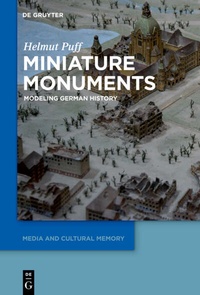
Miniature Monuments
Description

Miniature Monuments: Modeling German History
offers a series of essays on small-scale models of bombed out cities. Created between 1946 and the present, these plastic renderings of places provide eerie glimpses of destruction and devastation resulting of the air war. This study thus permits fresh angles on post-war responses to the compounded losses of WW II, and it does so through considering these "miniature monuments" (of, among others, Frankfurt, Munich, Schwetzingen, Heilbronn and Hiroshima) in a deep cultural history that interlaces the sixteenth, eighteenth, and twentieth centuries.
Three-dimensional renderings in diminutive size have rarely been subjected to rigorous theoretical reflection. Conventionally, models, whether of ruins or intact spaces, have been assumed to be "easily legible"; that is, they have been assumed to be vehicles of the authentic. Yet rubble and other models should be theorized as complex simulacra of abstract realities and catalysts of memories.
Miniature Monuments
thus tackles a haunting paradox: building ruins. The book elucidates how utterly contingent processes of crumbling and collapse (the English words for the Latin
ruina
) came to command such great interest in modern Europe that tremendous efforts were taken to uncover, render, and, most of all, recreate ruins.
More details
Other editions
Additional editions
Person
Content
2 - Contents [Seite 7]
3 - List of Illustrations [Seite 9]
4 - Chapter One [Seite 11]
4.1 - Introduction [Seite 13]
4.1.1 - Air War and Representation [Seite 20]
4.1.2 - Rubble Models and the Ruins Code [Seite 29]
4.1.3 - This Book [Seite 37]
5 - Chapter Two [Seite 43]
5.1 - Rubble City, Frankfurt [Seite 47]
5.1.1 - The Memory of Material Loss [Seite 52]
5.1.2 - Modeling the Past, Present, and Future [Seite 59]
5.1.3 - Monumental Efforts [Seite 73]
6 - Chapter Three [Seite 91]
6.1 - Cities as Models in Munich [Seite 95]
6.1.1 - A Rare and Marvellous Object [Seite 97]
6.1.2 - Visual Technologies of Urban Space [Seite 101]
6.1.3 - Modeling Bavaria [Seite 104]
6.1.4 - Mastery through Models and the Lathe [Seite 114]
6.1.5 - The Politics of Urbanism [Seite 122]
7 - Chapter Four [Seite 137]
7.1 - Schwetzingen's Built Ruins [Seite 141]
7.1.1 - Fascination with Ruins [Seite 143]
7.1.2 - Arcadia on the Rhine [Seite 154]
7.1.3 - Miniature Ruins [Seite 172]
8 - Chapter Five [Seite 181]
8.1 - From Rubble to Ruins in Heilbronn and Elsewhere [Seite 185]
8.1.1 - Modeling Urban Destruction [Seite 190]
8.1.2 - Shaping Public Commemoration [Seite 204]
8.1.3 - From Commemoration to Historicization [Seite 226]
9 - Epilogue [Seite 243]
9.1 - Scaling Hiroshima [Seite 245]
9.2 - In Conclusion [Seite 267]
10 - Bibliography [Seite 273]
10.1 - Archives [Seite 273]
10.2 - Periodicals [Seite 273]
10.3 - Print Publications [Seite 273]
10.4 - Movies [Seite 301]
10.5 - Online Sources [Seite 301]
11 - Index [Seite 303]
