

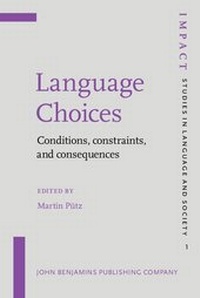
Language Choices
Conditions, constraints, and consequences
1st Edition
Published on 13. February 1997
XXI, 430 pages
978-90-272-7584-4 (ISBN)
Description

This volume is about various aspects of the theory and application of language contact and language conflict phenomena seen from an interdisciplinary perspective. The focus is on the linguistic, social, psychological, and educational issues (conditions, constraints, and consequences) involved in the status and use of languages in multilingual settings.
The book is divided into four sections dealing with the following areas: Theoretical issues: This section addresses key issues such as the nature of the concepts of language maintenance, language loyalty and language identity, language shift, language loss and language death. It includes the search for models of the often contradictory theoretical issues involved in language contact.
Language policy and language planning: This section examines the various language policies carried out by official agencies and focuses on the two basic options available to a multilingual nation: assimilation or pluralism.
Attitudes towards languages: The section is geared towards research into determinants of language attitudes, the methods for the measurements of attitudes, as well as the relationship between language policy and attitude change.
Codeswitching and language choice: The linguistic, social, psychological, and anthropological implications of using two different codes will be examined from different perspectives. Relevant research topics include: the situational uses of code-switching, linguistic and social constraints on codeswitching, and code-switching vs. borrowing. A further research paradigm deals with the search for relativized constraints, resulting from the interaction of universal principles and aspects particular to each codeswitching situation.
The book is divided into four sections dealing with the following areas: Theoretical issues: This section addresses key issues such as the nature of the concepts of language maintenance, language loyalty and language identity, language shift, language loss and language death. It includes the search for models of the often contradictory theoretical issues involved in language contact.
Language policy and language planning: This section examines the various language policies carried out by official agencies and focuses on the two basic options available to a multilingual nation: assimilation or pluralism.
Attitudes towards languages: The section is geared towards research into determinants of language attitudes, the methods for the measurements of attitudes, as well as the relationship between language policy and attitude change.
Codeswitching and language choice: The linguistic, social, psychological, and anthropological implications of using two different codes will be examined from different perspectives. Relevant research topics include: the situational uses of code-switching, linguistic and social constraints on codeswitching, and code-switching vs. borrowing. A further research paradigm deals with the search for relativized constraints, resulting from the interaction of universal principles and aspects particular to each codeswitching situation.
More details
Other editions
Additional editions
Book
02/1997
John Benjamins Publishing Co
€162.18
Shipment within 10-15 days
Person
Content
- LANGUAGE CHOICES
- Editorial page
- Title page
- Copyright page
- Table of contents
- Language choices: contact and conflict? Introduction
- Section 1: Language contact and language choice: Sociolinguistic and linguistic issues
- Section 2: Language policy and language planning
- Section 3: Language use and attitudes towards language(s)
- Section 4: Code-switching: One speaker, two languages
- References
- Section 1:Language contact and language choice: Sociolinguistic and linguistic issues
- Language ecology - contact without conflict
- 1. Introduction
- 2. What is a Language Ecology?
- 3. Contact and conflict
- 4. On the linguistic sources of conflict reduction
- 5. Implications for language planning
- 6. Conclusions
- References
- Towards a dynamic view of multilingualism
- 1. Introduction
- 2. Wholistic view of bilingualism
- 3. Linguistic and cognitive consequences of bilingualism
- 3.1. Crosslinguistic influence in bilinguals
- 3.2. Impact of bilingualism on cognitive development
- 3.2. 1. Metalinguistic awareness
- 3.2.2. Creative thinking and mental flexibility
- 3.2.3. Interactional competence and communicative sensitivity
- 4.Variability on an individual level
- 5. A dynamic approach to multilingualism
- 6. Conclusion
- Notes
- References
- A matter of choice
- Note
- References
- The choice of linguae francae in triglossic environments in Africa
- 1. Introduction
- 2. The Whinnom formula
- 3. African-based pidgins and creoles
- 4. Triglossic language-contact environments
- 5. Non-pidginized African vehiculars
- 6. Diglossia versus triglossia
- Notes
- References
- Towards an ethnography of language shift: goals and methods
- 1. Introduction
- 2. First steps towards a typology of language contact situations
- 3. Investigating language shift: some general remarks
- 4. What exactly is the ethnography of language shift?
- 5. Towards an ethnography of language shift
- 6. The interdependency between goals and methods
- 7. The ethnography of language shift applied: shifting from Siyeyi to Setswana in northwestern Botswana
- 7. 1. The setting
- 7.2. Reconstructing unstable bilingualism among the Yeyi population
- 7.3. Language choice and attitudes among different generations of Siyeyi speakers
- 7.4. Linguistic consequences of the language shift process
- 8. Conclusions
- Notes
- References
- Language shift and sentence processing in Moroccan Arabic
- 1. Introduction
- 2. Sentence processing and bilingualism
- 3. MA in the Netherlands
- 3. 1. General demographic data
- 3.2. Home Language use and proficiency
- 4. Sentence processing and language shift
- 4.1. The cue validity experiment
- 4.2. Results and discussion
- 5. Conclusions
- Note
- References
- Is airbagging hip or mega-out? A new dictionary of anglicisms
- 1. Introduction
- 2. Anglicisms and ways to describe them
- 2.1. Is airbagging hip?
- 2.2. Aliens and denizens
- 2.3. Calques
- 2.4. The classification of loanwords
- 3. Anglicisms in international contrast
- 4. Data collection for the UDASEL
- 5. The status of the individual words in the 16 languages described
- 5.1 . Guide-lines
- 5.2. Spelling and pronunciation
- 5.3. Morphology
- 5.4. Meaning
- 5.5. Dates and mediating languages
- 5.6. Purism
- 6. Anglicisms and other loanwords
- Appendix 1
- Appendix 2
- Notes
- References
- Section2: Language policy and language planning
- Lessons for Europe from language policy in Australia
- 1. Introduction
- 2. Would the real Europeans and Australians please identify themselves
- 2.1. Identity as a construction
- 2.2. Identities, Europe and European
- 2.3. Australian identities
- 3. Australian language policy
- 4. The European language policy scene
- 4.1. Working languages, the real supra-national languages
- 4.2. A three language formula
- 5. Exemplification of multilingual policy means and goals
- 6. Analogies between Europe and Australia, lessons?
- Notes
- References
- National-variety purism in the national centers of the German language
- 1. The German-speaking nations
- 2. The national centers of the German language
- 3. Some features of German, Austrian and Swiss Standard German
- 4. Asymmetries and differences in awareness
- 5. Stereotypes (Hetero-Stereotypes)
- 6. Protecting the own national variety
- References
- Toward a plurilingual urban environment: Language policy and language planning in Brussels
- Notes
- References
- Double allegiance between nationalism and Western modernization in language choice:The case of Botswana and Tanzania
- 1. Introduction
- 2. Nationalism and national language promotion
- 3. The other side of the coin
- 4. Some remarks on the two scenarios
- 5. Conclusion
- References
- An evaluative account of Ethiopia's new language policy
- 1. Introduction
- 2. Brief background information on the New Constitution
- 3. Languages in the New Constitution
- 4. The decentralization of language conflicts
- 4.1. "Homogeneous " regions
- 4.2. Language based conflicts in the Southern Region
- 4.3. "New majorities" and individual rights
- 5. Implementation strategies and policy targets of the new language policy
- 6. Final remarks
- Reference
- Looking at means and ends in language policy in Namibia
- 1. Uncritical acceptance
- 2. Namibia: A brief overview
- 3. Language policy in education in Namibia
- 4. Concerns about policy and pedagogic matters
- 5. Distant and ultimate aims
- 6. Language in education: distant and ultimate ends
- 7. Some thoughts on language and conflict
- References
- Section 3: Language use and attitudes towards language(s)
- Language assessment tools: Uses and limitations
- 0. Introduction
- 1. Word lists
- 2. Comprehension tests
- 3. Assessing bilingual proficiency
- 3.1. The Sentence Repetition Test
- 3.2. Second Language Oral Proficiency Evaluation
- 4. Comparisons
- 5. Conclusion
- Notes
- References
- An ethnographic method for studying attitudes towards child language
- 1. Introduction
- 1.1.Rationale
- 1.2. Setting
- 1.3. An ethnographic approach
- 2. Components of a language attitude study
- 2.1. Evaluative terms
- 2.2. Speech stimuli
- 2.3. Measuring scales
- 3. Piloting
- 4. Conclusions and projections
- 4.1. Indicators of instrument reliability
- 4.2. Projection of further research
- 5. Endnote
- 6. References
- Language attitudes in Switzerland: French and German along the language border
- 1. The linguistic situation in Switzerland
- 2. Language attitudes
- 2.1 Theoretical framework
- 2.2. Attitudes in Switzerland towards German and towards French
- 2.3. Hypotheses
- 3. Method
- 3.1. The matched guise technique
- 3.2. Procedure
- 3.3. Sample
- 3.4. Measures
- 4. Results of the matched guise study
- 4.1. Data
- 4.2. Discussion of the results
- 4.3. Conclusions
- Notes
- References
- Communication in the Aiemannic area: Language use and attitudes in Colmar and Freiburg
- 1. Introduction
- 2. The linguistic situation
- 3. Code choke and usage
- 3.1. Informal domain: family, classmates, friends
- 3.1.1. Baden
- 3.1.2. Alsace
- 3.2. Public domain: bars, shops, street
- 3.2.1. Baden
- 3.2.2. Alsace
- 3.3. Conclusions
- 4. Language exposure and contact
- 4.1. Face-to-face contact
- 4.2. Exposure to German language media
- 5. Perceptions and estimations
- 6. Conclusions
- Notes
- References
- Language attitude and the linguistic construction of ethnic identity:The case of Krio in Sierra Leone
- 1. Historical background
- 1.1. Foundation and development of the Sierra Leone Colony
- 1.2. The Protectorate
- 2. Self-ascription and language
- 2.1. Evidence of a language survey in Freetown and its surrounding villages
- 2.2. Language education and standardization
- 3. Concluding remarks
- References
- Section 4: Code-switching: One speaker, two languages
- Contactsand conflicts: perspectives from code-switching research
- 1. Introduction
- 2. Definition of code-switching
- 3. The role of code-switching in language change
- 3.1. Code-switching and borrowing
- 3.2. Content words
- 3.3. Discourse markers
- 3.4. Grammatical markers
- 4. Psycholinguistics of code-switching
- 4.1. Acquisition
- 4.2. Bilingual competence
- 4.3. Experimental investigation and processing models of code-switching
- 5. Conclusion
- Notes
- References
- Code-switching processes: Alternation, insertion, congruent lexicalization
- 1. Introduction
- 2. Diagnostic criteria
- Acknowledgements
- References
- I'll meet you halfway with language": Code-switching within a South African urban context
- 1. Introduction
- 1.1. Aim
- 1.2. Background
- 1.3. Languages involved
- 1.4. Generation of data
- 2. CS patterns
- 2.1. Exemplification
- 2.2. CS types
- 2.2.1. The chain of switching
- 2.2.2. English as the trigger
- 2.2.3. Conversational formulas
- 2.2.4. Repetitional CS
- 2.2.5. CS to English and Afrikaans
- 2.2.6. Linguistic tailoring
- 2.3. Maintaining the balance
- 2.4. From the speakers' perspective
- 3. Code-switching functions
- 3.1. Accommodation and its sub-functions
- 3.2. CS as a function of displaying linguistic versatility
- 3.3. Constraints on the use of CS to accommodate the addressee
- 3.4. CS to English and Afrikaans
- 4. Interpretations in terms of the Markedness Model
- 4.1. The markedness model versus other models of code-switching
- 4.2. An interpretation of the accommodation function
- 4.3. Marked choices in the light of the function of accommodation
- 4.5. Interpretation
- 5. Concluding observations
- 6. List of abbreviations
- 7. Appendix
- 8. Notes
- 9. References
- Subject Index
- List of contributors
