

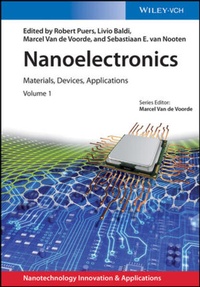
Nanoelectronics
Description

A brief introduction is followed by an overview of present and emerging logic devices, memories and power technologies. Specific chapters are dedicated to the enabling factors, such as new materials, characterization techniques, smart manufacturing and advanced circuit design. The second part of the book provides detailed coverage of the current state and showcases real future applications in a wide range of fields: safety, transport, medicine, environment, manufacturing, and social life, including an analysis of emerging trends in the internet of things and cyber-physical systems. A survey of main economic factors and trends concludes the book.
Highlighting the importance of nanoelectronics in the core fields of communication and information technology, this is essential reading for materials scientists, electronics and electrical engineers, as well as those working in the semiconductor and sensor industries.
More details
Other editions
Additional editions
Persons
Livio Baldi is currently a freelance consultant to Lfoundry S.r.l. He graduated in electronic engineering at the University of Pavia, Italy, and joined the company SGS-ATES (now STMicroelectronics) where he held various positions inside Central R&D. Later he was in charge of cooperative research projects for STMicroelectronics, within Framework Programmes and EUREKA programs for Nanoelectronics (MEDEA and CATRENE). He participated in setting-up the ETP Nanolectronics and has been active in the ENIAC and ECSEL JTIs.
Sebastiaan E. van Nooten is currently an independent consultant to the semiconductor and semi-conductor equipment industry. After his graduation from the Technical University of Delft, The Netherlands, he joined the German company Telefunken. Subsequently, he held various positions in different companies in the European semiconductor equipment industry. Since 2007 he was engaged in several European cluster programs such as CATRENE and as project coordinator for ENIAC projects, a public-private partnership in nanoelectronics.
Marcel Van de Voorde has 40 years` experience in European Research Organisations including CERN-Geneva, European Commission, with 10 years at the Max Planck Institute in Stuttgart, Germany. For many years, he was involved in research and research strategies, policy and management, especially in European research institutions. He holds a Professorship at the University of Technology in Delft, the Netherlands, as well as multiple visiting professorships in Europe and worldwide. He holds a doctor honoris causa and various honorary Professorships.
He is senator of the European Academy for Sciences and Arts, in Salzburg and Fellow of the World Academy for Sciences. He is a Fellow of various scientific societies and has been decorated by the Belgian King. He has authored of multiple scientific and technical publications and co-edited multiple books in the field of nanoscience and nanotechnology.
Content
PART I. Fundamentals on Nanoelectronics
A Brief History of the Semiconductor Industry
More-than-Moore Technologies and Applications
Logic Devices Challenges and Opportunities in the Nano Era
Memory Technologies
PART II. Devices in the Nano Era
Beyond-CMOS Low-Power Devices: Steep-Slop Switches for Computation and Sensing
RF CMOS
Smart Power Devices Nanotechnology
Integrated Sensors and Actuators: Their Nano-Enabled Evolution into the Twenty-First Century
PART III. Advanced Materials and Materials Combination
Silicon Wafers as a Foundation for Growth
Nanoanalysis
PART IV. Semiconductor Smart Manufacturing
Front-End Processes
Lithography for Nanoelectronics
Reliability of Nanoelectronic Devices
PART V. Circuit Design in Emerging Nanotechnologies
Logic Synthesis of CMOS Circuits and Beyond
System Design in the Cyber-Physical Era
Heterogeneous Systems
Nanotechnologies Testing
PART VI. Nanoelectronics-Enabled Sectors and Societal Challenges
Industrial Applications
Health
Smart Energy
Validation of Highly Automated Safe and Secure Vehicles
Nanotechnology for Consumer Electronics
PART VII. From Device to Systems
Nanoelectronics for Smart Cities
PART VIII. Industrialisation: Economics/Markets - Business Values - European Visions - Technology Renewal and Extended Functionality
Europe Positioning in Nanoelectronics
Thirty Years of Cooperative Research and Innovation in Europe: The Case for Micro- and Nanoelectronics and Smart Systems Integration
The Education Challenge in Nanoelectronics
Conclusions
Index
Foreword
Motto: The future of integrated electronics is the future of electronics itself.
G.E. Moore1
1 The Nanoelectronics Industry
The electronic components industry, generically described as "nanoelectronics," is an industry with specificities that set it apart from almost all other industries. Its perimeter is expanding continuously; it started by relying on chemists and physicists handling semiconductor crystals; then added electrical engineers to build circuits and functional blocks; now it also employs considerable numbers of software and system engineers. Its customers achieve increased economic efficiency by allowing functionality to be integrated in components; this way, they allow their vendors to expand their competence and move up the value chain.
The nanoelectronics positioning in the global economy is often depicted as the reversed pyramid shown in Figure 1. At the tip of the pyramid, there is the nanoelectronics industry producing components - popularly known as "computer chips." At the next level, "original equipment manufacturers" (OEMs) use the components to build electronic products with a market value roughly five times higher than that of the components. The electronic equipment industry enables information and communications services with a market value about five times higher than that of the equipment they use. This way, it can be estimated that nanoelectronics enable economic activities with a total value around 25 times higher than its own market value: in 2014, they approached $9000 billions, or 11% of the approximately $80,000 billions gross domestic product of the world. Their weight continues increasing year after year.
Figure 1 Nanoelectronics enabling products and services.
The electronic components are used in almost any artifact produced by the industry: they can be found everywhere, from the lock on a hotel door to the space shuttle. They are manufactured under extreme cleanliness conditions on slices of monocrystalline silicon called "wafers" in dedicated facilities called "wafer fabs." A wafer fab operates highly sophisticated equipment using specialty materials to build hundreds or thousands of structures on each wafer. A structure can contain billions of devices, essentially transistors, but also resistors, capacitors, inductors, and so on; it is so complex that it can only be conceived using "electronic design automation" (EDA) tools, in fact computer programs that assemble predefined functionalities from a library containing blocks capable to perform arithmetic and logic calculations, memory blocks to store software and data, connectivity blocks, and so on. Before delivering them to the users, the structures are diced from the wafer, put in packages foreseen with electrical contacts, tested, and marked; these operations are performed in specialized "assembly lines."
The nanoelectronics industry consists essentially of all the entities that contribute toward delivering electronic components to the OEMs: they are primarily "integrated devices manufacturers" (IDM) and their suppliers, although the IDM denomination is not exactly correct. First, not all component providers build "integrated" devices; in fact, the "discrete" components (such as individual transistors, diodes, etc.) continue being an important part of the total production, with specific components showing significant growth, such as light-emitting diodes (LEDs) used as lamps, power devices, or micro-electromechanical systems (MEMS). Second, not all component providers are also "manufacturers"; an increasing part is represented by an "emerging" value chain consisting of "fabless" companies using contract manufacturing executed by third parties called "foundries." This trend started in 1987 with the establishment of the Taiwan Semiconductor Manufacturing Company (TSMC), the first "pure play" foundry, but became highly significant in the last 5 years since two fabless companies rank among the top 10 sales leaders. Third, a number of specialties (like equipment, materials, design automation or assembly and test) split off from the IDMs forming branches of a dedicated supply chain that must be also given proper consideration. Figure 2 illustrates the segmentation of the industry in different specialties and business models.
Figure 2 The segmentation of the nanoelectronics industry.
This overview of the nanoelectronics industry takes into account all types of discrete and/or integrated electronic components suppliers, together with their dedicated supply chains.
2 The Nanoelectronics Ecosystem
The nanoelectronics industry has one of the highest innovation rates in the economy, often ranking number 1 in terms of R&D expenditures as a percentage of sales. The industry capitalizes upon ingenuity from everywhere in the world, and from any sources, including commercial companies of all sizes, academic and institutional research, and individual investigators. It succeeded sustaining over more than half a century an unparalleled flux of innovation.
The extreme precision and cleanliness necessary to achieve reasonable manufacturing yields at nanometric scale results in unusually high fixed costs of the research and manufacturing infrastructure. It is actually quite impossible to confirm the value of an innovation at low technology readiness levels (TRLs)2: positive laboratory results are no more than a hope; successful implementations in realistic environments are no more than a possibility; any novel idea must be taken all the way to an operational environment before concluding on its viability. Since the operational environments are extremely costly, typically in the multibillion dollar range, the industry uses "lab-fabs," that is, facilities used both for research and for manufacturing of commercial products that can absorb the majority of the fixed costs. This approach is practically adopted across the board.
Around each company operating lab-fabs, there is a considerable number of small- and medium-sized companies, of research institutes, and university laboratories collaborating to maintain a technology pipeline filled with new ideas that are continuously scrutinized and moved toward higher TRLs to narrow the selection to the ones that can be included in future recipes. The metaphor of the industry is an ecosystem, relying on the large sequoia trees to withstand fires and tempests in the forest, on medium-sized trees and small bushes to provide a habitat bringing creative ideas to life, and on grass root innovation from university and institutional research to maintain a soil reach in nutrients.
The industry makes effective use of project-oriented collaborative research; it is natural to find it well represented in programs carried out by alliances or consortia that naturally cross boundaries between geographic areas and between disciplines.
Also, its systemic and strategic significance attracts the attention of public entities; some of them get involved in setting directions and priorities, some other simply provide financial incentives to facilitate the progress or promote a particular location.
3 Miniaturization
The primary engine of progress in the industry is the "miniaturization." Unparalleled advances in equipment, materials, and manufacturing techniques enable a continuous reduction in size of the elementary function, the transistor. The peculiarity of the semiconductor technology consists in the fact that this improves simultaneously not only all performances parameter but also the unit costs. This trend was recognized already in 1965 (see footnote 1), being known as the "Moore's law"; it initially stated that the number of components per integrated function will double every year. Today, it is usually formulated in terms of the number of components per unit area doubling every (so many) month. In fact, the number of months is of secondary importance as long as this quasi-exponential progression continues, as it did since half a century, in spite of periodical warnings about insurmountable barriers - always overcome by the ingenuity of the researchers in the field. This is described as the "More Moore" progression.
Nanoelectronics follows since 1994 the "International Technology Roadmap for Semiconductors"3 (ITRS) generated by hundreds of specialists from all around the world. It identifies the challenges to overcome and the timing of the industrial deployment of the successive technology generation called "nodes." Each node is characterized by a "feature size" expressed in nanometers, a rather generic identifier for a whole new set of technology capabilities that obviously depend on many more parameters than just one geometric dimension. Each feature size is smaller by the square root of 2 than the previous one, so that every new node appears to cut in half the silicon real estate needed for a function, in reference to the Moore's law. Companies try to beat the ITRS schedule and be first to market with the next node; in fact, the differences in time are small, and industry moves more or less in lockstep. This quasi-synchronization induced by ITRS guarantees the demand for the equipment and materials suppliers that could therefore invest in R&D at least 5 years before a new node was...
