

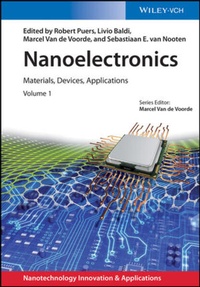
Nanoelectronics
Materials, Devices, Applications
1st Edition
Published on 11. April 2017
742 pages
978-3-527-80071-1 (ISBN)
Description

Offering first-hand insights by top scientists and industry experts at the forefront of R&D into nanoelectronics, this book neatly links the underlying technological principles with present and future applications.
A brief introduction is followed by an overview of present and emerging logic devices, memories and power technologies. Specific chapters are dedicated to the enabling factors, such as new materials, characterization techniques, smart manufacturing and advanced circuit design. The second part of the book provides detailed coverage of the current state and showcases real future applications in a wide range of fields: safety, transport, medicine, environment, manufacturing, and social life, including an analysis of emerging trends in the internet of things and cyber-physical systems. A survey of main economic factors and trends concludes the book.
Highlighting the importance of nanoelectronics in the core fields of communication and information technology, this is essential reading for materials scientists, electronics and electrical engineers, as well as those working in the semiconductor and sensor industries.
A brief introduction is followed by an overview of present and emerging logic devices, memories and power technologies. Specific chapters are dedicated to the enabling factors, such as new materials, characterization techniques, smart manufacturing and advanced circuit design. The second part of the book provides detailed coverage of the current state and showcases real future applications in a wide range of fields: safety, transport, medicine, environment, manufacturing, and social life, including an analysis of emerging trends in the internet of things and cyber-physical systems. A survey of main economic factors and trends concludes the book.
Highlighting the importance of nanoelectronics in the core fields of communication and information technology, this is essential reading for materials scientists, electronics and electrical engineers, as well as those working in the semiconductor and sensor industries.
More details
Other editions
Additional editions
Book
05/2017
1st Edition
Wiley-VCH
€319.00
Article exhausted; check different version
Software
04/2017
Wiley-VCH
€413.05
No shipping information available
Persons
Robert Puers is Professor at the Faculty of Engineering of the Catholic University Leuven, Belgium, and Chair of the Leuven Nanocenter. He is a European research pioneer in micromachining, MEMS and packaging techniques, focused on biomedical implantable systems. Robert Puers took major efforts to increase the impact of MEMS in the international research community, in education as well as in industry. To commercialize his academic research achievements, he launched three spin-off companies, ICSense, Zenso and MinDCet.
Livio Baldi is currently a freelance consultant to Lfoundry S.r.l. He graduated in electronic engineering at the University of Pavia, Italy, and joined the company SGS-ATES (now STMicroelectronics) where he held various positions inside Central R&D. Later he was in charge of cooperative research projects for STMicroelectronics, within Framework Programmes and EUREKA programs for Nanoelectronics (MEDEA and CATRENE). He participated in setting-up the ETP Nanolectronics and has been active in the ENIAC and ECSEL JTIs.
Sebastiaan E. van Nooten is currently an independent consultant to the semiconductor and semi-conductor equipment industry. After his graduation from the Technical University of Delft, The Netherlands, he joined the German company Telefunken. Subsequently, he held various positions in different companies in the European semiconductor equipment industry. Since 2007 he was engaged in several European cluster programs such as CATRENE and as project coordinator for ENIAC projects, a public-private partnership in nanoelectronics.
Marcel Van de Voorde has 40 years` experience in European Research Organisations including CERN-Geneva, European Commission, with 10 years at the Max Planck Institute in Stuttgart, Germany. For many years, he was involved in research and research strategies, policy and management, especially in European research institutions. He holds a Professorship at the University of Technology in Delft, the Netherlands, as well as multiple visiting professorships in Europe and worldwide. He holds a doctor honoris causa and various honorary Professorships.
He is senator of the European Academy for Sciences and Arts, in Salzburg and Fellow of the World Academy for Sciences. He is a Fellow of various scientific societies and has been decorated by the Belgian King. He has authored of multiple scientific and technical publications and co-edited multiple books in the field of nanoscience and nanotechnology.
Livio Baldi is currently a freelance consultant to Lfoundry S.r.l. He graduated in electronic engineering at the University of Pavia, Italy, and joined the company SGS-ATES (now STMicroelectronics) where he held various positions inside Central R&D. Later he was in charge of cooperative research projects for STMicroelectronics, within Framework Programmes and EUREKA programs for Nanoelectronics (MEDEA and CATRENE). He participated in setting-up the ETP Nanolectronics and has been active in the ENIAC and ECSEL JTIs.
Sebastiaan E. van Nooten is currently an independent consultant to the semiconductor and semi-conductor equipment industry. After his graduation from the Technical University of Delft, The Netherlands, he joined the German company Telefunken. Subsequently, he held various positions in different companies in the European semiconductor equipment industry. Since 2007 he was engaged in several European cluster programs such as CATRENE and as project coordinator for ENIAC projects, a public-private partnership in nanoelectronics.
Marcel Van de Voorde has 40 years` experience in European Research Organisations including CERN-Geneva, European Commission, with 10 years at the Max Planck Institute in Stuttgart, Germany. For many years, he was involved in research and research strategies, policy and management, especially in European research institutions. He holds a Professorship at the University of Technology in Delft, the Netherlands, as well as multiple visiting professorships in Europe and worldwide. He holds a doctor honoris causa and various honorary Professorships.
He is senator of the European Academy for Sciences and Arts, in Salzburg and Fellow of the World Academy for Sciences. He is a Fellow of various scientific societies and has been decorated by the Belgian King. He has authored of multiple scientific and technical publications and co-edited multiple books in the field of nanoscience and nanotechnology.
Content
Forewords
PART I. Fundamentals on Nanoelectronics
A Brief History of the Semiconductor Industry
More-than-Moore Technologies and Applications
Logic Devices Challenges and Opportunities in the Nano Era
Memory Technologies
PART II. Devices in the Nano Era
Beyond-CMOS Low-Power Devices: Steep-Slop Switches for Computation and Sensing
RF CMOS
Smart Power Devices Nanotechnology
Integrated Sensors and Actuators: Their Nano-Enabled Evolution into the Twenty-First Century
PART III. Advanced Materials and Materials Combination
Silicon Wafers as a Foundation for Growth
Nanoanalysis
PART IV. Semiconductor Smart Manufacturing
Front-End Processes
Lithography for Nanoelectronics
Reliability of Nanoelectronic Devices
PART V. Circuit Design in Emerging Nanotechnologies
Logic Synthesis of CMOS Circuits and Beyond
System Design in the Cyber-Physical Era
Heterogeneous Systems
Nanotechnologies Testing
PART VI. Nanoelectronics-Enabled Sectors and Societal Challenges
Industrial Applications
Health
Smart Energy
Validation of Highly Automated Safe and Secure Vehicles
Nanotechnology for Consumer Electronics
PART VII. From Device to Systems
Nanoelectronics for Smart Cities
PART VIII. Industrialisation: Economics/Markets - Business Values - European Visions - Technology Renewal and Extended Functionality
Europe Positioning in Nanoelectronics
Thirty Years of Cooperative Research and Innovation in Europe: The Case for Micro- and Nanoelectronics and Smart Systems Integration
The Education Challenge in Nanoelectronics
Conclusions
Index
PART I. Fundamentals on Nanoelectronics
A Brief History of the Semiconductor Industry
More-than-Moore Technologies and Applications
Logic Devices Challenges and Opportunities in the Nano Era
Memory Technologies
PART II. Devices in the Nano Era
Beyond-CMOS Low-Power Devices: Steep-Slop Switches for Computation and Sensing
RF CMOS
Smart Power Devices Nanotechnology
Integrated Sensors and Actuators: Their Nano-Enabled Evolution into the Twenty-First Century
PART III. Advanced Materials and Materials Combination
Silicon Wafers as a Foundation for Growth
Nanoanalysis
PART IV. Semiconductor Smart Manufacturing
Front-End Processes
Lithography for Nanoelectronics
Reliability of Nanoelectronic Devices
PART V. Circuit Design in Emerging Nanotechnologies
Logic Synthesis of CMOS Circuits and Beyond
System Design in the Cyber-Physical Era
Heterogeneous Systems
Nanotechnologies Testing
PART VI. Nanoelectronics-Enabled Sectors and Societal Challenges
Industrial Applications
Health
Smart Energy
Validation of Highly Automated Safe and Secure Vehicles
Nanotechnology for Consumer Electronics
PART VII. From Device to Systems
Nanoelectronics for Smart Cities
PART VIII. Industrialisation: Economics/Markets - Business Values - European Visions - Technology Renewal and Extended Functionality
Europe Positioning in Nanoelectronics
Thirty Years of Cooperative Research and Innovation in Europe: The Case for Micro- and Nanoelectronics and Smart Systems Integration
The Education Challenge in Nanoelectronics
Conclusions
Index
