

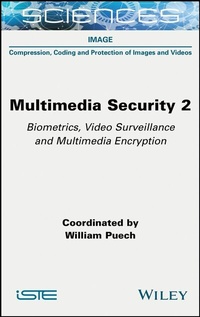
Multimedia Security 2
Description

Multimedia Security 2 analyzes issues relating to biometrics, protection, integrity and encryption of multimedia data. It also covers aspects such as crypto-compression of images and videos, homomorphic encryption, data hiding in the encrypted domain and secret sharing.
William Puech is Professor of Computer Science at Université de Montpellier, France. His research focuses on image processing and multimedia security in particular, from its theories to its applications.
More details
Other editions
Additional editions
Person
Content
Foreword by Gildas Avoine xi
Foreword by Cédric Richard xiii
Preface xv
William PUECH
Chapter 1 Biometrics and Applications 1
Christophe CHARRIER, Christophe ROSENBERGER and Amine NAIT-ALI
1.1 Introduction 1
1.2 History of biometrics 3
1.3 The foundations of biometrics 6
1.3.1 Uses of biometrics 7
1.3.2 Definitions 7
1.3.3 Biometric modalities 8
1.4 Scientific issues 10
1.4.1 Presentation attacks 10
1.4.2 Acquisition of new biometric data or hidden biometrics 12
1.4.3 Quality of biometric data 14
1.4.4 Efficient representation of biometric data 19
1.4.5 Protecting biometric data 22
1.4.6 Aging biometric data 24
1.5 Conclusion 25
1.6 References 26
Chapter 2 Protecting Documents Using Printed Anticopy Elements 31
Iuliia TKACHENKO, Alain TREMEAU and Thierry FOURNEL
2.1 Introduction 31
2.2 Document authentication approaches: an overview 33
2.3 Print test shapes 35
2.3.1 Print test signatures 36
2.3.2 Glyphs 38
2.3.3 Guilloches 39
2.4 Copy-sensitive graphical codes 41
2.4.1 Copy detection pattern 42
2.4.2 Two-level barcodes 44
2.4.3 Watermarked barcodes 47
2.4.4 Performance of CSGC authentication 48
2.5 Conclusion 52
2.6 References 52
Chapter 3 Verifying Document Integrity 59
Petra GOMEZ-KRAMER
3.1 Introduction 59
3.2 Fraudulent manipulation of document images 62
3.2.1 Imitation 62
3.2.2 Copy-and-paste of a region from the same document 62
3.2.3 Copy-and-paste of a region from another document 63
3.2.4 Deleting information 63
3.3 Degradation in printed and re-scanned documents 64
3.3.1 Degradations linked to the print process 65
3.3.2 Degradations linked to scanning 66
3.3.3 Degradation models 67
3.4 Active approaches: protection by extrinsic fingerprints 68
3.4.1 Watermarking a document 68
3.4.2 Digital signatures 73
3.5 Passive approaches: detecting intrinsic characteristics 76
3.5.1 Printer identification 77
3.5.2 Detecting graphical clues 80
3.5.3 Other approaches 81
3.6 Conclusion 82
3.7 References 82
Chapter 4 Image Crypto-Compression 91
Vincent ITIER, Pauline PUTEAUX and William PUECH
4.1 Introduction 91
4.2 Preliminary notions 93
4.2.1 The JPEG image format 93
4.2.2 Introduction to cryptography 96
4.3 Image encryption 100
4.3.1 Naive methods 102
4.3.2 Chaos-based methods 104
4.3.3 Encryption-then-compression 105
4.4 Different classes of crypto-compression for images 106
4.4.1 Substitution-based crypto-compression 108
4.4.2 Shuffle-based crypto-compression 108
4.4.3 Hybrid crypto-compression 110
4.5 Recompressing crypto-compressed JPEG images 113
4.5.1 A crypto-compression approach robust to recompression 114
4.5.2 Recompression of a crypto-compressed image 117
4.5.3 Decoding a recompressed version of a crypto-compressed JPEG image 119
4.5.4 Illustration of the method 122
4.6 Conclusion 124
4.7 References 124
Chapter 5 Crypto-Compression of Videos 129
Cyril BERGERON, Wassim HAMIDOUCHE and Olivier DEFORGES
5.1 Introduction 129
5.1.1 Background 129
5.1.2 Video compression 130
5.1.3 Video security 131
5.2 State of the art 131
5.2.1 Naive encryption 132
5.2.2 Partial encryption 133
5.2.3 Perceptual encryption 134
5.2.4 Crypto-compression methods 134
5.2.5 Selective encryption methods 135
5.3 Format-compliant selective encryption 136
5.3.1 Properties 136
5.3.2 Constant bitrate format compliant selective encryption 139
5.3.3 Standardized selective encryption 140
5.3.4 Locally applied selective encryption 143
5.3.5 Decrypting selective encryption 149
5.4 Image and video quality 150
5.4.1 Experiments on encryption solutions 151
5.4.2 Video quality: experimental results 154
5.4.3 CSE: a complete real-time solution 162
5.5 Perspectives and directions for future research 163
5.5.1 Versatile Video Coding 163
5.5.2 Immersive and omnidirectinal video 164
5.6 Conclusion 165
5.7 References 166
Chapter 6 Processing Encrypted Multimedia Data Using Homomorphic Encryption 173
Sebastien CANARD, Sergiu CARPOV, Caroline FONTAINE and Renaud SIRDEY
6.1 Context 173
6.2 Different classes of homomorphic encryption systems 176
6.2.1 Partial solutions in classic cryptography 176
6.2.2 Complete solutions in cryptography using Euclidean networks 178
6.3 From theory to practice 181
6.3.1 Algorithmics 183
6.3.2 Implementation and optimization 183
6.3.3 Managing and reducing the size of encrypted elements 189
6.3.4 Security 191
6.4 Proofs of concept and applications 193
6.4.1 Facial recognition 193
6.4.2 Classification 196
6.4.3 RLE and image compression 201
6.5 Conclusion 207
6.6 Acknowledgments 207
6.7 References 207
Chapter 7 Data Hiding in the Encrypted Domain 215
Pauline PUTEAUX and William PUECH
7.1 Introduction: processing multimedia data in the encrypted domain 215
7.1.1 Applications: visual secret sharing 216
7.1.2 Applications: searching and indexing in encrypted image databases 217
7.1.3 Applications: data hiding in the encrypted domain 218
7.2 Main aims 219
7.2.1 Digital rights management 220
7.2.2 Cloud storage 220
7.2.3 Preserving patient confidentiality 220
7.2.4 Classified data 220
7.2.5 Journalism 220
7.2.6 Video surveillance 221
7.2.7 Data analysis 221
7.3 Classes and characteristics 221
7.3.1 Properties 221
7.3.2 Classic approaches to encryption 223
7.3.3 Evaluation criteria 227
7.4 Principal methods 231
7.4.1 Image partitioning 231
7.4.2 Histogram shifting 232
7.4.3 Encoding 234
7.4.4 Prediction 235
7.4.5 Public key encryption 237
7.5 Comparison and discussion 237
7.6 A high-capacity data hiding approach based on MSB prediction 239
7.6.1 General description of the method 239
7.6.2 The CPE-HCRDH approach 243
7.6.3 The EPE-HCRDH approach 245
7.6.4 Experimental results for both approaches 249
7.7 Conclusion 253
7.8 References 253
Chapter 8 Sharing Secret Images and 3D Objects 259
Sebastien BEUGNON, Pauline PUTEAUX and William PUECH
8.1 Introduction 259
8.2 Secret sharing 261
8.2.1 Classic methods 262
8.2.2 Hierarchical aspects 264
8.3 Secret image sharing 272
8.3.1 Principle 272
8.3.2 Visual cryptography 273
8.3.3 Secret image sharing (polynomial-based) 274
8.3.4 Properties 275
8.4 3D object sharing 276
8.4.1 Principle 276
8.4.2 Methods without format preservation 276
8.4.3 Methods with format preservation 277
8.5 Applications for social media 280
8.6 Conclusion 287
8.7 References 288
List of Authors 293
Index 295
1
Biometrics and Applications
Christophe CHARRIER1, Christophe ROSENBERGER1 and Amine NAIT-ALI2
1GREYC, Normandy University, University of Caen, ENSICAEN, CNRS, France
2LISSI, University of Paris-Est Créteil Val de Marne, France
Biometrics is a technology that is now common in our daily lives. It is notably used to secure access to smartphones or computers. This chapter aims to provide readers with an overview of this technology, its history and the solutions provided by research on societal and scientific issues.
1.1. Introduction
There are three generic ways to verify or determine an individual's identity: (1) what we know (PIN, password, etc.); (2) what we have (badge, smart card, etc.); and (3) what we are (fingerprint, face, etc.) or what we know how to do (keystroke dynamics, gait, etc.). Biometrics is concerned with this last set of approaches. Biometrics, and more precisely security biometrics, consists of verifying or identifying the identity of an individual based on their morphological characteristics (such as fingerprints), behavioral characteristics (such as voice) or biological characteristics (such as DNA).
The biometric features by which an individual's identity can be verified are called biometric modalities. Examples of some biometric modalities are shown in Figure 1.1. These modalities are based on the analysis of individual data, and are generally grouped into three categories: biological, behavioral and morphological biometrics. Biological biometrics is based on the analysis of biological data related to the individual (saliva, DNA, etc.). Behavioral biometrics concerns the analysis of an individual's behavior (gait, keyboard dynamics, etc.). Morphological biometrics relates to particular physical traits that are permanent and unique to any individual (fingerprints, face, etc.).
Figure 1.1. Examples of biometric modalities used to verify or determine the identity of an individual
Nowadays, the use of facial or fingerprint recognition has come to feel natural to many people, notably among the younger generations. Biometric technology is part of our everyday lives (used for border control, smartphones, e-payment, etc.). Figure 1.2 shows the spectacular evolution and market prospects of this technology. In an increasingly digital world, biometrics can be used to verify the identity of an individual using a digital service (social network or e-commerce). While fingerprints and facial or iris recognition are among the most well-known biometric modalities (notably due to their use in television series or movies), a very wide range of biometric data can be captured from an individual's body or from digital traces. An individual can be recognized in the physical and digital worlds using information from both spheres.
The use of this technology raises a number of questions: how new is this technology? How does a biometric system work? What are the main areas of current and future research? These questions will be addressed in the three main sections of this chapter: the history of biometrics (section 1.2), the technological foundations of biometrics (section 1.3) and the scientific issues and perspectives (section 1.4).
Figure 1.2. Evolution and perspectives of the biometrics market (source: Biometric System Market, October 2019)
1.2. History of biometrics
Biometrics may be as old as humanity itself. In essence, biometrics relates to a measurement that can be performed on living things, and in a security context, it refers to the recognition of individuals by their physical and/or behavioral characteristics. This property of recognition is primarily human based, and not dependent on technology. As humans, we recognize one another through aspects such as facial features, hands or gait; the human brain has the capacity to distinguish, compare and, consequently, recognize individuals. In reality, biometrics - as we now understand it - is simply a technological replication of what the human brain can do. Key aims include speed, reproducibility, precision and memorization of information for populations of theoretically infinite size (Nait-Ali and Fournier 2012).
From the literature, we find that biometrics began to be conceptualized several centuries BC, notably in the Babylonian civilization, where clay tablets used for trading purposes have been found to contain fingerprints. Similarly, fingerprinted seals appear to have been used in ancient China and ancient Egypt. It was not until the 14th century, however, that a Persian book, entitled Jaamehol-Tawarikh, mentioned the use of fingerprints for individual identification. Other later publications concerning the fingerprint and its characteristics include the work of G. Nehemiah (1684), M. Malpighi (1686), and a book published in 1788, in which the anatomist J. Mayer highlighted the unique nature of papillary traces.
It was only during the industrial revolution, notably in the mid-19th century, that the ability to clearly identify individuals became crucial, particularly due to an intensification of population mobility as a result of the development of commercial exchanges. The first true identification procedures were established in 1858, when William Herschel (working for the Indian Civil Service at the time) first used and included palm prints, then fingerprints, in the administrative files of employees (see Figure 1.3). Later, several medical scientists, anthropologists and statisticians, including Henry Faulds, Francis Galton and Juan Vucetich, developed their own studies of fingerprints. Vucetich was even responsible for the first instance of criminal identification using this technique, which took place in Argentina in 1892 (the Francisca Rojas case).
Figure 1.3. a) William James Herschel (1833-1917), and b) example of palm and finger prints (source: public domain)
A further turning point in biometrics occurred in the 1870s when Alphonse Bertillon, a French police officer, began to implement anthropometric techniques which came to be known as the Bertillon System, or "bertillonnage". Broadly speaking, this involved taking multiple measurements of the human body, including the face and hands. By combining these measurements with a photograph of the person and other physical descriptions (see Figure 1.4), Bertillon developed files which could be used to identify criminals and delinquents, even if they were disguised or using a false identity (see Figure 1.5). The first criminal identification using this technique in France occurred in 1902: Henri Léon Scheffer was identified by matching fingerprints taken from a crime scene with the information on his anthropological documents. At this time, the Bertillon system was used to a greater or lesser extent in many countries around the world.
Some 30 years later (1936), an ophthalmologist, Frank Burch, introduced the concept of identifying individuals by iris characteristics, although Burch did not develop this idea into an identification system. Biometrics as we now understand it began to take shape in the 1960s, drawing on technological advances in electronics, computing and data processing. The first semi-automatic facial recognition system was developed by the American Woodrow W. Bledsoe (Bledsoe and Chan 1965). The system consists of manually taking the coordinates of the characteristic points of the face from a photograph. These coordinates are then stored in a database and processed by computer by calculating distances with respect to reference points. In the same year, the first model of the acoustic speech signal was proposed by Gunnar Fan, in Sweden, laying the foundations for speech recognition. The first automatic biometric systems began to appear in the 1970s. Notable examples include a system for recognizing individuals by hand shape (1974), a system for extracting minutiae from fingerprints (FBI, 1975), a facial recognition system (Texas Instruments, 1976), a patent for a system for extracting signature characteristics for individual verification (1977), a patent for an individual verification system using 3D features of the hand (David Sidlauskas, 1985), a patent for the concept of recognizing individuals by the vascular network features at the back of the eye (Joseph Rice, 1995) and a patent for the concept of identifying individuals by characteristics of the iris (Leonard Flom and Aran Safir, 1986); the algorithm for this final system was later patented by John Daugman in 1994.
Figure 1.4. Plate taken from the Identification Anthropométrique journal (1893). a) Criminal types. b) Anthropometric file
Figure 1.5. Example of an anthropometric file using the Bertillon system (source: public domain)
The 1980s-1990s also saw an upsurge in activity with respect to facial recognition, notably with the application of principal component analysis (PCA) techniques by Kirby and Sirovich in 1988 (Kirby and Sirovich 1990), then the introduction of Eigenfaces by Turk and Pentland (1991). Turk and Pentland's paper was well received by the biometrics community, and has been cited over 18,500 times at the time of writing (2020). The authors demonstrated facial recognition using a limited number of parameters (compared to the number of pixels in a digital image), permitting the use of real-time...
