

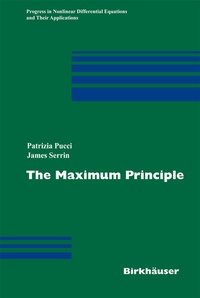
The Maximum Principle
1st Edition
Published on 23. December 2007
X, 236 pages
978-3-7643-8145-5 (ISBN)
Description

Maximum principles are bedrock results in the theory of second order elliptic equations. This principle, simple enough in essence, lends itself to a quite remarkable number of subtle uses when combined appropriately with other notions. Intended for a wide audience, the book provides a clear and comprehensive explanation of the various maximum principles available in elliptic theory, from their beginning for linear equations to recent work on nonlinear and singular equations.
Reviews / Votes
Aus den Rezensionen: "Das Maximumprinzip ist das stärkste Hilfsmittel, um Eindeutigkeit und stetige Abhängigkeit der Lösungen skalarer elliptischer und parabolischer Differentialgleichungen 2. Ordnung zu beweisen. ... In der Tat geht das Buch von Pucci-Serrin das Thema von Neuem an: Schwache Lösungen und Sobolewräume werden verwendet . Ohne Übertreibung kann das Buch als Juwel in der Reihe 'Progress in Nonlinear Differential Equations and Their Applications' bezeichnet werden ..." (N.Ortner, in: IMN Internationale Mathematische Nachrichten, April/2010, Issue 213, S. 55)More details
Other editions
Additional editions
Patrizia Pucci | J. B. Serrin
The Maximum Principle
Book
09/2007
1st Edition
Birkhäuser
€128.39
Shipment within 7-9 days
Content
and Preliminaries.- Tangency and Comparison Theorems for Elliptic Inequalities.- Maximum Principles for Divergence Structure Elliptic Differential Inequalities.- Boundary Value Problems for Nonlinear Ordinary Differential Equations.- The Strong Maximum Principle and the Compact Support Principle.- Non-homogeneous Divergence Structure Inequalities.- The Harnack Inequality.- Applications.
Chapter 1 Introduction and Preliminaries (p. 1-2)
1.1 Introduction
The maximum principles of Eberhard Hopf are classical and bedrock results of the theory of second order elliptic partial differential equations. They go back to the maximum principle for harmonic functions, already known to Gauss in 1839 on the basis of the mean value theorem. On the other hand, they carry forward to the maximum principles of Gilbarg, Trudinger and Serrin, and the maximum principles for singular quasilinear elliptic differential inequalities, a theory initiated particularly by V´azquez and Diaz in the 1980s, but with earlier intimations in the work of Benilan, Brezis and Crandall. The purpose of the present work is to provide a clear explanation of the various maximum principles available for second-order elliptic equations, from their beginnings in linear theory to recent work on nonlinear equations, operators and inequalities. While simple in essence, these results lend themselves to a quite remarkable number of subtle uses when combined appropriately with other notions.
The first chapter concerns tangency and comparison theorems, based to begin with on the pioneering results of Eberhard Hopf. Section 2.1 includes in particular a discussion of Hopf's nonlinear contributions, which are in fact not nearly as well known as his classical linear principle. We continue with a treatment of quasilinear equations and inequalities, with linear equations of course being an important special case. We consider both non-singular and singular cases, that is, in the latter case, equations which lose ellipticity at special values of the gradient of solutions, particularly at critical points. The concern here with singular equations arises from their growing importance in variational theory and applied mathematics, as well as their from specific theoretical interest, e.g., the celebrated p-Laplace operator .p.
The results of Hopf apply specifically to C2 solutions of elliptic differential inequalities. In many cases, however, especially when the equations and inequalities in question are expressed in divergence form, as in the calculus of variations, one can expect solutions to be no more than of class C1 or even only weakly differentiable in some Sobolev space. The solutions then must naturally be taken in a distribution sense. Correspondingly, in such cases, the study of maximum principles requires new techniques as alternatives to Hopf's approach. These methods, necessarily integral in nature, originally arose from the work of a number of mathematicians, going back as far as Tonelli, Leray and Morrey in the years 1928-1935. Sections 2.4 and 2.5 are devoted specifically to C1 solutions of divergence structure inequalities, allowing both singular and non-singular operators. Theorem 2.4.1 and its attendant corollaries are of special interest for their simplicity and elegance, see also the corresponding uniqueness result for the singular Dirichlet problem (2.6.2). We note also the Tangency Theorem 2.5.2 obtained from the weak Harnack inequality (Section 7.1). Chapter 3 continues the study of divergence structure inequalities, but for more general operators for which the methods of Chapter 2 are inadequate.
1.1 Introduction
The maximum principles of Eberhard Hopf are classical and bedrock results of the theory of second order elliptic partial differential equations. They go back to the maximum principle for harmonic functions, already known to Gauss in 1839 on the basis of the mean value theorem. On the other hand, they carry forward to the maximum principles of Gilbarg, Trudinger and Serrin, and the maximum principles for singular quasilinear elliptic differential inequalities, a theory initiated particularly by V´azquez and Diaz in the 1980s, but with earlier intimations in the work of Benilan, Brezis and Crandall. The purpose of the present work is to provide a clear explanation of the various maximum principles available for second-order elliptic equations, from their beginnings in linear theory to recent work on nonlinear equations, operators and inequalities. While simple in essence, these results lend themselves to a quite remarkable number of subtle uses when combined appropriately with other notions.
The first chapter concerns tangency and comparison theorems, based to begin with on the pioneering results of Eberhard Hopf. Section 2.1 includes in particular a discussion of Hopf's nonlinear contributions, which are in fact not nearly as well known as his classical linear principle. We continue with a treatment of quasilinear equations and inequalities, with linear equations of course being an important special case. We consider both non-singular and singular cases, that is, in the latter case, equations which lose ellipticity at special values of the gradient of solutions, particularly at critical points. The concern here with singular equations arises from their growing importance in variational theory and applied mathematics, as well as their from specific theoretical interest, e.g., the celebrated p-Laplace operator .p.
The results of Hopf apply specifically to C2 solutions of elliptic differential inequalities. In many cases, however, especially when the equations and inequalities in question are expressed in divergence form, as in the calculus of variations, one can expect solutions to be no more than of class C1 or even only weakly differentiable in some Sobolev space. The solutions then must naturally be taken in a distribution sense. Correspondingly, in such cases, the study of maximum principles requires new techniques as alternatives to Hopf's approach. These methods, necessarily integral in nature, originally arose from the work of a number of mathematicians, going back as far as Tonelli, Leray and Morrey in the years 1928-1935. Sections 2.4 and 2.5 are devoted specifically to C1 solutions of divergence structure inequalities, allowing both singular and non-singular operators. Theorem 2.4.1 and its attendant corollaries are of special interest for their simplicity and elegance, see also the corresponding uniqueness result for the singular Dirichlet problem (2.6.2). We note also the Tangency Theorem 2.5.2 obtained from the weak Harnack inequality (Section 7.1). Chapter 3 continues the study of divergence structure inequalities, but for more general operators for which the methods of Chapter 2 are inadequate.
