

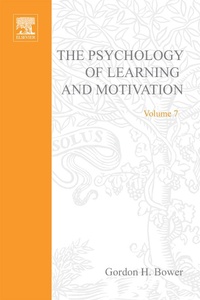
Psychology of Learning and Motivation
Academic Press
Published on 14. December 1973
369 pages
978-0-08-086358-0 (ISBN)
Description

Psychology of Learning and Motivation
More details
Other editions
Additional editions

Book
09/1973
Academic Press
€68.09
Article exhausted; check different version
Person
Content
- Front Cover
- The Psychology of Learning and Motivation: Advances in Research and Theory
- Copyright Page
- Contents
- List of Contributors
- Contents of Previous Volumes
- Chapter 1. Grammatical Word Classes: A Learning process and Its Simulataion
- I. Introduction
- II. Description of the Model
- III. Empirical Background and Relation to Other Theories
- IV. Computer Simulation
- V. Experimental Results
- VI. Summary
- References
- Chapter 2. Reaction Time Measurements in the Study of Memory process: Theory and Data
- I. Introduction
- II. Self-Terminating Memory Scanning Model
- III. Experimental Tests of the Model
- IV. Summary and Conclusions
- References
- Chapter 3. Individual Differences in Cognition: A New Approach to Intelligence
- I. Introduction
- II. The Distributed Memory Model of Mental Functioning
- III. Research Plan
- IV. General Experiments
- V. Experiments on Details
- VI. Discussion
- VII. Conclusion
- References
- Chapter 4. Stimulus Encoding processes in Human Learning and Memory
- I. Introduction
- II. Verbal Processes in Stimulus Pretraining
- III. Stimulus Encoding and Response Variables
- IV. Interdependence of Recall and Recognition
- V. Stimulus Encoding and Stimulus Variables
- VI. Encoding and the Transfer of Stimulus Differentiation
- VII. Summary and Conclusions
- References
- Chapter 5. Subproblem Analysis of Discrimination Learning
- I. Introduction
- II. Subproblem Analysis of Animal Discrimination Learning
- III. Subproblem Analysis of Children's Discrimination Learning
- IV. Concluding Comment
- References
- Chapter 6. Delayed Matching and ShorT-Term Memory in monkeys
- I. Introduction: Delayed Matching-to-Sample and Short-Term Memory
- II. Nonspecific Sources of Interference in Delayed Matching-to-Sample
- III. Role of Sample Duration in Delayed Matching-to-Sample
- IV. Retrieval Cues and Short-Term Memory in Monkeys
- V. The Development of Short-Term Retention in Monkeys
- VI . Concluding Remarks
- References
- Chapter 7. Percentile Reinforcement: Paradigms for Experimental Analysis of Response Shaping
- I. Introduction
- II. Response Shaping as an Attempt to Control Relationships between Behavior and Reinforcement Criteria
- III. Nontemporal Concepts of Relationships between Behavior and Reinforcement Criteria
- IV. Implementation Details and Refinements
- V. Temporal Concepts of Relationships between Behavior and Reinforcement Criteria
- VI. Other Applications of Percentile-Type Schedules
- References
- Chapter 8. Prolonged Rewarding Brain Stimulation
- I. Historical Introduction
- II. Aversiveness or Adaptation
- III. Further Experiments to Test Adaptation Theory
- IV. Discussion
- References
- Chapter 9. Patterned Reinforcerment
- I. Introduction
- II. Patterns of Reinforcement
- III. Subordinate Patterns of Reinforcement
- IV. Superordinate Patterns of Reinforcement
- V. Some Speculations about Certain Stimulus Functions in Patterned Reinforcement
- VI. Conclusions
- VII. Addendum
- References
- Author Index
- Subject Index
