

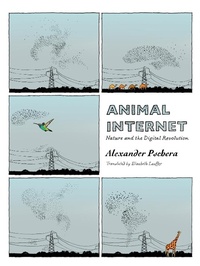
Animal Internet
Description

"An original book that goes against the trend to stubbornly keep nature and technology divided from one another."—Der Spiegel
"Animal Internet is one of the most interesting books that I've read in recent years."—Bavarian Radio
"What Pschera describes sounds futuristic but it's already widespread reality . . . Pschera's book is not just popular science: he describes not only the status quo, but also thinks about an ongoing transformation."—Wired.de
Some fifty thousand creatures around the globe—including whales, leopards, flamingoes, bats, and snails—are being equipped with digital tracking devices. The data gathered and studied by major scientific institutes about their behavior will warn us about tsunamis, earthquakes and volcanic eruptions, but also radically transform our relationship to the natural world. With a broad cultural and historical perspective, this book examines human ties with animals, from domestic pets to the soaring popularity of bird watching and kitten images on the web. Will millennia of exploration soon be reduced to experiencing wilderness via smartphone? Contrary to pessimistic fears, author Alexander Pschera sees the Internet as creating a historic opportunity for a new dialogue between man and nature.
Foreword by Martin Wikelski, Director, Max Planck Institute for Ornithology
Alexander Pschera, born in 1964, has published several books on the internet and media. He studied German, music, and philosophy at Heidelberg University. He lives near Munich where he writes for the German magazine Cicero as well as for German radio.
More details
Other editions
Additional editions
Persons
Elisabeth Lauffer is the recipient of the 2014 Gutekunst Translation Prize. After graduating from Wesleyan University she lived in Berlin and then obtained a master's in education from Harvard. She now lives in Vermont, where she is the Admissions Coordinator and German Language Director at the Middlebury-Monterey Language Academy.
Content
- Table of Contents
- Foreword
Martin Wikelski, Director, Max Planck Institute for Ornithology
- Introduction: Why Today's Little Red Riding Hood Has a Smartphone in Her Basket
An Old Story in a New Light
- Why We Are Now Nothing More Than Beautiful Souls
In the Labyrinth of a Postmodern Awareness of Nature
- Why We Know Whether a Swallow is Frightened in a Storm
What Really Happens on the Animal Internet
- Why We Should Care If a Frog Wanders Around in China
The New Generation of Working Animals
- Why Alexander von Humboldt Hasn't Logged Off Yet...
The People Behind the Animal Internet
- ... and Why "Problem Bear" Bruno Might Still Be Alive Today
On New Forms of Coexistence
- Why Technology is Not All Bad, and Nature Not All Good
Data Protection for Animals and the Positive Sides of Transparency
- Why Animals Were Always Friends of Humans
A Little Story of Empathy
- Why the Internet is Crawling with Cats
The Internet as a Shared Space of Being
- Why After Nature, Nature Will Still Exist
Humans and Animals in the Anthropocene
- Acknowledgements
- Notes
- Bibliography
