

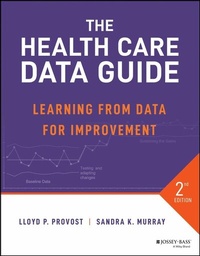
The Health Care Data Guide
Description

Now in its second edition, The Health Care Data Guide: Learning from Data for Improvement delivers a practical blueprint for using available data to improve healthcare outcomes. In the book, a team of distinguished authors explores how health care practitioners, researchers, and other professionals can confidently plan and implement health care enhancements and changes, all while ensuring those changes actually constitute an improvement.
This book is the perfect companion resource to The Improvement Guide: A Practical Approach to Enhancing Organizational Peformance, Second Edition, and offers fulsome discussions of how to use data to test, adapt, implement, and scale positive organizational change.
The Health Care Data Guide: Learning from Data for Improvement, Second Edition provides:
* Easy to use strategies for learning more readily from existing health care data
* Clear guidance on the most useful graph for different types of data used in health care
* A step-by-step method for making use of highly aggregated data for improvement
* Examples of using patient-level data in care
* Multiple methods for making use of patient and other feedback data
* A vastly better way to view data for executive leadership
* Solutions for working with rare events data, seasonality and other pesky issues
* Use of improvement methods with epidemic data
* Improvement case studies using data for learning
A must read resource for those committed to improving health care including allied health professionals in all aspects of health care, physicians, managers, health care leaders, and researchers.
More details
Other editions
Additional editions
Persons
LLOYD P. PROVOST is a cofounder of Associates in Process Improvement, the developers of the Model for Improvement roadmap and the Quality as a Business Strategy template for focusing organizations on improvement. Lloyd is a senior fellow at the Institute for Healthcare Improvement, where he supports the use of data for learning in programs.
SANDRA K. MURRAY is a principal in Corporate Transformation Concepts, an independent consulting firm. She is faculty for the Institute for Healthcare Improvement's year-long Improvement Advisor Professional Development Program and their Breakthrough Series College. Sandra has taught numerous programs through the National Association for Healthcare Quality. Her cohort of client organizations encompasses the spectrum of health care delivery.
Content
Figures, Tables, and Exhibits xiii
Preface xxix
Acknowledgments xxxiii
The Authors xxxv
About the Companion Website xxxvii
Part I Using Data for Improvement 1
Chapter 1 Improvement Methodology 3
Fundamental Questions for Improvement 4
What Are We Trying to Accomplish? 5
How Will We Know that a Change is an Improvement? 7
What Changes Can We Make That Will Result in Improvement? 8
The PDSA Cycle for Improvement 9
Tools and Methods to Support the Model for Improvement 13
Designing PDSA Cycles for Testing Changes 15
Analysis of Data from PDSA Cycles 19
Summary26 Key Terms 26
Chapter 2 Using Data for Improvement 27
What Does the Concept of Data Mean? 27
How are Data Used? 29
Types of Data 36
Using A Family of Measures 43
The Importance of Operational Definitions 47
Data for Different Types of Studies 51
Sampling53 Sampling Strategies 55
What About Sample Size? 58
Stratification of Data 61
What about Case-Mix Adjustment? 63
Transforming Data 65
Analysis and Presentation of Data 68
Summary75 Key Terms 75
Chapter 3 Understanding Variation Using Run Charts 77
Introduction77 What Is a Run Chart? 77
Use of a Run Chart 80
Constructing a Run Chart 80
Examples of Run Charts for Improvement Projects 84
Rules to Aid in Interpreting Run Charts 89
Special Issues in Using Run Charts 97
Stratification with Run Charts 113
Using the Cumulative Sum Statistic with Run Charts 116
Summary120 Key Terms 121
Chapter 4 Learning from Variation in Data 123
The Concept of Variation 123
Introduction to Shewhart Charts 129
Depicting and Interpreting Variation Using Shewhart Charts 135
The Role of Annotation with Shewhart Charts 140
Establishing Limits for Shewhart Charts 141
Revising Limits for Shewhart Charts 145
Stratification with Shewhart Charts 147
Shewhart Charts and Targets, Goals, or Other Specifications 152
Special Cause: Is It Good or Bad? 155
Summary157 Key Terms 158
Chapter 5 Understanding Variation Using Shewhart Charts 159
Selecting the Type of Shewhart Chart 160
Shewhart Charts for Continuous Data 163
I Charts 164
Examples of Shewhart Charts for Individual Measurements 166
Rational Ordering with an I Chart 168
Example of I Chart for Deviations from a Target 170
Xbar S Shewhart Charts 171
Shewhart Charts for Attribute Data 177
Subgroup Size for Attribute Charts 178
The P Chart for Classification Data 180
Examples of P Charts 182
Creation of Funnel Limits for a P Chart 186
Shewhart Charts for Counts of Nonconformities 188
c charts 190
U Chart 192
Creation of Funnel Limits for a U Chart 195
Alternatives for Attribute Charts for Rare Events 197
G Chart for Opportunities Between Rare Events 198
T Chart for Time Between Rare Events 202
Process Capability 206
Process Capability from an I Chart 208
Capability of a Process from Xbar and S Charts 208
Capability of a Process from Attribute Control Charts 210
Capability from a P Chart 210
Capability from a C or U Chart 210
Summary211 Key Terms 212
Appendix 5.1 Calculating Shewhart Limits 213
I Chart (For Individual Values Of Continuous Data) 213
Xbar S Chart (For Continuous Data In Subgroups) 214
P Chart (For Classification Data) 217
c chart (count Of Incidences) 218
U Chart (Incidences Per Area Of Opportunity) 219
G Chart (Cases Between Incidences) 220
T Chart 221
Chapter 6 Additional Tools For Understanding Variation In Data 223
Depicting Variation 223
Additional Tools for Learning from Variation 225
Frequency Plots 225
Frequency Plot Construction 226
Frequency Plots Used with Shewhart Charts 228
Frequency Plots and Stratification 232
Pareto Charts 236
Pareto Chart Construction 238
Pareto Charts Used with Shewhart Charts 239
Pareto Chart and Stratification 244
Scatterplots250 Scatterplot Construction 251
Scatterplots Used with Shewhart Charts 254
Scatterplots and Stratification 258
Radar Charts 260
Constructing a Radar Chart 261
Radar Charts Used with Shewhart Charts 261
Radar Charts and Stratification 263
Summary265 Key Terms 265
Chapter 7 Shewhart Chart Savvy: Dealing with Common Issues 267
Creating Effective Shewhart Charts 267
Tip 1: Type of Data and Subgroup Size 267
Tip 2: Rounding Data 268
Tip 3: Formatting Charts 268
Tip 4. Decisions for Recalculating limits, or Rephasing, on a Shewhart Chart 274
Extending Centerline and Limits Backward 277
Typical Problems with Software for Calculating Shewhart Charts 279
Characteristics to Consider When Purchasing SPC Software 282
Another Caution with I Charts and Chart Selection 285
Guidelines for Shewhart Charts in Research Studies and Publications 287
Use of Shewhart Charts in Research Studies 288
Shewhart Charts in Publications 290
Shewhart's Theory versus Statistical Inference 292
Summary296 Key Terms 296
Part II Advanced Theory and Methods with Data For Improvement 297
Chapter 8 More Shewhart-Type Charts 299
Other Shewhart-Type Charts 301
The NP Chart 301
Xbar Range (Xbar R) Chart 302
Median Chart 304
Attribute Charts with Large Subgroup Sizes (P' and U') 306
Prime Charts (P' and U') 307
Negative Binomial Chart 313
Some Adaptations to Shewhart Charts 316
MA Chart 317
CUSUM Chart 320
Exponentially Weighted Moving Average (EWMA) Chart 328
Standardized Shewhart Charts 331
Multivariate Shewhart-Type Charts 334
Summary338 Key Terms 339
Chapter 9 Special Uses for Shewhart Charts 341
Shewhart Charts with a Changing Centerline 341
Shewhart Charts with a Sloping Centerline 342
Shewhart Charts with Seasonal Effects 344
Adjusting Shewhart Charts for Confounders 349
Transformation of Data with Shewhart Charts 355
Shewhart Charts for Autocorrelated Data 361
Risk-Adjusted or Case-Mix Adjusted Shewhart Charts 366
Comparison Charts 368
Confidence Intervals and Confidence Limits 369
Summary373 Key Terms 373
Chapter 10 Drilling Down Into Aggregate Data for Improvement Ii 375
What are Aggregate Data? 375
What is the Challenge Presented by Aggregate Data? 376
Introduction to the Drill Down Pathway 381
Stratification 381
Sequencing 382 Rational Subgrouping 383
An Illustration of the Drill Down Pathway: Adverse Drug Events384 Drill Down Pathway Step One 385
Drill Down Pathway Step Two 385
Drill Down Pathway Step Three 387
Drill Down Pathway Step Three, Continued 389
Drill Down Pathway Step Four 393
Drill Down Pathway Step Five 397
Drill Down Pathway Step Six 400
Summary400 Key Terms 401
Part III Applications of Shewhart Charts in Health Care 403
Chapter 11 Learning from Individual Patient Data 405
Examples of Shewhart Charts for Individual Patients 407
Example 1: Asthma Patient Use of Shewhart Charts 408
Example 2: Prostate-Specific Antigen (PSA) Screening for Prostate Cancer 409
Example 3: Monitoring Patient Measures in the Hospital 411
Example 4: Bone Density for a Patient Diagnosed with Osteoporosis 412
Example 5: Temperature Readings for a Hospitalized Patient 415
Example 6: Shewhart Charts for Continuous Monitoring of Patients 418
Example 7: Monitoring Weight 420
Example 8: Monitoring Blood Sugar Control for Patients with Diabetes 421
Example 9: Using Shewhart Charts in Pain Management 422
Summary423
Chapter 12 Learning from Patient Feedback to Improve Care 425
Summarizing Patient Feedback Data 429
Presentation of Patient Satisfaction Data 437
Using Patient Feedback for Improvement 438
The PDSA Cycle for Testing and Implementing Changes 438
Improvement Team Working on Clinic Satisfaction 438
Improvement Team Working on Pain 442
Feedback from Employees 444
Using Patient Satisfaction Data in Planning for Improvement 445
Special Issues with Patient Feedback Data 447
Are There Challenges When Summarizing and Using Patient Satisfaction Survey Data? 447
Does Survey Scale Matter? 449
Summary450 Key Terms 450
Chapter 13 Using Shewhart Charts in Health Care Leadership 451
A Health Care Organization's Vector of Measures 452
Developing a VOM 453
So How do We Best Display a VOM? 461
Administrative Issues with a VOM 464
Some Examples of Measures for Other VOMs 467
Emergency Department 468
Primary Care Center 468
System Flow Measures 469
Health Authority 469
Large Urban Hospital 471
IHI Whole System Measures 471
Summary473 Key Terms 474
Chapter 14 Shewhart Charts for Epidemic Data 475
Shewhart Charts in Epidemiology 476
Development of Shewhart Charts for Epidemic Data 479
c charts (Epoch 1) 479
Charts of Epoch 2 481
Charts for Epoch 3 485
Charts for Epoch 4 486
Some Issues with the Hybrid Chart for COVID-19 Deaths 487
Data Quality 487
Day-of-the-Week Adjustment 487
Application of the Hybrid Charts to Cases, Hospitalizations, and Intensive Care Unit Admissions 489
Summary492 Key Term 492
Chapter 15 Case Studies 493
Case Study A: Improving Access to a Specialty Care Clinic 495
Case Study B: Radiology Improvement Projects 504
Case Study C: Reducing Post-Cabg Infections 514
Case Study D: Drilling Down into Percentage of C-Sections 526
Case Study E: Reducing Length of Stay After Surgery 537
Case Study F: Reducing Hospital admissions 551
Case Study G: Accidental Puncture/Laceration Rate 558
Case Study H: Improving Telemedicine Failed Calls and No Shows 568
Case Study I: Variation in Financial Data 583
Index 595
Shewhart Chart Selection Guide 609
FIGURES, TABLES, AND EXHIBITS
FIGURES
FIGURE 1.1 Model for Improvement
FIGURE 1.3 Sequential PDSA Cycles for Learning and Improvement
FIGURE 1.4 PDSA Cycles from Testing to Implementation
FIGURE 1.5 Results of a Before-and-After Test: Case
FIGURE 1.6 Other Possible Run Charts Associated with Before-and-After Graph
FIGURE 1.7 Analysis of Data from a PDSA Cycle
FIGURE 1.8 Run Charts of Key Measures for Diabetes Improvement Project
FIGURE 2.2 Measurement for Judgment versus Improvement
FIGURE 2.3 Moving from Judgment to Improvement Measures
FIGURE 2.4 Using Percentile Rankings
FIGURE 2.5 Measure Based on an Index Instead of Actual Units
FIGURE 2.6 Simple Scales for Turning Personal Experience into Data
FIGURE 2.7 Percentage of DRG Exceeding LOS Guidelines Indicating Improvement
FIGURE 2.8 Percentage of Unplanned Readmissions Worsening
FIGURE 2.9 Multiple Measures on a Single Graph
FIGURE 2.10 Surgical Safety FOM
FIGURE 2.11 Image Reflective of an Enumerative Study
FIGURE 2.12 Image Reflective of an Analytic Study
FIGURE 2.13 Large Sample Compared to Small Sample
FIGURE 2.14 Sample Size and Ability to Detect Change
FIGURE 2.15 Stratification Involves Separation and Classification
FIGURE 2.16 Shewhart Chart of Post-CABG Complication Rate Without Stratification
FIGURE 2.17 Post-CABG Complication Rate Stratified by Protocol
FIGURE 2.18 Little Difference Between Risk-Adjusted and Non-Risk-Adjusted Data
FIGURE 2.19 Large Differences Between Risk-Adjusted and Non-Risk-Adjusted Data
FIGURE 2.20 Run Chart of Number of Falls
FIGURE 2.21 Run Chart of Rate of Falls
FIGURE 2.22 Graphs of Fall Rate and Number of Falls
FIGURE 2.23 Patient Waiting Time
FIGURE 2.24 Tools to Learn from Variation in Data
FIGURE 2.25 Scatter Plots for Data in Table 2.18
FIGURE 3.1 Historical Example of a Run Chart
FIGURE 3.3 Run Chart Leading to Questions
FIGURE 3.4 Run Chart with Labels and Median
FIGURE 3.5 Run Chart with Goal Line and Tests of Change Annotated
FIGURE 3.6 Stat Lab Run Chart with No Evidence of Improvement
FIGURE 3.7 Improvement Evident Using a Set of Run Charts Viewed on One Page
FIGURE 3.8 Run Charts Used as Small Multiples
FIGURE 3.9 Run Chart Displaying Multiple Measures
FIGURE 3.10 Run Chart Displaying a Different Measure for Each Axis
FIGURE 3.11 Run Chart Displaying Multiple Statistics for the Same Measure
FIGURE 3.12 Run Chart with Little Data
FIGURE 3.13 Run Chart with Clinic Team Uncertain About Improvement
FIGURE 3.14 Four Rules for Identifying Nonrandom Signals of Change
FIGURE 3.15 Run Chart Evaluating Number of Runs
FIGURE 3.16 Measure with Too Few Runs
FIGURE 3.17 Run Chart with Too Many Runs
FIGURE 3.18 Run Charts of Clinic Cycle Time
FIGURE 3.19 Average Time to Administer Antibiotics
FIGURE 3.20 Three Key Uses of Run Charts in Improvement Initiatives
FIGURE 3.21 Beginning a Run Chart as Soon as the First Data Are Available
FIGURE 3.22 Run Charts for Waiting Time Data
FIGURE 3.23 Delay Detecting Signal with Proper Median Technique
FIGURE 3.24 Detecting Signal with Proper Median Technique
FIGURE 3.25 Detecting Signal of Improvement with Two Medians
FIGURE 3.26 Two Cases When Median Ineffective on Run Chart
FIGURE 3.27 Run Chart of Incidents Resulting in Too Many Zeros
FIGURE 3.28 Run Chart of Cases between an Incident
FIGURE 3.29 Starting and Updating Chart of Cases between Undesirable Rare Events
FIGURE 3.30 Mature Run Charts Tracking Cases Between Rare Events
FIGURE 3.31 Use of Data Line on Run Chart
FIGURE 3.32 Data from Unequal Time Intervals Displayed in Usual Run Chart
FIGURE 3.33 Data From Unequal Time Intervals Displayed to Reveal Impact of Time
FIGURE 3.34 Run Chart from Figure 3.22 With Seventh Week Added
FIGURE 3.35 Run Chart with Inappropriate Use of Trend Line
FIGURE 3.36 Run Chart of Autocorrelated Data from a Patient Registry
FIGURE 3.37 Run Chart with Percentage Doubled in Most Recent Month
FIGURE 3.38 Shewhart Control Chart (P Chart) Adjusting Limits Based on Denominator Size
FIGURE 3.39 Infant Mortality Data Stratified Using a Run Chart
FIGURE 3.40 Harm Data Stratified Using a Run Chart
FIGURE 3.42 Run Chart and CUSUM Run Chart of Patient Satisfaction Data
FIGURE 4.1 Using Shewhart Charts to Give Direction to an Improvement Effort
FIGURE 4.2 Example of Shewhart Chart with Equal Subgroup Size
FIGURE 4.3 Example of Shewhart Chart with Unequal Subgroup Size
FIGURE 4.4 Rules for Detecting a Special Cause
FIGURE 4.5 Detecting "Losing the Gains" For an Improved Process
FIGURE 4.6 Depicting Variation Using a Run Chart versus a Shewhart Chart
FIGURE 4.7 Shewhart Charts Common Cause and Special Cause Systems
FIGURE 4.8 Shewhart Chart Revealing Process or System Improvement
FIGURE 4.9 Shewhart Chart Using Rational Subgrouping
FIGURE 4.10 Shewhart Chart Using Stratification
FIGURE 4.11 Shewhart Charts Depicting a Process or System "Holding the Gain"
FIGURE 4.12 Run Charts and Shewhart Charts for Waiting Time Data
FIGURE 4.13 Improper and Proper Extension of Baseline Limits on Shewhart Chart
FIGURE 4.14 Dealing with Special Cause Data in Baseline Limits
FIGURE 4.15 Recalculating Limits After Special Cause Improvement
FIGURE 4.16 Recalculating Limits after Exhausting Efforts to Remove Special Cause
FIGURE 4.17 Stratification of Laboratory Data with a Shewhart Chart
FIGURE 4.18 Disaggregation of ADEs Data
FIGURE 4.19 ADE Rate Rationally Subgrouped in Different Ways
FIGURE 4.20 Shewhart Chart Meeting Goal but Unstable
FIGURE 4.21 Shewhart Chart Stable but Not Meeting Goal
FIGURE 4.22 Special Cause in Desirable Direction
FIGURE 4.23 Shewhart Chart with Special Cause in Undesirable Direction
FIGURE 4.24 Shewhart Chart for LOS
FIGURE 4.25 Percentage of Patients with an Unplanned Readmission
FIGURE 5.1 Shewhart Chart Selection Guide
FIGURE 5.2 I Chart for Volume of Infectious Waste
FIGURE 5.3 I Chart Extended and Updated with New Limits
FIGURE 5.4 Rational Ordering for an I Chart for Intake Process
FIGURE 5.5 I Chart for Budget Variances
FIGURE 5.6 Xbar S Chart for Radiology Test Turnaround Time
FIGURE 5.7 Xbar S Chart for LOS
FIGURE 5.8 Xbar S Chart for LOS by Provider
FIGURE 5.9 Xbar and S Chart Subgrouped by Provider and Quarter
FIGURE 5.10 Xbar S Chart Showing Improvement in Deviation from Start Times
FIGURE 5.11 P Chart for Percentage of Patients Harmed
FIGURE 5.12 Extended P Chart for Percentage of Patients Harmed
FIGURE 5.13 P Chart Showing Second Phase After Improvement
FIGURE 5.14 P Chart for Percentage of Unplanned Readmissions
FIGURE 5.15 P Chart for Percentage of MRSA for Hospital System
FIGURE 5.16 Funnel Plot of P Chart for Percentage of MRSA for Hospital System
FIGURE 5.17 P Chart with Funnel Limits for Systemwide Medication Compliance
FIGURE 5.18 C Chart for Employee Needlesticks
FIGURE 5.19 C Chart for Issues by Surgeon
FIGURE 5.20 U Chart for Flash Sterilization
FIGURE 5.21 U Charts Showing the Effect of Choosing the Standard Area of Opportunity
FIGURE 5.22 U Chart for Complaints by Clinic with Funnel Limits
FIGURE 5.23 Comparison of G Chart to U Chart
FIGURE 5.25 T Chart for Number of Days between ADEs
FIGURE 5.26 Different Formats for Displaying a T Chart
FIGURE 5.27 T Chart for Retained Foreign Objects
FIGURE 5.28 Process Capability: Typical Situations and Actions
FIGURE 5.29 Capability From an I Chart
FIGURE 5.30 Capability Analysis from an Xbar S Chart
FIGURE 6.1 Tools to Learn from Variation in Data
FIGURE 6.2 Histogram, Dot Plot, and Stem-and-Leaf Plot for Age at Fall
FIGURE 6.3 Frequency Plot (Dot Plot) of Patient Satisfaction Data
FIGURE 6.4 Age of Children with Head Injury
FIGURE 6.5 Shewhart Chart of Average Minutes to Initiate Antibiotics for Sepsis Patients
FIGURE 6.6 Histogram of Minutes to Antibiotic Start for Patients with Sepsis
FIGURE 6.7 Stable Shewhart Chart of Patient Fall Rate
