

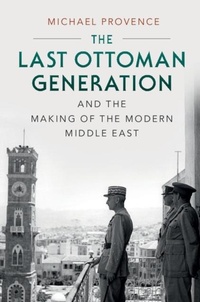
The Last Ottoman Generation and the Making of the Modern Middle East
Published on 26. July 2017
978-1-108-21546-6 (ISBN)
Description

The modern Middle East emerged out of the collapse of the Ottoman Empire, when Britain and France partitioned the Ottoman Arab lands into several new colonial states. The following period was a charged and transformative time of unrest. Insurgent leaders, trained in Ottoman military tactics and with everything to lose from the fall of the Empire, challenged the mandatory powers in a number of armed revolts. This is a study of this crucial period in Middle Eastern history, tracing the period through popular political movements and the experience of colonial rule. In doing so, Provence emphasises the continuity between the late Ottoman and Colonial era, explaining how national identities emerged, and how the seeds were sown for many of the conflicts which have defined the Middle East in the late twentieth and early twenty-first centuries. This is a valuable read for students of Middle Eastern history and politics.
Reviews / Votes
'A brilliant new history that captures the Ottoman foundations of the modern Middle East in the decades between the First and Second World Wars. The hopes and disappointments of the interwar years shaped the Arab world down to the present day. Engagingly written, Michael Provence brings this era to life for readers today.' Eugene Rogan, University of Oxford 'This is a wonderfully original book, a merciless reconstruction of the British and French mandates in the Middle East as local contemporaries would have experienced them.' Peter Sluglett, National University of Singapore 'This remarkable work examines how the peoples of the Middle East perceived their present and future before the cataclysm of World War I, famine and death, Ottoman collapse and foreign occupation completely reshaped their region. Instead of looking at the main features that we think of when we look back on the twentieth century in the Middle East, The Last Ottoman Generation and the Making of the Modern Middle East rather starts with the hopes and expectations of an elite in what became the separate Arab states and Turkey that in many respects shared a common background, expectations and outlook. This is an original and illuminating interpretation of events in a region that is still deeply affected by the transformations that Michael Provence illustrates so perceptively.' Rashid Khalidi, Edward Said Professor of Modern Arab Studies, Columbia University 'Michael Provence's book is a revelation. Casting aside the old pieties of state nationalism, Provence sets the story of the Arab Middle East in the first half of the twentieth century squarely in the context of the late-Ottoman scene, bringing to life the world of soldiers, politicians and intellectuals struggling to cope with the loss of the Ottoman system, which they believed was a fairer dispensation than the colonial nation states imposed on the Middle East in the wake of World War I. Deeply researched and written in clear, compelling prose, this book is essential reading for anyone who wants a deeper understanding of the history of the modern Middle East.' Laila Parsons, McGill University, Canada '[This book] is a definitive study of this crucial period in Middle Eastern history, tracing the period through popular political movements and the experience of colonial rule. In doing so, Provence emphasizes the continuity between the late Ottoman and Colonial era, explaining how national identities emerged, and how the seeds were sown for many of the conflicts which have defined the Middle East in the late twentieth and early twenty-first centuries. An invaluable read for students of Middle Eastern history and politics ...' James A Cox, Library Bookwatchs 'The insightful study taps into most of the scholarship exploring this crucial period and primary archival sources found in France, Turkey, and Britain. Provence makes the case for thinking of the interaction between indigenous and foreign forces as crucial to understanding the current state of affairs in the region. In this respect, students of the Middle East will gain from consulting a book that is the best of its genre. As such, it is critical reading for upper-level undergraduates and graduate students. Essential.' I. Blumi, Choice '... a stimulating semi-revisionist history focusing on continuities rather than ruptures ... The book excavates remarkable details from the years of flux after the collapse of the Ottoman state.' The Hurriyet Daily NewsMore details
Language
English
Place of publication
Cambridge
United Kingdom
Target group
Professional and scholarly
Illustrations
Worked examples or Exercises; 4 Maps; 15 Halftones, black and white
File size
3,17 MB
ISBN-13
978-1-108-21546-6 (9781108215466)
Copyright in bibliographic data and cover images is held by Nielsen Book Services Limited or by the publishers or by their respective licensors: all rights reserved.
Schweitzer Classification
Other editions
Additional editions
Michael Provence
The Last Ottoman Generation and the Making of the Modern Middle East
Book
08/2017
Cambridge University Press
€131.60
Shipment within 15-20 days
Michael Provence
The Last Ottoman Generation and the Making of the Modern Middle East
Book
08/2017
Cambridge University Press
€38.00
Shipment within 15-20 days
Person
Michael Provence teaches Middle East history at the Department of History, University of California, San Diego. He is the author of The Great Syrian Revolt and the Rise of Arab Nationalism (2005).
Content
1. Introduction; 2. Ottoman modernity in the long nineteenth century: training state servants and making citizens; 3. The theory and practice of colonialism in the post-Ottoman Middle East; 4. Losing the war and fighting the settlement: the post-Ottoman Middle East takes shape, 1918-22; 5. League of Nations hopes and disappointments: the return of armed struggle in the post-Ottoman era, 1923-7; 6. Colonial constitutions and treaties: post-Ottoman militarism, 1927-36; 7. The final days of the last Ottoman generation, 1936-8; 8. Epilogue and conclusion.
