

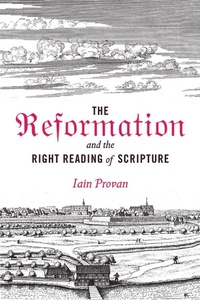
The Reformation and the Right Reading of Scripture
Description

In 1517, Luther nailed his Ninety-Five Theses to the door of Wittenberg's castle church. Luther's seemingly inconsequential act ultimately launched the Reformation, a movement that forever transformed both the Church and Western culture. The repositioning of the Bible as beginning, middle, and end of Christian faith was crucial to the Reformation. Two words alone captured this emphasis on the Bible's divine inspiration, its abiding authority, and its clarity, efficacy, and sufficiency: sola scriptura. In the five centuries since the Reformation, the confidence Luther and the Reformers placed in the Bible has slowly eroded. Enlightened modernity came to treat the Bible like any other text, subjecting it to a near endless array of historical-critical methods derived from the sciences and philosophy. The result is that in many quarters of Protestantism today the Bible as word has ceased to be the Word. In The Reformation and the Right Reading of Scripture, Iain Provan aims to restore a Reformation-like confidence in the Bible by recovering a Reformation-like reading strategy. To accomplish these aims Provan first acknowledges the value in the Church's precritical appropriation of the Bible and, then, in a chastened use of modern and postmodern critical methods. But Provan resolutely returns to the Reformers' affirmation of the centrality of the literal sense of the text, in the Bible's original languages, for a right-minded biblical interpretation. In the end the volume shows that it is possible to arrive at an approach to biblical interpretation for the twenty-first century that does not simply replicate the Protestant hermeneutics of the sixteenth, but stands in fundamental continuity with them. Such lavish attention to, and importance placed upon, a seriously literal interpretation of Scripture is appropriate to the Christian confession of the word as Word--the one God's Word for the one world.
More details
Other editions
Additional editions
Person
Iain Provan is Emeritus Professor of Biblical Studies, Regent College.
Content
1. Introduction: O Little Town of... WittenbergPart I. Before There Were Protestants: Long-Standing Questions2. Scripture and Canon in the Early Church: On Chickens and Their Eggs3. The Formation of the Christian Canon: The Pressure of the Twenty-Two4. On the Meaning of Words: The Literal, the Spiritual, and the Plain Confusing5. The Reading of Scripture in the New Testament: All That the Prophets Have Spoken6. Literal Reading, Typology, and Allegory in Paul: A Rose by Any Other Name7. Justin, Irenaeus, and Tertullian: False Economies and Hidden Treasure8. Origen, Theodore, and Augustine: The Fertility of Scripture9. How Shall We Then Read?: The Church Fathers, the Reformers, and Ourselves10. The Septuagint as Christian Scripture: It's All Greek to Me11. The Vulgate, the Renaissance, and the Reformation: When in Rome...Part II. Now There Are Protestants: Scripture in a Changing World12. The Perspicuity of Scripture Alone: A Lamp unto My Feet13. The Authority of Scripture: Thy Word Is Truth14. The Bible, the Heavens, and the Earth: The Beginnings of an Eclipse15. The Emergence of Secular History: The Way We (Really) Were16. On Engaging with a Changing World: Fight, Flight, and the Fifth WayPart III. Still Protesting: Scripture in the (Post)Modern World17. Source and Form Criticism: Behind the Text18. Redaction and Rhetorical Criticism: The Persuasive Text19. Structuralism and Poststructuralism: Texts and Subtexts20. Narrative Criticism: Getting the Story Straight21. Social-Scientific and Feminist Criticism Texts as Social Constructs22. The Canonical Reading of Scripture: The End of Criticism23. PostscriptAppendix: Modern Developments in Our Understanding of the Biblical Text
