

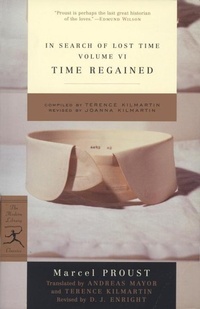
In Search of Lost Time, Volume VI
Time Regained (A Modern Library E-Book)
Published on 1. November 2000
768 pages
978-0-679-64183-4 (ISBN)
Description

'Proust is perhaps the last great historian of the loves, the society, the intelligence, the diplomacy, the literature and the art of the Heartbreak House of capitalist culture.' ------------EDMUND WILSON
The final volume of In Search of Lost Time chronicles the years of World War I, when, as M. de Charlus reflects on a moonlit walk, Paris threatens to become another Pompeii. Years later, after the war's end, Proust's narrator returns to Paris, where Mme. Verdurin has become the Princesse de Guermantes. He reflects on time, reality, jealousy, artistic creation, and the raw material for literature--his past life.
The final volume of a new, definitive text of A la recherche du temps perdu was published by the Bibliotheque de la Pleiade in 1989. For this authoritative English-language edition, D. J. Enright has revised the late Terence Kilmartin's acclaimed reworking of C. K. Scott Moncrieff's translation to take into account the new French editions.
NOTE: This edition does not include the Synopsis of "Time Regained" or the Guide to Proust.
The final volume of In Search of Lost Time chronicles the years of World War I, when, as M. de Charlus reflects on a moonlit walk, Paris threatens to become another Pompeii. Years later, after the war's end, Proust's narrator returns to Paris, where Mme. Verdurin has become the Princesse de Guermantes. He reflects on time, reality, jealousy, artistic creation, and the raw material for literature--his past life.
The final volume of a new, definitive text of A la recherche du temps perdu was published by the Bibliotheque de la Pleiade in 1989. For this authoritative English-language edition, D. J. Enright has revised the late Terence Kilmartin's acclaimed reworking of C. K. Scott Moncrieff's translation to take into account the new French editions.
NOTE: This edition does not include the Synopsis of "Time Regained" or the Guide to Proust.
More details
Other editions
Additional editions
Book
02/1999
Random House Inc
€21.00
Shipment within 10-20 days
Marcel Proust
In Search of Lost Time: Time Regained v. 6
Book
05/1993
Random House Inc
€47.22
Article exhausted; check different version
Person
Marcel Proust was born in the Parisian suburb of Auteuil on July 10, 1871. His father, Adrien Proust, was a doctor celebrated for his work in epidemiology; his mother, Jeanne Weil, was a stockbroker's daughter of Jewish descent. He lived as a child in the family home on Boulevard Malesherbes in Paris, but spent vacations with his aunt and uncle in the town of Illiers near Chartres, where the Prousts had lived for generations and which became the model for the Combray of his great novel. (In recent years it was officially renamed Illiers-Combray.) Sickly from birth, Marcel was subject from the age of nine to violent attacks of asthma, and although he did a year of military service as a young man and studied law and political science, his invalidism disqualified him from an active professional life.
During the 1890s Proust contributed sketches to Le Figaro and to a short-lived magazine, Le Banquet, founded by some of his school friends in 1892. Pleasures and Days, a collection of his stories, essays, and poems, was published in 1896. In his youth Proust led an active social life, penetrating the highest circles of wealth and aristocracy. Artistically and intellectually, his influences included the aesthetic criticism of John Ruskin, the philosophy of Henri Bergson, the music of Wagner, and the fiction of Anatole France (on whom he modeled his character Bergotte). An affair begun in 1894 with the composer and pianist Reynaldo Hahn marked the beginning of Proust's often anguished acknowledgment of his homosexuality. Following the publication of Emile Zola's letter in defense of Colonel Dreyfus in 1898, Proust became 'the first Dreyfusard,' as he later phrased it. By the time Dreyfus was finally vindicated of charges of treason, Proust's social circles had been torn apart by the anti-Semitism and political hatreds stirred up by the affair.
Proust was very attached to his mother, and after her death in 1905 he spent some time in a sanitorium. His health worsened progressively, and he withdrew almost completely from society and devoted himself to writing. Proust's early work had done nothing to establish his reputation as a major writer. In an unfinished novel, Jean Santeuil (not published until 1952), he laid some of the groundwork for In Search of Lost Time, and in Against Sainte-Beuve, written in 1908-09, he stated as his aesthetic credo: 'A book is the product of a different self from the one we manifest in our habits, in society, in our vices. If we mean to try to understand this self it is only in our inmost depths, by endeavoring to reconstruct it there, that the quest can be achieved.' He appears to have begun work on his long masterpiece sometime around 1908, and the first volume, Swann's Way, was published in 1913. In 1919 the second volume, Within a Budding Grove, won the Goncourt Prize, bringing Proust great and instantaneous fame. Two subsequent sections--The Guermantes Way (1920-21) and Sodom and Gomorrah (1921)--appeared in his lifetime. (Of the depiction of homosexuality in the latter, his friend André Gide complained: 'Will you never portray this form of Eros for us in the aspect of youth and beauty?') The remaining volumes were published following Proust's death on November 18, 1922: The Captive in 1923, The Fugitive in 1925, and Time Regained in 1927.
During the 1890s Proust contributed sketches to Le Figaro and to a short-lived magazine, Le Banquet, founded by some of his school friends in 1892. Pleasures and Days, a collection of his stories, essays, and poems, was published in 1896. In his youth Proust led an active social life, penetrating the highest circles of wealth and aristocracy. Artistically and intellectually, his influences included the aesthetic criticism of John Ruskin, the philosophy of Henri Bergson, the music of Wagner, and the fiction of Anatole France (on whom he modeled his character Bergotte). An affair begun in 1894 with the composer and pianist Reynaldo Hahn marked the beginning of Proust's often anguished acknowledgment of his homosexuality. Following the publication of Emile Zola's letter in defense of Colonel Dreyfus in 1898, Proust became 'the first Dreyfusard,' as he later phrased it. By the time Dreyfus was finally vindicated of charges of treason, Proust's social circles had been torn apart by the anti-Semitism and political hatreds stirred up by the affair.
Proust was very attached to his mother, and after her death in 1905 he spent some time in a sanitorium. His health worsened progressively, and he withdrew almost completely from society and devoted himself to writing. Proust's early work had done nothing to establish his reputation as a major writer. In an unfinished novel, Jean Santeuil (not published until 1952), he laid some of the groundwork for In Search of Lost Time, and in Against Sainte-Beuve, written in 1908-09, he stated as his aesthetic credo: 'A book is the product of a different self from the one we manifest in our habits, in society, in our vices. If we mean to try to understand this self it is only in our inmost depths, by endeavoring to reconstruct it there, that the quest can be achieved.' He appears to have begun work on his long masterpiece sometime around 1908, and the first volume, Swann's Way, was published in 1913. In 1919 the second volume, Within a Budding Grove, won the Goncourt Prize, bringing Proust great and instantaneous fame. Two subsequent sections--The Guermantes Way (1920-21) and Sodom and Gomorrah (1921)--appeared in his lifetime. (Of the depiction of homosexuality in the latter, his friend André Gide complained: 'Will you never portray this form of Eros for us in the aspect of youth and beauty?') The remaining volumes were published following Proust's death on November 18, 1922: The Captive in 1923, The Fugitive in 1925, and Time Regained in 1927.
