

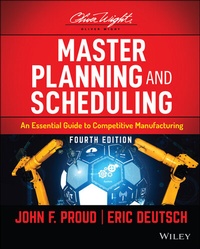
Master Planning and Scheduling
Description

The newly revised Fourth Edition of Master Planning and Scheduling: An Essential Guide to Competitive Manufacturing delivers a masterful exploration of today's master planning and scheduling techniques, as well as an insightful discussion of the future of the master planning and scheduling processes and profession.
Written in the context of an ever-evolving digital environment and augmented with new and critical information required to implement best practices, the book is a guide for practitioners and leaders on the principles of master planning and scheduling and its application in modern and future work environments.
In this book, readers will learn:
* Insights regarding top-down, bottom-up, and side-to-side integration of business practices in support of a company's strategic direction and tactical deployment
* The critical link between time-phased integrated business planning, master planning, master scheduling, capacity planning, and material planning
* "How-to" details and examples to support master planning and scheduling implementation and enhancements within the company's demand and supply organizations
Master Planning and Scheduling is an indispensable guide for supply chain professionals, planners and schedulers in all functional domains of a business. It also belongs on the bookshelves of any executive or manager who seeks to improve their understanding of best practice planning and scheduling processes and how those processes enable a business to outperform the competition through alignment, integration and synchronization across all functions in an organization.
More details
Other editions
Additional editions
Persons
JOHN F. PROUD is a business advisor with Oliver Wight. Throughout his career, Mr. Proud has enjoyed collaborating with several large companies, from Lockheed Martin and Boeing to Weyerhaeuser and Starbucks. He has educated and consulted throughout the USA as well as around the free world. Numerous companies under his leadership and coaching have implemented supply chain management including master planning and scheduling best practice principles for more than 50 years. Mr. Proud was a recipient of Who's Who Albert Nelson Marquis Lifetime Achievement Award in 2021 and will be listed in Who's Who in America in 2022.
ERIC DEUTSCH is a business advisor with Oliver Wight, working with companies to implement and improve their integrated business planning processes. He has an academic background and career experience in the biotech industry and, since starting his consulting practice, has worked across many industries to coach and advise clients through transformational change. In addition to advising clients, he is a member of the Oliver Wight Board of Directors, and teaches the Oliver Wight Master Planning and Scheduling Course offered publicly several times per year.
Content
Acknowledgments xxiii
Foreword xxix
Introduction xxxi
Initial Thoughts xxxix
1 Chaos in Manufacturing 1
Problems in Manufacturing 2
And the Solutions 7
Getting Out of the Overloaded Master Plan and/or Master Schedule 16
Rescheduling the Overloaded Master Plan and/or Master Schedule 19
2 Why Master Planning and Scheduling 25
The Four Cornerstones of a Manufacturing Business 25
Between Strategy and Execution 27
What Is a Master Plan versus a Master Schedule? 31
Maximizing, Minimizing, and Optimizing 32
Objectives of Master Planning and Scheduling (If You Don't Know Where You're Going, Any Road Will Get You There) 33
Challenges for the Master Planner and Master Scheduler 35
Principles of Master Planning and Scheduling 37
MPS, MRPII, ERP, SCM, and ITP 39
Finding the Diamond in the Rough-Why It's Important 58
The Four Cornerstones of Manufacturing Revisited 67
Four Levels of Planning (Sometimes Use Only Three) 68
Why Master Planning and Scheduling Is a Must in Business Excellence 74
3 The Mechanics of Master Planning and Scheduling 79
The Importance of Master Planning and Scheduling 79
The Master Planning and Scheduling Matrices 80
Master Scheduling in Action 87
Why and How Master Scheduling Drives Material Requirements Planning and Detailed Scheduling 92
The What, Why, and How of Safety Stock 99
Additional Material Planning Techniques 103
Maintaining Demand/Supply Balance Inside the Planning Time Fence 107
Master Plan and Schedule Design Criteria 113
So, What's Next? 115
4 Managing the Supply Chain with Master Planning and Scheduling 117
The Master Planner's and Master Scheduler's Job 119
Exception-Driven Action Messages 125
Six (Sometimes Seven) Key Questions to Answer 129
Answering the Six (or Seven) Questions 133
Time Zones as Aids to Decision Making 134
Planning Within Master Planning and Scheduling Policy 138
No Past Dues 141
Managing with Planning Time Fences 142
Load-Leveling in Manufacturing 147
Lean Manufacturing and Continuous Improvement 150
Mixed-Model Scheduling 151
Planned Plant Shutdowns 154
5 Using the MPS Output for Make-to-Stock Products 159
The Master Schedule Screens 160
Working Make-to-Stock Master Scheduled Items 168
Time Phasing the Bills-of-Material 170
Understanding Exception-Driven Action Messages 172
Bridging Data and Judgment 180
The Seven Key Questions Revisited 184
Scheduling in a World of Many Schedules 185
From Master Planning and Scheduling to Time-Phased Material Requirements Planning 194
From Master Planning to Master Scheduling (It's Called Master Planning and Scheduling) 199
6 Where and What to Master Plan and Master Schedule 203
Manufacturing Strategies Defined 204
Choosing the Right Manufacturing Strategy 206
Master Planning, Master Scheduling, and Product Structures 210
Multilevel Master Planning and Scheduling 213
Ensuring That Supply Plans and Schedules Are Aligned, Synchronized, and Integrated 216
Master Scheduling Capacities, Activities, and Events 224
7 Scheduling in a Flow Environment 227
Different Manufacturing Environments 228
Similarities Between Intermittent and Flow Environments 232
Product Definition 236
The Planning Process 239
Process Company Using Rough Cut Capacity Planning: An Extended Example 244
Catalysts and Recovered Material 250
Production Line Scheduling 251
Planning Multiplant Workloads 252
8 Planning Bills 255
The Overly Complex Bill-of-Material 257
Anatomy of a Planning Bill 266
Creating Demand at the Master Planning and Scheduling Level 271
9 Two-Level MPS Coupled with Other Advanced Techniques 277
The Backlog Curve 277
Identifying Demand 281
Creating the Master Plan and/or Master Schedule for Products Using a Make-to-Order Manufacturing Strategy 288
Option Overplanning 292
Calculating Projected Available Balance for Pseudo Items 294
Calculating Available-to-Promise 295
Using Available-to-Promise to Commit Customer Orders 297
Changes in Projected Available Balance 303
Option Overplanning for Products in the Make-to-Stock Environment 305
Master Planning and Scheduling Products in Make-to-Stock and Make-to-Order Environments: A Comparison 309
10 Using MPS Output for Make-to-Order Products 313
Using Planning Bills to Simplify Option Scheduling 315
The Scheduling Process 317
Master Scheduling Common Components 321
Analyzing the Detail Data 325
Balancing the Sold-Out Zone for Common Components 326
Handling Abnormal Demand 328
Action Messages 330
Working the Pseudo Options 330
Master Scheduling Purchased Items in the Planning Bill 341
Linking the Master Plan to the Master Schedule to the Material Plan 346
Manufacturing Strategies-Products in the Make-to-Order Environment 350
11 Master Planning and Scheduling in Custom-Product Environments 355
The Unique Challenges of the DTO and ETO Environments 356
The Case of New Product Introduction 358
Master Planning and Scheduling-Activities and Events 363
Prices and Promises to Keep 367
What Can Go Wrong 368
Integrating Design and Operation Activities 370
Plan Down, Replan Up 373
Make-to-Contract Environments 381
The Need for Standards-A Long Time Ago 382
When Supply Can't Satisfy Demand 386
12 Finishing or Final Assembly Scheduling 389
Manufacturing Strategy Tied to Finishing/Final Assembly Schedules 389
Manufacturing Strategy Approaches 391
Traditional Means of Communicating the Master Plan and/or Master Schedule 395
The Role of People and Computers in Finishing and Final Assembly Scheduling-Past, Present, and Future 397
The Kanban System 399
Tying It All Together (Aggregate Integrated Business Planning Through Master Planning and Scheduling Through Detailed Production Scheduling) 403
Final Assembly or Process Routings 406
Configuring and Building to a Customer Order 408
Finishing or Final Assembly Combined Materials and Operations List 411
Choosing the Most Effective Approach 413
Master Plans versus Master Schedules versus Finishing Schedules 414
Master Scheduling Logistics (Sharing In/Out Information) 415
13 Data Integrity Requirements to Support Master Planning and Scheduling 417
What Is Data Integrity and Why Is It Important? 418
Gaining Control and Integration Points 422
The Four Pillars of Data Integrity 425
Applying the Four Pillars of Data Integrity in Support of Master Planning and Scheduling 438
Summary 452
14 Integrated Business Planning 455
Integrated Business Planning Process Elements in Brief 457
Workable, Adjustable Plans 466
Master Supply Planning 468
Integrated Business Planning and the Master Supply Schedule 470
Synchronizing and Assessing Demand and Supply 481
Measuring Accuracy and Performance 487
The Evolution of Integrated Business Planning 495
15 Resource Requirements Planning and Rough Cut Capacity Planning 499
Know Before You Go 500
Rough Cut Revealed 502
The Rough Cut Process 502
Creating the Resource Profile 505
Finalizing the Resource Profile 512
Capacity Inputs 514
Overloading Demonstrated and/or Planned Capacity 520
Rough Cut Capacity Planning at the Master Planning and Master Scheduling Levels 522
Resource Requirements and Rough Cut Capacity Planning Graphs 529
Using and Working the Rough Cut Capacity Plan 533
Simulations-Rough Cut Capacity Planning 538
Screen and Report Formats 540
Rough Cut Capacity Planning at a Process Company (Industry Example) 543
The Benefits and Limitations of Rough Cut Capacity Planning 551
Implementing the Rough Cut Capacity Planning Process 554
Closing Comments Regarding Resource Requirements Planning and Rough Cut Capacity Planning 555
16 Supply Management and Aggregate Master Planning 559
Supply Management and Master Planning in Action 565
The Impact of New Product in Supply Management and Master Planning 567
Inventory Projection and Planning 572
Will the Plan Work? 575
Product-Driven, Disaggregated Inventory Planning 577
Product-Driven, Aggregated Backlog Planning 579
Product-Driven, Disaggregated Backlog Planning 585
Production-Driven Environments 589
Reviewing and Approving the Aggregate Supply Plan 591
Interplant Product Integration 592
Key Performance Metrics-Calculations, Colors, Standards 597
Should Companies Have Supply Managers and/or Master Planners? 598
17 Demand Management and Aggregate Master Planning 603
What Is Demand Management? 603
The Impact of New Product in Demand Management 608
Master Launch Plan and Pipeline Funnel Examples for New Products 609
Problems with the Demand Forecast 614
The Impact of Demand Bias on Supply Chain Management 615
Coping with Forecast Inaccuracies 617
Reviewing and Approving the Aggregate Demand Plan 619
It's About Quantities 621
It's About Time 623
Demand and Forecast Adjustment 631
Customer Order Processing with Process Flow Diagram Example 637
Possible Problems Caused by Abnormal Demand 640
Customer Linking 642
Getting Sales Pipeline Control 645
Distribution Resource/Requirements Planning 646
Available-to-Promise 655
ATP with Two Demand Streams 659
Should Companies Have Demand Managers? 663
18 The Proven Path to a Successful MPS Implementation (Phase 1) 669
From the Original Implementation Plan to the Current Proven Path 669
The Proven Path to Successful Operational Excellence 671
The Decision Point 673
Going on the Air 675
The Former Proven Path to Master Planning and Scheduling in a Class A Operational Excellence Environment 676
The Journey to Excellence-Today and Tomorrow 679
Oliver Wight's Class A Integrated Planning and Control Milestone 681
The Proven Path (3rd Version) to Successful Supply Chain Management and Master Planning and Scheduling Implementation 683
Phase 1: Lead Phase (Understanding and Committing) 685
Company Vision of Operations (A Modified Client Example) 687
Case for Change (A Modified Excerpt from a Client Example) 696
Segue to . . . 702
The Proven Path to a Successful MPS Implementation (Phase 2) Influencers Transform MPS Process Design and Structure 702
19 The Proven Path to a Successful MPS Implementation (Phase 2) 705
Methodology for Implementing Change Revisited 705
Phase 2: Transform Phase (Process Designing and Structuring) 707
Policy, Flow Diagrams, Procedures, Work Instructions, and Metrics Defined 731
Segue to . . . 741
The Proven Path to a Successful MPS Implementation (Phase 3) Users Own MPS Launch and Measures 741
20 The Proven Path to a Successful MPS Implementation (Phase 3) 743
Methodology for Implementing Change Revisited-Again! 743
Phase 3: Own Phase (Launching and Measuring) 745
Deterrents to Successful Implementation of the Master Planning and Scheduling Process and Supporting System Technology 762
The Master Planner's and Master Scheduler's List of Responsibilities 764
Putting It All Together to Ensure Success-Guaranteed 768
An Aggressive Master Plan and Schedule for the MPS Implementation 771
The Variables of a Master Planning and Scheduling Implementation 774
Epilogue
Order from Chaos 779
Final Thoughts - People and Process and Profession 783
Appendix A Master Planning and Scheduling Process and Performance Standards 809
Appendix B Master Planning and Scheduling Improvement Initiative Task Listing 817
Appendix C Master Planning and Scheduling Policy, Procedure, and Flow Diagram 827
Appendix D Master Planning and Scheduling 831
Appendix E Supply Chain Management Overall Process Flow Diagram (An Example) 843
Appendix F Master Planning and Scheduling Process Flow Diagram Examples 845
Appendix G Master Planning and Scheduling RACI Examples 851
Appendix H Master Planning and Scheduling Spinoff Task Team Charter 855
Appendix I Master Planning and Scheduling Oliver Wight International Offerings Founders' and Co-Authors' Biographies 859
Glossary 865
Index 895
Acknowledgments
You're never too old to set another goal or to dream a new dream!
We are jointly grateful to a number of people who have shaped as well as enhanced our professional careers through education, coaching, and idea sharing. Many of these people are current and past members of Oliver Wight International, of which we have been members for 33 years (John) and 10 years (Eric). One person in particular, George Palmatier, has had more influence in our combined careers than the many others.
George Palmatier, former Oliver Wight associate, was not only a great thought leader but a great simplifier, a quality that Oliver Wight (the man) held with high esteem. George was the man who could stand up in a room full of passionate (and opinionated) Oliver Wight principals, engage in a heated debate on one topic or another, and speak simple truths and principles that would cut right to the heart of the matter. Simply put, when George stood up, we listened. He brought the same gravitas and unique perspective to his clients. We have had the pleasure in our careers, both as clients of Oliver Wight while in industry and as Oliver Wight principals, to listen to and absorb George's wisdom. We will be forever grateful for his influence, guidance, and friendship.
Additionally, we would like to thank our book reviewers, who spent many hours working their way through parts of this book (the entire book might have been too much for each reviewer in the time allotted in our master plan and schedule!). Those book reviewers are David Goddard, Oliver Wight Americas (OWA); Paul McGuire, OWA; Kris Morgan, Curation Foods, Inc.; Pam Lindsey, OWA; and Ben Sellers, OWA. The book's original reviewers should not be forgotten. Those reviewers were Darryl Landvater, OWA and the late Mike Bales, Dick Pugliese, John Sari, and Larry Wilson.
John F. Proud's Personal Acknowledgments
I continue to find myself in a place surrounded by people who care about doing things right and doing the right things. My career has covered 50-plus years from being a naval officer to a co-author of this master planning and scheduling book. Without the navy in my background, I'm not sure what type of person I might have turned out to be. Without Oliver Wight in my past and present, I again don't have any idea where I might have wound up. However, I do know one thing: this book and its preceding three editions might never have been written, or, if they were, I would not be one of the co-authors.
Besides the people already mentioned in my present and past acknowledgments, I want to highlight what a pleasure it was to work with Walt Goddard, Tom Gillen, Al Stevens, Dick Ling, Roger Brooks, Jim Correll, Jerry Clement, Marv Jensen, Bill Pendleton, Tom Allen, Eric Deutsch, and so many others. When I was in learning mode, they taught me. When I was in listening mode, they talked to me. When I was in teaching mode, they listened to me. When I was in troubled mode, they comforted me. And the story goes on!
Now in 2021, I once again find myself in a very privileged situation. Working for the past couple of years with my colleague, Eric Deutsch, we are proud to release this first and only definitive book covering the complete subject of master planning and scheduling.
Original Acknowledgments for Master Scheduling-A Practical Guide to Competitive Manufacturing, First (1994), Second (1999), and Third (2007) Editions
I am deeply grateful to a number of people who have shaped as well as enhanced my professional career through education and idea sharing. Many of these people are current and past members of the Association for Operations Management (APICS), which I have been a member of for over 25 years. However, two people have had more influence in that career than the many others.
Dick Ling, former Oliver Wight associate and former president of Arista Education and Consulting, exposed me to the real profession of master scheduling. Had I not crossed paths with Dick Ling and several other Oliver Wight associates, I would not have been able to write this book. I learned my master scheduling skills from the best in the industry-Dick Ling, Oliver Wight associates, and professional master schedulers working in Class A companies worldwide.
Dick Pugliese, while serving as general manager of a Xerox plant, gave me the opportunity to be part of a Class A Manufacturing Resource Planning system implementation. It was during this time that I learned how a manufacturing company should work if it is to be successful and achieve Class A results.
Other colleagues and associates have also taught me much about this complex subject. John Dougherty literally spent hours with me discussing and developing concepts that we hope furthered the industry's understanding of how important master scheduling is to the manufacturing environment. Walt Goddard, John Sari, and Al Stevens also developed numerous master scheduling concepts over the years and were kind enough to share them with me. Oliver Wight associates Tom Gillen, who helped me with the engineering issues, and George Palmatier, who made sure I did justice to the demand side of the business, also deserve recognition.
Several other people who I would like to thank and acknowledge are: Dick Luecke, who was instrumental in taking my thoughts and structuring them into sentences and phrases that actually make sense; Lori Stacey, who spent hours upon hours typing, correcting, retyping, and recorrecting the lengthy manuscript; the Oliver Wight Publications staff, who have been effective, cooperative, patient, and understanding throughout this book's entire process; and the John Wiley & Sons staff, who added the professional flavor.
Once the manuscript draft was available, Mike Bales, former vice-president operations, G & W Electric; Dick Pugliese, retired executive; John Sari, Oliver Wight Alliance; and Larry Wilson, Oliver Wight Americas principal worked their way through the many pages, challenging my thoughts and recommending changes as appropriate. Without their critical input, this book would be less than the book it is today. My "severest and best critic" was former Oliver Wight associate Darryl Landvater, who challenged not only content but organization. A special thank you goes to Darryl for his effort, time, and patience.
Another special thank you goes to my original editor and publisher, Jim Childs, as well as my current editor, Matt Holt, who I am sure I caused great grief when I missed several milestones along the way-What? The person who wrote the book on valid master schedules was "past due"? If you ever doubt how important it is for a manufacturing company to create valid schedules and then perform to these schedules in order to satisfy its customers, just give my publisher a call. In addition to Jim Childs, Dana Scannell was the first to give me the chance to write this book and encouraged me to keep going when my frustrations were high and my stamina was low.
My final thank you goes to my lovely (late) wife, Darlene, who gave me the time necessary and seldom complained about being left alone while I worked in the office. Darlene was truly my best friend, and without her understanding and encouragement, I would never have found myself in a position to write these acknowledgments for what I still believe was the first and only definitive book covering the subject of master scheduling.
Eric Deutsch Personal Acknowledgments
I am deeply grateful for those who had faith in me and enabled me to grow and learn throughout my career. Their companionship, coaching, and inspiration was, and is, invaluable to me.
I began my career at Novagen, Inc., a growing biotech company in Madison, Wisconsin. Tom Foti hired me as a dish scrubber and lab assistant while I was working to attain my Bachelor of Science degree in Bacteriology from the University of Wisconsin-Madison. When I graduated, he hired me as a laboratory production scientist, but soon I took on other supervisory and operational responsibilities outside of the lab under his guidance. Tom and I worked on many projects (scientific, operational, software implementations, etc.) and had many adventures over the ensuing years. It was then that I learned, largely through the school of hard knocks and a little scientific problem solving, how to plan and schedule for manufacturing in a growing company. I owe Tom a huge debt of gratitude.
Tim Moser seemed to appear at just the right time in my career. Tim was an intern at Novagen via the University of Madison School of Business and was hired full time after attaining his MBA in Supply Chain Management. Tim opened my eyes to the true profession of supply chain management. It was through Tim and his network of supply chain professionals that I took my "subsistence understanding" of manufacturing management to a true appreciation of the science behind operations and supply chain management. I must also thank Pete Lukszys for bringing Tim into the Novagen organization and providing his own guidance and leadership to me over the years.
Novagen was the target of several acquisitions over time, ultimately by Merck KGaA. There are many people I would like to thank: Bob Mierendorf and Lisa Johnson for showing executive leadership with heart, compassion, and integrity; Tom Van Oosbree for his leadership, scientific guidance, and being such an all-around great human being; Aditya Sobti (now an Oliver Wight principal) for his faith and guidance through lots of changes and trying times. And...
