

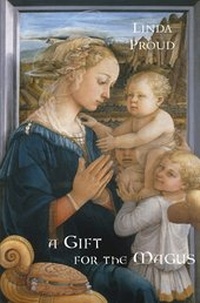
A Gift for the Magus
Description

A Gift for the Magus is a novel about the painter, Fra Filippo Lippi, his adventurous life and his dramatic relationship with his patron, Cosimo de' Medici. According to Alberti, to be a good painter you must be a good man. Was Alberti wrong, or was Lippi a better man than generally believed? While telling Lippi's compelling story, this novel explores the nature of goodness. Set in Florence in the 1450s, it acts as a prequel to 'The Botticelli Trilogy'.
All prices
More details
Other editions
Additional editions
Content
Padua
1434
The friar arrived early in the crypt. Above, in the church, Mass was in progress and the notes of the Kyrie chant rose and dipped like birdsong in a place elsewhere, hidden and beyond view. Lord have mercy. Here in the stone crypt, lit by a few stinking tallow candles that marked the vaulted ceiling with rings of soot, it was damp and chilly. Fra Filippo sniffed and huddled deeply within his black Carmelite habit and white mantle.
The habit was paint-spattered and long overdue a laundering. He had been told many times that, having left the monastery to become a painter, he should not wear the habit, and certainly he should not wear it as a work apron, but one of the joys of living outside the Carmine was that he did not have to do what he was told. Not that he ever had. He liked wearing the habit. It gave a useful impression of holiness, even when it was caked with dribbles of raw egg.
As his eyes grew accustomed to the dark, he explored more deeply into the crypt. The group had several meeting places in churches of the city, but it was his first time in Santa Sofia. Old. Old beyond time. Certainly beyond the last century that, with its plague, war and famine, had reduced all cities to a third of their size so that they sat shrunken within their ancient walls like dried kernels in their shells.
Some said it was time for renewal and that the way to regenerate was to return to the past, not the harsh, recent past, but the long-ago golden age of ancient Greece and Rome. The crypt followed the shape of the circular apse above and was supported by squat, sturdy pillars capped with grotesque animal carvings. He wondered what people meant when they said 'ancient Rome'. Was this crypt ancient Roman? It looked old enough and good enough, but he thought it was not that old. This church's past was the exotic one of converted pagans, of goths and franks and langobards: the invasions of the barbarians, bearded chieftains with names like Dagobert and Rothari and Pandulf Ironhead. He wondered who had ruled here in Padua at the time this holy church was built. The crypt and its many passages and chapels seemed haunted by the ghosts of long-haired and recently converted warriors speaking in strange tongues.
The walls, damp and peeling, were painted with the arms of the city of Padua and its great families, most of whom were no more, for the fortunes of Padua were more transient than most. Now it was ruled by Venice and people acted as if it would be so for ever more, but one reading of these walls would remind them how fickle fortune can be. The dagged sleeves, tourney helmets and eagle crests of dead families on lime-encrusted walls proved it.
Filippo liked the lettering of the names and mottoes and held his candle up to study it. Masaccio would have disapproved, of course, but he was dead and Filippo was free to enjoy what his betters considered to be barbaric and long out of fashion, these curious letter forms with their curlicues and adornments that hung off the capitals like earrings. These days they wanted Roman letters, smooth, round and rational, written letters based on forms made by the chisel.
Above in the church the deacon was intoning from the Gospel the story of the prodigal son. Filippo returned to the centre of the crypt and its altar which seemed very ancient indeed. And that stone chest over there. He went to examine it and found it carved most wonderfully with the figures of Roman gods. A sarcophagus, surely, which had once contained the corpse of someone important. Ah! Ancient Rome - he had found it! Was the church built on an old pagan temple? He studied the images carved on the sarcophagus and tried to learn from them. Masaccio used to say that we can find all the instruction we need in ancient Rome, but try as he might, Filippo could never discover in sculpture the lessons he needed in paint. He traced the muscled figures with his finger. Perhaps he would return on the morrow and make some studies. But of what use would the figure of Apollo be to the painting he was making of Saint Anthony of Padua?
'Look not on our sins,' intoned a distant voice, filtered by the tiled floor above Filippo's vaulted ceiling, 'but on the faith of your Church, and grant us the peace and unity of your kingdom where you live for ever and ever.'
The chant of the Agnus Dei soared up into the rafters of Santa Sofia and rained down even into the crypt. Filippo looked upwards, his eyes moist, his face wistful, an expression that those who knew him called 'his orphan face'. It was the expression of one who always found himself outside, cut off from life by a door for which he had no key. He listened to the faithful making their way to the Eucharistic bread, to be blessed and made new.
At the rough-hewn altar in the crypt three benches had been put out. With not much time left now, he sat on one and, taking a ball of mastic from his draw-string purse, warmed it by rolling it between his palms. He stretched it and stuck it beneath the bench and into it he pressed three dice. Tonight he had to win by whatever means he had at his disposal or he would be sleeping on the banks of the Bacchiglione with the star-strewn sky for a blanket, at that time of the year when the nights were getting cold.
On the altar was a wood carving of the Madonna, old and worm-eaten but sweet in her modest demeanour. Someone had placed a small vase of cornflowers before it many months ago, the blooms now mere ghostly forms, grey and brittle with none of the colour. Cobweb flowers.
He heard the steps of men approaching and rose to make it seem that he had himself arrived only moments earlier.
The game had lasted a week so far with a pot getting ever-fatter. Each night they met in a different location and on this night their host was the deacon who had just presided over the Mass above. An elderly man, he had two broad front teeth separated by a gap that made him look as if he had the cloven foot of the devil in his mouth; whenever he spoke or laughed he threw back his head and gave everyone a far greater view of his ugly teeth than was necessary. He welcomed the group of players to Santa Sofia, 'The first church built in Padua, on the site of an ancient Roman temple.'
The painter, Francesco Squarcione, was already on his knees before the sarcophagus, imprinting his memory with the figures of Apollo and those he immediately identified as the Muses. Squarcione, who was the first choice of painter in Padua, had far more confidence than either his skill or his original trade as a tailor should have allowed. 'I know this well, of course,' he was saying, 'but I have not studied it enough. I go to Verona, to Rome, all over Italy, to draw ruins and add to my collections of coins and statues, and I neglect what is at home. When I win this pot, I'm going to Greece.'
'Is there much of ancient Rome in Greece?' Filippo asked, making a show of inspecting the dice that the deacon had placed on the altar table, blowing on them and weighing them in his hands as if he had the sensitivity of a gold scale.
Squarcione looked at him as if unsure whether Lippi was joking or merely stupid. You never could tell with Florentines. 'If we are rediscovering the beauties of our ancient Roman past,' he said carefully, 'imagine how much there is to discover of ancient Greece, which inspired Rome. Inspired her, yes, in the imitation of nature and beauties of proportion. Greece! Oh, Mother Greece! Matrix of all the Arts!'
Two students of the university who had just arrived were imitating Squarcione behind his back, strutting with toes turned out, capturing the swagger of the painter whose opinion of himself outstripped his opinion of anyone else - although it had to be said that his opinion of others tended to be high. He was the first to admire those worthy of admiration - Filippo Lippi included - but he admired no one so much as he admired himself.
The sixth and last man of the group to arrive was the sacristan from the Scrovegni Chapel. Part of Filippo's aim in winning this game was to get this particular man in his debt, for he desired to gain admittance to the chapel when there was no one else there, to be alone for hours with the paintings of Giotto. Given his inability to afford the necessary backhander, he must encourage the sacristan to play on beyond his means and then offer to cover his debts.
'Come my friends,' said the deacon, 'let us recommence our game, here upon this sacrificial altar of the pagans.' So saying, he covered the statue of the Virgin with a bag, whether to protect her purity or hide their impurity, Filippo could not tell, but he was grateful for it.
'Those flowers need changing,' he said, sitting down on the bench where he had hidden his dice. 'Is this really a sacrificial altar?'
'It is indeed,' said the deacon. 'Those godless pagans would strap a living virgin to the table, plunge a knife in here,' he pointed to his breast, 'and slit her down to the navel to pull out the living heart.'
'That's not true!' Squarcione protested. 'The Romans did not practice human sacrifice!'
'What did they do to Jesus, then?'
One of the students had become bug-eyed and green-tinged but Filippo was rather enjoying the image of a writhing, naked virgin strapped to the slab. He liked that picture and had to wake himself out of it. Business was afoot, serious business. The pot had swelled to ten ducats and he meant to have every one of them, plus whatever was added this evening.
'Thanks be to God that we are Christians,' said the sacristan.
The deacon crossed...
