

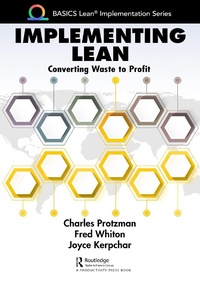
Implementing Lean
Converting Waste to Profit
1st Edition
Published on 30. December 2022
288 pages
978-1-000-77961-5 (ISBN)
Description

Lean is about building and improving stable and predictable systems and processes to deliver to customers high-quality products/services on time by engaging everyone in the organization. Combined with this, organizations need to create an environment of respect for people and continuous learning. It's all about people. People create the product or service, drive innovation, and create systems and processes, and with leadership buy-in and accountability to ensure sustainment with this philosophy, employees will be committed to the organization as they learn and grow personally and professionally.
Lean is a term that describes a way of thinking about and managing companies as an enterprise. Becoming Lean requires the following: the continual pursuit to identify and eliminate waste; the establishment of efficient flow of both information and process; and an unwavering top-level commitment. The concept of continuous improvement applies to any process in any industry.
Based on the contents of The Lean Practitioners Field Book, the purpose of this series is to show, in detail, how any process can be improved utilizing a combination of tasks and people tools and introduces the BASICS Lean (R) concept. The books are designed for all levels of Lean practitioners and introduces proven tools for analysis and implementation that go beyond the traditional point kaizen event. Each book can be used as a stand-alone volume or used in combination with other titles based on specific needs.
Each book is chock-full of case studies and stories from the authors' own experiences in training organizations that have started or are continuing their Lean journey of continuous improvement. Contents include valuable lessons learned and each chapter concludes with questions pertaining to the focus of the chapter. Numerous photographs enrich and illustrate specific tools used in Lean methodology.
Implementing Lean: Converting Waste to Profit explores implementation methods, line balancing methods, including baton zone or bumping, and implementing Lean in the office and machine shops. The goal of this book is to introduce the balance of the tools and how to proceed once the analysis is completed. There are many pieces to a Lean implementation and all of them are interconnected. This book walks through the relationships and how the data presented can be leveraged to prepare for the implementation. It also provides suggest solutions for improvements and making recommendations to management to secure their buy-in and approval.
Lean is a term that describes a way of thinking about and managing companies as an enterprise. Becoming Lean requires the following: the continual pursuit to identify and eliminate waste; the establishment of efficient flow of both information and process; and an unwavering top-level commitment. The concept of continuous improvement applies to any process in any industry.
Based on the contents of The Lean Practitioners Field Book, the purpose of this series is to show, in detail, how any process can be improved utilizing a combination of tasks and people tools and introduces the BASICS Lean (R) concept. The books are designed for all levels of Lean practitioners and introduces proven tools for analysis and implementation that go beyond the traditional point kaizen event. Each book can be used as a stand-alone volume or used in combination with other titles based on specific needs.
Each book is chock-full of case studies and stories from the authors' own experiences in training organizations that have started or are continuing their Lean journey of continuous improvement. Contents include valuable lessons learned and each chapter concludes with questions pertaining to the focus of the chapter. Numerous photographs enrich and illustrate specific tools used in Lean methodology.
Implementing Lean: Converting Waste to Profit explores implementation methods, line balancing methods, including baton zone or bumping, and implementing Lean in the office and machine shops. The goal of this book is to introduce the balance of the tools and how to proceed once the analysis is completed. There are many pieces to a Lean implementation and all of them are interconnected. This book walks through the relationships and how the data presented can be leveraged to prepare for the implementation. It also provides suggest solutions for improvements and making recommendations to management to secure their buy-in and approval.
More details
Series
Edition
1. Auflage
Language
English
Place of publication
London
United Kingdom
Publishing group
Taylor & Francis Ltd
Target group
Professional and scholarly
Illustrations
109 Line drawings, black and white; 109 Illustrations, black and white
ISBN-13
978-1-000-77961-5 (9781000779615)
Copyright in bibliographic data and cover images is held by Nielsen Book Services Limited or by the publishers or by their respective licensors: all rights reserved.
Schweitzer Classification
Other editions
Additional editions
Book
12/2022
1st Edition
Productivity Press
€69.51
Shipment within 10-20 days
Book
12/2022
1st Edition
Productivity Press
€185.70
Shipment within 10-20 days
Persons
Charles Protzman, MBA, CPM formed Business Improvement Group (B.I.G.), LLC, in November 1997. B.I.G. is located in Baltimore, Maryland. Charlie and his son, Dan, specialize in implementing and training Lean thinking principles and the Lean business delivery system (LBDS) in small to fortune 50 companies involved in Manufacturing, Healthcare, Government and Service Industries.
Charles is the coauthor of Leveraging Lean in Healthcare: Transforming Your Enterprise into a High Quality Patient Care Delivery System, recipient of the Shingo Research and Professional Publication Award, and the Leveraging Lean in Healthcare Series as well as several other books in process. His son, Dan, is co-author with Charles and Joe McNamara on the new book One-Piece Flow vs. Batching, CRC Press. Charles has over 34 years of experience in materials and operations management. He spent 13¿ years with AlliedSignal, now Honeywell, where he was an aerospace strategic operations manager and the first AlliedSignal Lean master. He has received numerous special-recognition and cost-reduction awards. Charles was an external consultant for Department of Business and Economic Development's (DBED's) Maryland Consortium during and after his tenure with AlliedSignal. He had input into the resulting DBED world class criteria document and assisted in the first three initial DBED world class company assessments. B.I.G. was a Strategic Partner of ValuMetrix Services, a division of Ortho-Clinical Diagnostics, Inc., a Johnson & Johnson company. He is an international Lean consultant and has taught beginner to advanced students courses in Lean principles and total quality all over the world.
Charlie Protzman states, "My grandfather started me down this path and has influenced my life to this day. My grandfather made four trips to Japan from 1948 to the 1960s. He loved the Japanese people and culture and was passionate and determined to see Japanese manufacturing recover from World War II."
Charles spent the last 18 years implementing successful Lean product line conversions, kaizen events, and administrative business system improvements (transactional Lean) worldwide. He is following in the footsteps of his grandfather, who was part of the Civil Communications Section (CCS) of the American Occupation. Prior to recommending Dr. Deming's 1950 visit to Japan, C.W. Protzman Sr. surveyed over 70 Japanese companies in 1948. Starting in late 1948, Homer Sarasohn and C.W. Protzman Sr. taught top executives of prominent Japanese companies an eight-week course in American participative management and quality techniques in Osaka and Tokyo. Over 5100 top Japanese executives had taken the course by 1956. Many of the lessons we taught the Japanese in 1948 are now being taught to Americans as "Lean principles." The Lean principles had their roots in the United States and date back to the early 1700s and later to Taylor, Gilbreth, and Henry Ford. The principles were refined by Taiichi Ohno and expanded by Dr. Shigeo Shingo. Modern-day champions are Norman Bodek (the Grandfather of Lean), Jim Womack, and Dan Jones.
Charles participated in numerous benchmarking and site visits, including a two-week trip to Japan in June 1996, where he worked with Hitachi in a kaizen event. He is a master facilitator and trainer in TQM, total quality speed, facilitation, career development, change management, benchmarking, leadership, systems thinking, high-performance work teams, team building, Myers-Briggs Styles indicator, Lean thinking, and supply chain management. He also participated in Baldridge Examiner and Six Sigma management courses. He was an assistant program manager during "Desert Storm" for the Patriot missile-to-missile fuse development and pro-duction program. Charles is also a member SME, AME, IIE, IEEE, APT, and the International Performance Alliance Group (IPAG), an International team of expert Lean Practitioners (http://www.ipag-consulting.com).
Joyce Kerpchar, PA-C, has over 28 years of experience in the health-care industry and currently serves as the director of the Institute for Surgical Advancement at Florida Hospital Orlando, which is part of the Adventist Health System, an acute-care, tertiary hospital caring for more than 1.5 million patients a year. She joined Florida Hospital in 2001 and spent over five years as a senior consultant implementing Lean across the eight campuses in a variety of clinical departments, is a Six Sigma black belt, and is a certified MBTI instructor. Joyce is a co-author of Leveraging Lean in Healthcare: Transforming Your Enterprise into a High Quality Patient Care Delivery System, Recipient of the Shingo Research and Professional Publication Award.
Kerpchar began her career as a board-certified physician's assistant in cardiovascular and thoracic surgery and primary care medicine. Prior to joining Florida Hospital, she held a variety of administrative positions in health-care-related industries, which included managed care operations and contracting for a PruCare/Prudential Healthcare that served 200,000 members in nine counties in Central Florida, product management for Avio Corporation, as a provider of information technology for ambulatory health-care organization, and as a partner in a consulting firm that specialized in business and market entry strategy for high-tech start-ups.
Kerpchar is passionate about leveraging Lean in health-care processes to eliminate waste and reduce errors, to improve the overall quality, and to reduce the cost of providing health care.
Fred Whiton, MBA, PMP, PE, has 30 years of experience in the aerospace and defense industry, which includes engineering, operations, program and portfolio management, and strategy development. He is employed as a senior vice president with CACI at the time of this book's publication.
Fred has both domestic and international expertise within homeland security, communications command and control intelligence surveillance and reconnaissance sensors and services, military and commercial aerospace systems, and defense systems supporting the U.S. Navy, U.S. Air Force, U.S. Army, U.S. Department of Homeland Security, and the U.S. Intelligence Community across a full range of functions from marketing, concept development, engineer-ing, and production into life cycle sustainment and logistics. Fred began his career as a design engineer at General Dynamics, was promoted to a group engineer at Lockheed Martin, and was a director at Northrop Grumman within the Homeland Defense Government Systems team. As vice president of engineering and operations at Smiths Aerospace, he was the Lean champion for a Lean enterprise journey, working closely with Protzman as the Lean consultant, for a very successful Lean implementation within a union plant, including a new plant designed using Lean principles. Prior to joining CACI, he was vice president and general manager of the Tactical Communications and Network Solutions Line of Business within DRS Technologies.
Fred has a BS in mechanical engineering from the University of Maryland, an MS in mechanical engineering from Rensselaer Polytechnic Institute, a master's in engineering administration from The George Washington University, and an MBA from The University of Chicago. He is a professional engineer (PE) in Maryland, a certified project management professional (PMP), served as a commissioner on the Maryland Commission for Manufacturing Competitiveness under Governor Ehrlich, served as a commissioner on the Maryland Commission on Autism under Governor O'Malley, served in the boards of directors for the Regional Manufacturing Institute headquartered in Maryland and the First Maryland Disability Trust.
Content
Chapter 1 - Implementation Methodologies Chapter 2 - Kanban Chapter 3 - Line Balancing Chapter 4 - Lean and Machine Shops Chapter 5 - Lean Applied to Transactional Settings Appendix A - Chapter Answers Appendix B - Acronyms Appendix C - Glossary
