

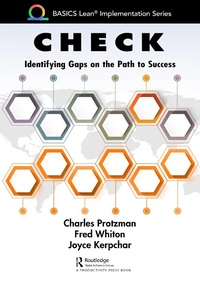
Check
Identifying Gaps on the Path to Success
Published on 30. December 2022
290 pages
978-1-000-78215-8 (ISBN)
Description

Lean is about building and improving stable and predictable systems and processes to deliver to customers high-quality products/services on time by engaging everyone in the organization. Combined with this, organizations need to create an environment of respect for people and continuous learning. It's all about people. People create the product or service, drive innovation, and create systems and processes, and with leadership buy-in and accountability to ensure sustainment with this philosophy, employees will be committed to the organization as they learn and grow personally and professionally.
Lean is a term that describes a way of thinking about and managing companies as an enterprise. Becoming Lean requires the following: the continual pursuit to identify and eliminate waste; the establishment of efficient flow of both information and process; and an unwavering top-level commitment. The concept of continuous improvement applies to any process in any industry.
Based on the contents of The Lean Practitioners Field Book, the purpose of this series is to show, in detail, how any process can be improved utilizing a combination of tasks and people tools and introduces the BASICS Lean (R) concept. The books are designed for all levels of Lean practitioners and introduces proven tools for analysis and implementation that go beyond the traditional point kaizen event. Each book can be used as a stand-alone volume or used in combination with other titles based on specific needs.
Each book is chock-full of case studies and stories from the authors' own experiences in training organizations that have started or are continuing their Lean journey of continuous improvement. Contents include valuable lessons learned and each chapter concludes with questions pertaining to the focus of the chapter. Numerous photographs enrich and illustrate specific tools used in Lean methodology
Check: Identifying Gaps on the Path to Success Transactional Processes contains chapters on implementing Lean, Kanban systems, line balancing, Heijunka-leveling, and the +QDIP process plus case studies of machine shop and transactional implementations. The implementation model describes the different approaches to Lean, compares them to Toyota, and explains each implementation model.
Lean is a term that describes a way of thinking about and managing companies as an enterprise. Becoming Lean requires the following: the continual pursuit to identify and eliminate waste; the establishment of efficient flow of both information and process; and an unwavering top-level commitment. The concept of continuous improvement applies to any process in any industry.
Based on the contents of The Lean Practitioners Field Book, the purpose of this series is to show, in detail, how any process can be improved utilizing a combination of tasks and people tools and introduces the BASICS Lean (R) concept. The books are designed for all levels of Lean practitioners and introduces proven tools for analysis and implementation that go beyond the traditional point kaizen event. Each book can be used as a stand-alone volume or used in combination with other titles based on specific needs.
Each book is chock-full of case studies and stories from the authors' own experiences in training organizations that have started or are continuing their Lean journey of continuous improvement. Contents include valuable lessons learned and each chapter concludes with questions pertaining to the focus of the chapter. Numerous photographs enrich and illustrate specific tools used in Lean methodology
Check: Identifying Gaps on the Path to Success Transactional Processes contains chapters on implementing Lean, Kanban systems, line balancing, Heijunka-leveling, and the +QDIP process plus case studies of machine shop and transactional implementations. The implementation model describes the different approaches to Lean, compares them to Toyota, and explains each implementation model.
More details
Series
Language
English
Place of publication
London
United Kingdom
Publishing group
Taylor & Francis Ltd
Target group
Professional and scholarly
Illustrations
131 Line drawings, black and white; 131 Illustrations, black and white
File size
17,56 MB
ISBN-13
978-1-000-78215-8 (9781000782158)
Copyright in bibliographic data and cover images is held by Nielsen Book Services Limited or by the publishers or by their respective licensors: all rights reserved.
Schweitzer Classification
Other editions
Additional editions
Book
12/2022
1st Edition
Productivity Press
€185.70
Shipment within 10-20 days
Book
12/2022
1st Edition
Productivity Press
€69.51
Shipment within 10-20 days
Persons
Lean is about building and improving stable and predictable systems and processes to deliver to customers high-quality products/services on time by engaging everyone in the organization. Combined with this, organizations need to create an environment of respect for people and continuous learning. It's all about people. People create the product or service, drive innovation, and create systems and processes, and with leadership buy-in and accountability to ensure sustainment with this philosophy, employees will be committed to the organization as they learn and grow personally and professionally.
Lean is a term that describes a way of thinking about and managing companies as an enterprise. Becoming Lean requires the following: the continual pursuit to identify and eliminate waste; the establishment of efficient flow of both information and process; and an unwavering top-level commitment. The concept of continuous improvement applies to any process in any industry.
Based on the contents of The Lean Practitioners Field Book, the purpose of this series is to show, in detail, how any process can be improved utilizing a combination of tasks and people tools and introduces the BASICS Lean (R) concept. The books are designed for all levels of Lean practitioners and introduces proven tools for analysis and implementation that go beyond the traditional point kaizen event. Each book can be used as a stand-alone volume or used in combination with other titles based on specific needs.
Each book is chocked full of case studies and stories from the authors' own experiences in training organizations who have started or are continuing their Lean journey of continuous improvement. Contents include valuable lessons learned and each chapter concludes with questions pertaining to focus of the chapter. Numerous photographs enrich and illustrate specific tools used in Lean methodology.
BASICS Lean (R) Implement and Check: A Guide to Methodologies, Kanbans, Line Balancing, Heijunka and Lean Transactional Processes contains chapters on implementing Lean, Kanban systems, line balancing, Heijunka-leveling, the +QDIP process plus case studies of machine shop and transactional implementations. The implementation model describes the different approaches to Lean and compares them to Toyota and explains each implementation model.
Lean is a term that describes a way of thinking about and managing companies as an enterprise. Becoming Lean requires the following: the continual pursuit to identify and eliminate waste; the establishment of efficient flow of both information and process; and an unwavering top-level commitment. The concept of continuous improvement applies to any process in any industry.
Based on the contents of The Lean Practitioners Field Book, the purpose of this series is to show, in detail, how any process can be improved utilizing a combination of tasks and people tools and introduces the BASICS Lean (R) concept. The books are designed for all levels of Lean practitioners and introduces proven tools for analysis and implementation that go beyond the traditional point kaizen event. Each book can be used as a stand-alone volume or used in combination with other titles based on specific needs.
Each book is chocked full of case studies and stories from the authors' own experiences in training organizations who have started or are continuing their Lean journey of continuous improvement. Contents include valuable lessons learned and each chapter concludes with questions pertaining to focus of the chapter. Numerous photographs enrich and illustrate specific tools used in Lean methodology.
BASICS Lean (R) Implement and Check: A Guide to Methodologies, Kanbans, Line Balancing, Heijunka and Lean Transactional Processes contains chapters on implementing Lean, Kanban systems, line balancing, Heijunka-leveling, the +QDIP process plus case studies of machine shop and transactional implementations. The implementation model describes the different approaches to Lean and compares them to Toyota and explains each implementation model.
Content
Chapter 1 - The House of Continuous Improvement Chapter 2 - Heijunka Chapter 3 - Mistake Proofing Chapter 4 - +QDIP & Huddles Chapter 5 - Visual Management Chapter 6 - Total Productivity Maintenance (TPM) Chapter 7 - Applying Lean to Accounting Appendix A - Chapter Answers Appendix B - Acronyms Appendix C - Glossary
