

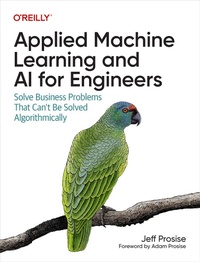
Applied Machine Learning and AI for Engineers
Description

While many introductory guides to AI are calculus books in disguise, this one mostly eschews the math. Instead, author Jeff Prosise helps engineers and software developers build an intuitive understanding of AI to solve business problems. Need to create a system to detect the sounds of illegal logging in the rainforest, analyze text for sentiment, or predict early failures in rotating machinery? This practical book teaches you the skills necessary to put AI and machine learning to work at your company.
Applied Machine Learning and AI for Engineers provides examples and illustrations from the AI and ML course Prosise teaches at companies and research institutions worldwide. There''s no fluff and no scary equations?just a fast start for engineers and software developers, complete with hands-on examples.
This book helps you:
- Learn what machine learning and deep learning are and what they can accomplish
- Understand how popular learning algorithms work and when to apply them
- Build machine learning models in Python with Scikit-Learn, and neural networks with Keras and TensorFlow
- Train and score regression models and binary and multiclass classification models
- Build facial recognition models and object detection models
- Build language models that respond to natural-language queries and translate text to other languages
- Use Cognitive Services to infuse AI into the apps that you write
More details
Other editions
Additional editions
Content
- Cover
- Copyright
- Table of Contents
- Foreword
- Preface
- Who Should Read This Book
- Why I Wrote This Book
- Running the Book's Code Samples
- Navigating This Book
- Conventions Used in This Book
- Using Code Examples
- O'Reilly Online Learning
- How to Contact Us
- Acknowledgments
- Part I. Machine Learning with Scikit-Learn
- Chapter 1. Machine Learning
- What Is Machine Learning?
- Machine Learning Versus Artificial Intelligence
- Supervised Versus Unsupervised Learning
- Unsupervised Learning with k-Means Clustering
- Applying k-Means Clustering to Customer Data
- Segmenting Customers Using More Than Two Dimensions
- Supervised Learning
- k-Nearest Neighbors
- Using k-Nearest Neighbors to Classify Flowers
- Summary
- Chapter 2. Regression Models
- Linear Regression
- Decision Trees
- Random Forests
- Gradient-Boosting Machines
- Support Vector Machines
- Accuracy Measures for Regression Models
- Using Regression to Predict Taxi Fares
- Summary
- Chapter 3. Classification Models
- Logistic Regression
- Accuracy Measures for Classification Models
- Categorical Data
- Binary Classification
- Classifying Passengers Who Sailed on the Titanic
- Detecting Credit Card Fraud
- Multiclass Classification
- Building a Digit Recognition Model
- Summary
- Chapter 4. Text Classification
- Preparing Text for Classification
- Sentiment Analysis
- Naive Bayes
- Spam Filtering
- Recommender Systems
- Cosine Similarity
- Building a Movie Recommendation System
- Summary
- Chapter 5. Support Vector Machines
- How Support Vector Machines Work
- Kernels
- Kernel Tricks
- Hyperparameter Tuning
- Data Normalization
- Pipelining
- Using SVMs for Facial Recognition
- Summary
- Chapter 6. Principal Component Analysis
- Understanding Principal Component Analysis
- Filtering Noise
- Anonymizing Data
- Visualizing High-Dimensional Data
- Anomaly Detection
- Using PCA to Detect Credit Card Fraud
- Using PCA to Predict Bearing Failure
- Multivariate Anomaly Detection
- Summary
- Chapter 7. Operationalizing Machine Learning Models
- Consuming a Python Model from a Python Client
- Versioning Pickle Files
- Consuming a Python Model from a C# Client
- Containerizing a Machine Learning Model
- Using ONNX to Bridge the Language Gap
- Building ML Models in C# with ML.NET
- Sentiment Analysis with ML.NET
- Saving and Loading ML.NET Models
- Adding Machine Learning Capabilities to Excel
- Summary
- Part II. Deep Learning with Keras and TensorFlow
- Chapter 8. Deep Learning
- Understanding Neural Networks
- Training Neural Networks
- Summary
- Chapter 9. Neural Networks
- Building Neural Networks with Keras and TensorFlow
- Sizing a Neural Network
- Using a Neural Network to Predict Taxi Fares
- Binary Classification with Neural Networks
- Making Predictions
- Training a Neural Network to Detect Credit Card Fraud
- Multiclass Classification with Neural Networks
- Training a Neural Network to Recognize Faces
- Dropout
- Saving and Loading Models
- Keras Callbacks
- Summary
- Chapter 10. Image Classification with Convolutional Neural Networks
- Understanding CNNs
- Using Keras and TensorFlow to Build CNNs
- Training a CNN to Recognize Arctic Wildlife
- Pretrained CNNs
- Using ResNet50V2 to Classify Images
- Transfer Learning
- Using Transfer Learning to Identify Arctic Wildlife
- Data Augmentation
- Image Augmentation with ImageDataGenerator
- Image Augmentation with Augmentation Layers
- Applying Image Augmentation to Arctic Wildlife
- Global Pooling
- Audio Classification with CNNs
- Summary
- Chapter 11. Face Detection and Recognition
- Face Detection
- Face Detection with Viola-Jones
- Using the OpenCV Implementation of Viola-Jones
- Face Detection with Convolutional Neural Networks
- Extracting Faces from Photos
- Facial Recognition
- Applying Transfer Learning to Facial Recognition
- Boosting Transfer Learning with Task-Specific Weights
- ArcFace
- Putting It All Together: Detecting and Recognizing Faces in Photos
- Handling Unknown Faces: Closed-Set Versus Open-Set Classification
- Summary
- Chapter 12. Object Detection
- R-CNNs
- Mask R-CNN
- YOLO
- YOLOv3 and Keras
- Custom Object Detection
- Training a Custom Object Detection Model with the Custom Vision Service
- Using the Exported Model
- Summary
- Chapter 13. Natural Language Processing
- Text Preparation
- Word Embeddings
- Text Classification
- Automating Text Vectorization
- Using TextVectorization in a Sentiment Analysis Model
- Factoring Word Order into Predictions
- Recurrent Neural Networks (RNNs)
- Using Pretrained Models to Classify Text
- Neural Machine Translation
- LSTM Encoder-Decoders
- Transformer Encoder-Decoders
- Building a Transformer-Based NMT Model
- Using Pretrained Models to Translate Text
- Bidirectional Encoder Representations from Transformers (BERT)
- Building a BERT-Based Question Answering System
- Fine-Tuning BERT to Perform Sentiment Analysis
- Summary
- Chapter 14. Azure Cognitive Services
- Introducing Azure Cognitive Services
- Keys and Endpoints
- Calling Azure Cognitive Services APIs
- Azure Cognitive Services Containers
- The Computer Vision Service
- The Language Service
- The Translator Service
- The Speech Service
- Putting It All Together: Contoso Travel
- Summary
- Index
- About the Author
- Colophon
