

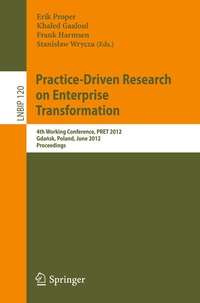
Practice-Driven Research on Enterprise Transformation
Description

This volume constitutes the proceedings of the 4th Working Conference on Practice-Driven Research on Enterprise Transformation (PRET), held in Gdansk, Poland, on June 27, 2012, as the industrial track of the 24th International Conference on Advanced Information Systems Engineering (CAiSE 2012).
Restructuring, divesting, improving performance, and merging are among the usual transformation activities that enterprises conduct to provide answers to the challenging demands put on them. To foster the much-needed debate between researchers and practitioners on these topics, the number of papers accepted for PRET is kept low, providing the authors and the audience with ample time to engage in discussions about both the practical implications of results and the theoretical underpinnings of phenomena observed in industrial practice. This year, five papers were selected after careful review, and each paper is between 20 and 25 pages long, to allow for the presentation of details.
The topics covered include enterprise architecture, business and IT alignment, and business process management and evaluation.
More details
Other editions
Additional editions
Content
- Title
- Preface
- Organization
- Table of Contents
- A Clarification of the Application Concept: The Caixa Geral de Depósitos Case
- The Situation
- The Project
- The Approach
- Views of a System
- The Results
- The Solution Concept
- The Application Concept
- The Platform Concept
- Reflection
- References
- Organizational Configuration Actor Role Modeling Using DEMO
- Introduction
- Flying the Organization
- Research Context and Research Approach
- Aircraft versus Organizational Configurations
- Aircraft Configuration
- Organizational Configuration
- Configuration Actor Role Modeling Using DEMO
- Actor Role Organization Modeling
- Actor Role Validation
- Actor Composite Roles
- Conclusion
- Future Work
- References
- A Method for Enterprise Architecture Alignment
- Introduction
- Related Work on EA Methods
- LEAP
- A Simple LEAP Example
- Logical Architecture
- Refinement
- Physical Architecture
- An Approach to Architecture Alignment
- Case Study
- Applying LEAP to the Case Study
- Step 1: Model Requirements
- Step 2: Define L-EA and Simulation
- Step 3: Collate Physical-EA
- Step 4: Configure Physical-EA
- Step 5: Define Physical-EA
- Step 6: Conformance
- Discussion and Further Work
- References
- A Practice-Based Framework for Enterprise Coherence
- Introduction
- Background to the Research Programme
- Requirements on the Governance of Enterprise Coherence
- Enterprise Coherence at the Level of Organizational Purpose
- Enterprise Coherence at the Design Level
- Perspectives
- Core Concepts
- Guiding Statements
- Core Models
- Relevant Relationships
- Experiences
- Coherence between the Levels
- Conclusion and Further Research
- References
- Measuring and Evaluating Business-IT Alignment for RAD Projects Using the REFINTO Framework and Tool
- Introduction
- REFINTO Framework and Tool: An Overview
- Architecture of the REFINTO Tool
- Using the REFINTO Framework
- Evaluating BIA Using the REFINTO Framework
- Pre-project Evaluation
- Intra-project Evaluation
- Post-project Evaluation
- Data Collection and Analysis
- Project Selection for Comparison
- Pre-project Analysis
- Intra-project Analysis
- Post-project Analysis
- Reflections on Results
- Limitations of the REFINTO Evaluation Mechanism
- Related Work
- Conclusions and Future Work
- References
- Author Index
