

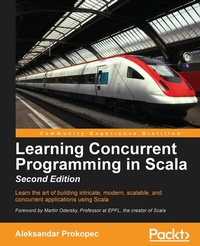
Learning Concurrent Programming in Scala
Practical Multithreading in Scala
2nd Edition
Published on 8. July 2025
434 pages
978-1-78646-214-5 (ISBN)
Description

Learn the art of building intricate, modern, scalable, and concurrent applications using Scala
Key Features
[*] Make the most of Scala by understanding its philosophy and harnessing the power of multicores
[*] Get acquainted with cutting-edge technologies in the field of concurrency, through practical, real-world applications
[*] Get this step-by-step guide packed with pragmatic examples
Book DescriptionScala is a modern, multiparadigm programming language designed to express common programming patterns in a concise, elegant, and type-safe way. Scala smoothly integrates the features of object-oriented and functional languages. In this second edition, you will find updated coverage of the Scala 2.12 platform. The Scala 2.12 series targets Java 8 and requires it for execution. The book starts by introducing you to the foundations of concurrent programming on the JVM, outlining the basics of the Java Memory Model, and then shows some of the classic building blocks of concurrency, such as the atomic variables, thread pools, and concurrent data structures, along with the caveats of traditional concurrency. The book then walks you through different high-level concurrency abstractions, each tailored toward a specific class of programming tasks, while touching on the latest advancements of async programming capabilities of Scala. It also covers some useful patterns and idioms to use with the techniques described. Finally, the book presents an overview of when to use which concurrency library and demonstrates how they all work together, and then presents new exciting approaches to building concurrent and distributed systems. Who this book is written for If you are a Scala programmer with no prior knowledge of concurrent programming, or seeking to broaden your existing knowledge about concurrency, this book is for you. Basic knowledge of the Scala programming language will be helpful.What you will learn
What you will learn from this book
? Get to grips with the fundamentals of concurrent programming on modern multiprocessor systems
? Build high-performance concurrent systems from simple, low-level concurrency primitives
? Express asynchrony in concurrent computations with futures and promises
? Seamlessly accelerate sequential programs by using data-parallel collections
? Design safe, scalable, and easy-to-comprehend in-memory transactional data models
? Transparently create distributed applications that scale across multiple machines
? Integrate different concurrency frameworks together in large applications
? Develop and implement scalable and easy-to-understand concurrent applications in Scala 2.12
Who this book is forIf you are a Scala programmer with no prior knowledge about concurrent programming, or seeking to broaden your existing knowledge about concurrency, this book is for you. Basic knowledge of the Scala programming language will be helpful. Also if you have a solid knowledge in another programming language, such as Java, you should find this book easily accessible.
Key Features
[*] Make the most of Scala by understanding its philosophy and harnessing the power of multicores
[*] Get acquainted with cutting-edge technologies in the field of concurrency, through practical, real-world applications
[*] Get this step-by-step guide packed with pragmatic examples
Book DescriptionScala is a modern, multiparadigm programming language designed to express common programming patterns in a concise, elegant, and type-safe way. Scala smoothly integrates the features of object-oriented and functional languages. In this second edition, you will find updated coverage of the Scala 2.12 platform. The Scala 2.12 series targets Java 8 and requires it for execution. The book starts by introducing you to the foundations of concurrent programming on the JVM, outlining the basics of the Java Memory Model, and then shows some of the classic building blocks of concurrency, such as the atomic variables, thread pools, and concurrent data structures, along with the caveats of traditional concurrency. The book then walks you through different high-level concurrency abstractions, each tailored toward a specific class of programming tasks, while touching on the latest advancements of async programming capabilities of Scala. It also covers some useful patterns and idioms to use with the techniques described. Finally, the book presents an overview of when to use which concurrency library and demonstrates how they all work together, and then presents new exciting approaches to building concurrent and distributed systems. Who this book is written for If you are a Scala programmer with no prior knowledge of concurrent programming, or seeking to broaden your existing knowledge about concurrency, this book is for you. Basic knowledge of the Scala programming language will be helpful.What you will learn
What you will learn from this book
? Get to grips with the fundamentals of concurrent programming on modern multiprocessor systems
? Build high-performance concurrent systems from simple, low-level concurrency primitives
? Express asynchrony in concurrent computations with futures and promises
? Seamlessly accelerate sequential programs by using data-parallel collections
? Design safe, scalable, and easy-to-comprehend in-memory transactional data models
? Transparently create distributed applications that scale across multiple machines
? Integrate different concurrency frameworks together in large applications
? Develop and implement scalable and easy-to-understand concurrent applications in Scala 2.12
Who this book is forIf you are a Scala programmer with no prior knowledge about concurrent programming, or seeking to broaden your existing knowledge about concurrency, this book is for you. Basic knowledge of the Scala programming language will be helpful. Also if you have a solid knowledge in another programming language, such as Java, you should find this book easily accessible.
All prices
More details
Edition
2nd Revised edition
Language
English
Place of publication
Birmingham
United Kingdom
Target group
Professional and scholarly
US School Grade: College Graduate Student
Edition type
Revised edition
File size
4,10 MB
ISBN-13
978-1-78646-214-5 (9781786462145)
Copyright in bibliographic data and cover images is held by Nielsen Book Services Limited or by the publishers or by their respective licensors: all rights reserved.
Schweitzer Classification
Other editions
Additional editions
Aleksandar Prokopec
Learning Concurrent Programming in Scala, Second Edition
Book
02/2017
Packt Publishing
€57.20
Shipment within 3-4 weeks
Person
Prokopec Aleksandar :
Aleksandar Prokopec, who also authored the first edition of this book, is a concurrent and distributed programming researcher. He holds a PhD in computer science from the cole Polytechnique Fdrale de Lausanne, Switzerland. He has worked at Google and is currently a principal researcher at Oracle Labs. As a member of the Scala team at EPFL, Aleksandar actively contributed to the Scala programming language, and he has worked on programming abstractions for concurrency, data-parallel programming support, and concurrent data structures for Scala. He created the Scala Parallel Collections framework, which is a library for high-level data-parallel programming in Scala, and participated in working groups for Scala concurrency libraries, such as Futures, Promises, and ScalaSTM. Aleksandar is the primary author of the reactor programming model for distributed computing.
Aleksandar Prokopec, who also authored the first edition of this book, is a concurrent and distributed programming researcher. He holds a PhD in computer science from the cole Polytechnique Fdrale de Lausanne, Switzerland. He has worked at Google and is currently a principal researcher at Oracle Labs. As a member of the Scala team at EPFL, Aleksandar actively contributed to the Scala programming language, and he has worked on programming abstractions for concurrency, data-parallel programming support, and concurrent data structures for Scala. He created the Scala Parallel Collections framework, which is a library for high-level data-parallel programming in Scala, and participated in working groups for Scala concurrency libraries, such as Futures, Promises, and ScalaSTM. Aleksandar is the primary author of the reactor programming model for distributed computing.
Content
Table of Contents
Introduction
Concurrency on the JVM and the Java Memory Model
Traditional Building Blocks of Concurrency
Asynchronous Programming with Futures and Promises
Data-Parallel Collections
Concurrent Programming with Reactive Extensions
Software Transactional Memory
Actors
Concurrency in Practice
Reactors
Introduction
Concurrency on the JVM and the Java Memory Model
Traditional Building Blocks of Concurrency
Asynchronous Programming with Futures and Promises
Data-Parallel Collections
Concurrent Programming with Reactive Extensions
Software Transactional Memory
Actors
Concurrency in Practice
Reactors

