

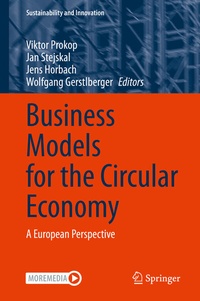
Business Models for the Circular Economy
Description

Increased ecological awareness and the growing scarcity of resources have led to the introduction of new environmental standards, triggering enterprises, regions, and even countries to adopt new business models and industrial reconversion approaches. However, despite increased interest in business models and their innovation, it still lacks the integration of circularity and sustainability and to date research on these areas is still limited. This book, therefore, provides readers with a closer picture of the issues of business models and their innovation for the circular economy in Europe, where the issues of sustainability and the shift towards the circular economy have become cornerstones of European policies and documents and where significant differences have been identified between firms and countries. This book provides a unique view of different European perspectives and enables the reader to compare the situation in countries with completely different historical and economic conditions as well as with different perceptions of the need for the actions leading to the sustainable development and to the shift towards the circular economy.
More details
Other editions
Additional editions
Persons
Viktor Prokop is deputy head of the Science and Research Centre at the Faculty of Economics and Administration at the University of Pardubice (Czech Republic). His research interests are innovation ecosystems and (eco) innovation and its determinants. His work has been published in journals such as Technological Forecasting and Social Change or Journal of Cleaner Production.
Jan Stejskal is Professor of Public and Regional Economics in the Faculty of Economics and Administration at the University of Pardubice (Czech Republic). He focuses on public policies aimed at increasing the resilience, sustainability, and performance of innovation ecosystems and regional actors that cooperate. He has published in journals such as Technological Forecasting and Social Change or Corporate Social Responsibility and Environmental Management.
Jens Horbach is Professor of Economics at the University of Applied Sciences Augsburg (Germany). He holds a PhD from Friedrich-Alexander University in Nuremberg (Germany). Prof. Horbach's current research interests focus on the empirical analysis of the determinants and effects of environmental innovations. He has published in major journals such as Research Policy or Ecological Economics.
Wolfgang Gerstlberger is Professor of Operations Management at Tallinn University of Technology (Estonia) since 2019. He received his PhD and habilitation in general management from Kassel University (Germany). His research interests are sustainability and digital transformation, and his work has been published in journals like the Journal of Cleaner Production and Energy Policy.
