

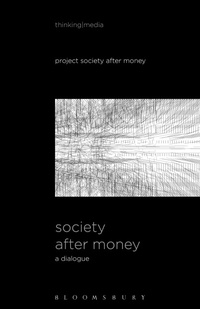
Society After Money
A Dialogue
1st Edition
Published on 18. April 2019
416 pages
978-1-5013-4739-9 (ISBN)
Description

Project Society After Money is an interdisciplinary project between commons theory, evolutionary political economy, media studies and sociology, that enter into a dialogue with one another in order to look at their specific theories and criticisms of money. Conceived as the beginning of a necessary interdisciplinary dialogue, the possibilities of post-monetary forms of organization and production are taken into account and examined. On one hand there is a lot of talk about 'digital revolution', 'mediatized society', 'networks', 'Industry 4.0'. On the other hand the present is described in terms of crisis: 'financial crisis', 'economic crisis', 'planetary boundaries'. At once there is the description of a media-technological change along with massive social and ecological disruptions.
Society After Money is based on the premise that there might be a conflict between digital media/digital technology and the medium of money - and perhaps new digital possibilities that allow alternative forms of economy. It criticizes what is normally seen as self-evident and natural, namely that social coordination has to be done by the medium of money. We're left with a highly innovative collection of contributions that initiates a broader social discourse on the role of money in the global society of the 21st century.
Society After Money is based on the premise that there might be a conflict between digital media/digital technology and the medium of money - and perhaps new digital possibilities that allow alternative forms of economy. It criticizes what is normally seen as self-evident and natural, namely that social coordination has to be done by the medium of money. We're left with a highly innovative collection of contributions that initiates a broader social discourse on the role of money in the global society of the 21st century.
Reviews / Votes
'Logic is the money of the mind', wrote Karl Marx in 1844. In 2018, in a world of humans with minds transformed by the global impact of information technologies, logic becomes distorted: Will money as we know it disappear? Society After Money uses transdisciplinary approaches to understand burning questions of today's society: How will the digital revolution change money forms? Is money indeed a necessary ingredient of social dynamics? What is the essence of money? In this thought provoking book, a broad variety of ideas has been collected. It should be read by everybody interested in thinking about money in a fresh and unconventional way. * Hardy Hanappi, Jean Monnet Chair for Political Economy of European Integration, Technological University of Vienna, Austria *More details
Series
Edition
1. Auflage
Language
English
Place of publication
New York
United States
Publishing group
Bloomsbury Publishing PLC (Digital)
Target group
Professional and scholarly
Illustrations
7 bw illus, 2 tables
File size
5,56 MB
ISBN-13
978-1-5013-4739-9 (9781501347399)
Copyright in bibliographic data and cover images is held by Nielsen Book Services Limited or by the publishers or by their respective licensors: all rights reserved.
Schweitzer Classification
Other editions
Additional editions
Book
10/2020
Bloomsbury Academic USA
€60.84
Shipment within 15-20 days
Book
04/2019
Bloomsbury Academic USA
€178.27
Shipment within 15-20 days
Person
"Project Society after Money" is an interdisciplinary project between commons theory (Stefan Meretz, Bonn), evolutionary economics (Manuel Scholz-Waeckerle, Vienna), media studies (Jens Schroeter, Bonn) and sociology (Hanno Pahl, Munich), which was founded in 2016, funded by the VW foundation 2016-2018. It includes several additional researchers from the aforementioned fields. It's aim is to discuss possible alternative economic forms beyond money. This research is highly relevant given the economic and ecological crisis.
Content
Introduction
1. A Society After Money? Historical Position, Characteristics and Perspectives of Current Approaches to Post-Monetary Economic Activity (Lars Heitmann, Project Society After Money, Germany)
2. Concept and Crisis of Money
2.1 The Elephant in the Room: The Money Commodity and its Mysteries (Ernst Lohoff, editor of Krisis, Germany)
2.2 Monetary Mechanisms: Origins, Dynamics and Crisis (Tobias Kohl, author of Geld und Gesellschaft: Zu Entstehung, Funktionsweise und Kollaps von monetaeren Mechanismen, Zivilisation und sozialen Strukturen, 2015)
2.3 Trialogue: Money as Medium or as General Commodity? (Ernst Lohoff, editor of Krisis, Germany; Hanno Pahl, Ludwig Maximilian University of Munich, Germany; Jens Schroeter, University of Bonn, Germany)
2.4 On the Possibility of a Society after Money: Evolutionary Political Economy, Economic Subjectivity and Planetary-Scale Computation (Ernest Aigner, Vienna University of Economics and Business, Austria, and Manuel Scholz-Waeckerle, Vienna University of Economics and Business, Austria)
3. Money as an Alien: Post-Monetary Elements in Utopian Literature and Science Fiction (Annette Schlemm, Independent Scholar, Germany)
4. Mediation After Money
4.1 A Critical View on the Criticism of Money (Christian Siefkes, independent scholar, Germany)
4.2 Categorical Foundations of a Post-Monetary Society (Stefan Meretz, co-founder of the German Commons Institute)
4.3 The Post-Capitalist Feminism Cookie. The Main Course: A Commons-Creating Peer Production as a Possible Future (Friederike Habermann, independent scholar, Germany)
4.4 Trialogue: Implicit and Explicit Views of Human Nature (Friederike Habermann, independent scholar, Germany; Stefan Meretz, co-founder of the German Commons Institute; Christian Siefkes, independent scholar, Germany)
5. Mediality After Money
5.1 Are We Approaching a Moneyless Society? (Peter Fleissner, TU Wein, Austria)
5.2 Money: For a Non-Money Economy (Stefan Heidenreich, University of Cologne, Germany)
5.3 Money and Digital Media (Jasmin Kathoefer, Braunschweig University of Art, Germany and Jens Schroeter, University of Bonn, Germany)
Afterword (Anitra Nelson, RMIT University, Australia)
List of Contributors
Index
1. A Society After Money? Historical Position, Characteristics and Perspectives of Current Approaches to Post-Monetary Economic Activity (Lars Heitmann, Project Society After Money, Germany)
2. Concept and Crisis of Money
2.1 The Elephant in the Room: The Money Commodity and its Mysteries (Ernst Lohoff, editor of Krisis, Germany)
2.2 Monetary Mechanisms: Origins, Dynamics and Crisis (Tobias Kohl, author of Geld und Gesellschaft: Zu Entstehung, Funktionsweise und Kollaps von monetaeren Mechanismen, Zivilisation und sozialen Strukturen, 2015)
2.3 Trialogue: Money as Medium or as General Commodity? (Ernst Lohoff, editor of Krisis, Germany; Hanno Pahl, Ludwig Maximilian University of Munich, Germany; Jens Schroeter, University of Bonn, Germany)
2.4 On the Possibility of a Society after Money: Evolutionary Political Economy, Economic Subjectivity and Planetary-Scale Computation (Ernest Aigner, Vienna University of Economics and Business, Austria, and Manuel Scholz-Waeckerle, Vienna University of Economics and Business, Austria)
3. Money as an Alien: Post-Monetary Elements in Utopian Literature and Science Fiction (Annette Schlemm, Independent Scholar, Germany)
4. Mediation After Money
4.1 A Critical View on the Criticism of Money (Christian Siefkes, independent scholar, Germany)
4.2 Categorical Foundations of a Post-Monetary Society (Stefan Meretz, co-founder of the German Commons Institute)
4.3 The Post-Capitalist Feminism Cookie. The Main Course: A Commons-Creating Peer Production as a Possible Future (Friederike Habermann, independent scholar, Germany)
4.4 Trialogue: Implicit and Explicit Views of Human Nature (Friederike Habermann, independent scholar, Germany; Stefan Meretz, co-founder of the German Commons Institute; Christian Siefkes, independent scholar, Germany)
5. Mediality After Money
5.1 Are We Approaching a Moneyless Society? (Peter Fleissner, TU Wein, Austria)
5.2 Money: For a Non-Money Economy (Stefan Heidenreich, University of Cologne, Germany)
5.3 Money and Digital Media (Jasmin Kathoefer, Braunschweig University of Art, Germany and Jens Schroeter, University of Bonn, Germany)
Afterword (Anitra Nelson, RMIT University, Australia)
List of Contributors
Index
