

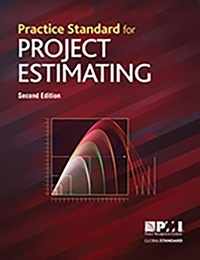
Practice Standard for Project Estimating - Second Edition
Published on 24. April 2020
136 pages
978-1-62825-645-1 (ISBN)
Description

Project estimating plays a vital role in project management. Typically completed in the initial planning stages, accurate project estimation can be a difficult task. Organizations and project managers should use these initial estimates to baseline the project schedule and cost, then refine these estimates as the project develops. Accurate estimation and refinement of the estimates leads to better and earlier decision making, thus maximizing value.Developed within the framework of A Guide to the Project Management Body of Knowledge (PMBOK® Guide) - Sixth Edition and other PMI standards, the Practice Standard for Project Estimating - Second Edition focuses on providing models for the project management profession in both plan-driven and change-driven adaptive (agile) life cycles. This practice standard describes the aspects of project estimating that are recognized as good practice on most projects most of the time and that are widely recognized and consistently applied.PMI practice standards describe processes, activities, constraints, inputs, and outputs for specific discipline subject areas and are targeted to all practitioners within projectized organizations, not just project managers.
More details
Other editions
Additional editions
Project Management Institute
Practice Standard for Project Estimating
Book
01/2020
2nd Edition
Project Management Institute
€60.00
Article not available at the moment
Content
- Front Cover
- Title Page
- Copyright
- Notice
- Table of Contents
- List of Figures and Tables
- Chapter 1: Introduction
- 1.1 Purpose of This Practice Standard
- 1.2 Project Estimating Definitions
- 1.3 Scope of Project Estimating
- 1.4 Project Estimating and The Project Management Practice
- 1.5 Relationships Among This Practice Standard and Other PMI Standards and Knowledge Areas
- 1.5.1 The PMBOK® Guide
- 1.5.2 Practice Standard for Earned Value Management [3]
- 1.5.3 Practice Standard for Work Breakdown Structures [4]
- 1.5.4 Practice Standard for Scheduling [5]
- 1.5.5 The Standard For Risk Management In Portfolios, Programs, and Projects [6]
- 1.5.6 The Standard for Program Management [7]
- 1.5.7 The Standard for Portfolio Management [8]
- 1.5.8 The Standard for Organizational Project Management (OPM) [9]
- 1.5.9 Navigating Complexity: A Practice Guide [10]
- 1.5.10 Agile Practice Guide
- 1.5.11 The PMI Guide To Business Analysis (Includes: The Standard For Business Analysis) [11]
- 1.6 Summary
- Chapter 2: Concepts
- 2.1 Overview
- 2.2 Estimating Roles
- 2.3 Estimating Life Cycle Stages
- 2.4 Evolving Estimates
- 2.5 Use of Metrics and Available Data
- 2.6 Estimation Variances
- 2.6.1 Predictive Life Cycles
- 2.6.2 Adaptive Life Cycles
- 2.6.3 Portfolio Estimate Variances
- 2.7 Characteristics of an Estimate
- 2.8 Industry-Specific Practices
- 2.9 Case Study
- 2.10 Summary
- Chapter 3: Prepare to Estimate
- 3.1 Overview
- 3.2 Prepare Project Estimating Approaches
- 3.2.1 Inputs
- 3.2.2 Outputs
- 3.2.3 Considerations
- 3.3 Case Study
- 3.4 Summary
- Chapter 4: Create Estimates
- 4.1 Overview
- 4.2 Use of Quantitative Estimating Techniques
- 4.2.1 Analogous Estimating Techniques
- 4.2.2 Parametric Estimating Techniques
- 4.2.3 Bottom-Up Estimating Techniques
- 4.3 Use of Relative Estimating Techniques
- 4.3.1 Relative Estimating Technique Inputs
- 4.3.2 Relative Estimating Technique Outputs
- 4.3.3 Relative Estimating Technique Considerations
- 4.4 Use of Qualitative Estimating Techniques
- 4.4.1 Inputs to Qualitative Estimating
- 4.4.2 Outputs of Qualitative Estimating
- 4.4.3 Qualitative Estimating Considerations
- 4.5 Considerations
- 4.5.1 Calibration
- 4.5.2 Optimism and Pessimism in Estimates
- 4.5.3 Progressive Elaboration of Estimates
- 4.5.4 Cost-Schedule Interrelationship
- 4.5.5 Accounting for Time
- 4.5.6 Anchoring
- 4.5.7 Machine Learning and Artificial Intelligence in Estimating
- 4.5.8 Common Success Factors
- 4.6 Case Study
- 4.7 Summary
- Chapter 5: Manage Estimates
- 5.1 Overview
- 5.2 Manage Estimates: A Living Plan Cycle
- 5.2.1 Inputs to the Manage Estimates Stage
- 5.2.2 Outputs of the Manage Estimates Stage
- 5.2.3 Considerations
- 5.3 Case Study
- 5.4 Summary
- Chapter 6: Improve Estimating Process
- 6.1 Overview
- 6.2 Assess the Estimating Process
- 6.2.1 Inputs to the Improve Estimating Process
- 6.2.2 Outputs of the Improve Estimating Process
- 6.3 Implement Changes and Share Lessons Learned
- 6.3.1 Inputs
- 6.3.2 Outputs
- 6.4 Considerations
- 6.5 Case Study
- 6.6 Summary
- References
- Appendix X1: The Practice Standard for Project Estimating - Second Edition Changes
- Appendix X2: Contributors And Reviewers of the Practice Standard for Project Estimating - Second Edition
- X2.1 The Practice Standard For Project Estimating - Second Edition Core Committee
- X2.2 Reviewers
- X2.2.1 SME Review
- X2.2.2 Public Exposure Draft Review
- X2.2.3 PMI Standards Program Member Advisory Group (SMAG)
- X2.2.4 Consensus Body Review
- X2.2.5 Production Staff
- X2.2.6 Harmonization Team
- Appendix X3: Case Study: Building a Custom Bicycle
- Section 2-Concepts
- Section 3-Prepare to Estimate
- Section 4-Create Estimates
- Section 5-Manage Estimates
- Section 6-Improve Estimating Process
- Appendix X4: Estimating Tools and Techniques
- X4.1 Overview
- Glossary
- 1. Common Acronyms
- 2. Definitions
- Index
- Back Cover
