

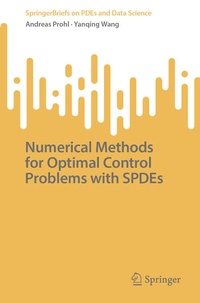
Numerical Methods for Optimal Control Problems with SPDEs
Description

This book is on the construction and convergence analysis of implementable algorithms to approximate the optimal control of a stochastic linear-quadratic optimal control problem (SLQ problem, for short) subject to a stochastic PDE. If compared to finite dimensional stochastic control theory, the increased complexity due to high-dimensionality requires new numerical concepts to approximate SLQ problems; likewise, well-established discretization and numerical optimization strategies from infinite dimensional deterministic control theory need fundamental changes to properly address the optimality system, where to approximate the solution of a backward stochastic PDE is conceptually new. The linear-quadratic structure of SLQ problems allows two equivalent analytical approaches to characterize its minimum: 'open loop' is based on Pontryagin's maximum principle, and 'closed loop' utilizes the stochastic Riccati equation in combination with the feedback control law. The authors will discuss why, in general, complexities of related numerical schemes differ drastically, and when which direction should be given preference from an algorithmic viewpoint.
More details
Other editions
Additional editions
Persons
Andreas Prohl is a professor at Eberhard Karls Universität Tübingen in Germany.
Yanqing Wang is currently an Associate Professor in the School of Mathematics and Statistics at Southwest University, Chongqing, China. His research interests include numerics of stochastic optimal control and the controllability of linear stochastic systems.
Content
Introduction.- Preliminaries.- Discretization based on the open-loop approach.- Discretization based on the closed-loop approach.
