

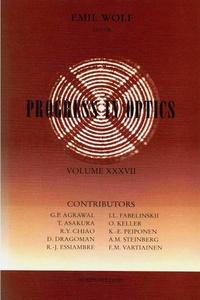
Progress in Optics
Elsevier (Publisher)
Published on 26. November 1997
440 pages
978-0-08-087997-0 (ISBN)
Description

This volume presents six articles describing theoretical and experimental research of interest in optics. The articles review applications of the Wigner distribution function in optics and optoelectronics, examine the mathematical foundations and the applicability of Kramers-Kronig relations to data inversion in linear and nonlinear optical spectroscopy and explore concentration and anisotropy fluctuations. Chapter four reviews the field of fibre-optical soliton communication systems, and includes discussion of periodic amplification, timing jitter and its control and time-division multiplexing. Chapter five focuses on theoretical aspects of the local field electrodynamics in mesoscopic media. The final chapter reviews experiments and theories concerning the time it takes for a photon or an electromagnetic wave packet to tunnel across a barrier.
More details
Other editions
Additional editions

Book
11/1997
North-Holland
€179.51
Article exhausted; check different version
Persons
Content
- Front Cover
- Progress in Optics, Volume XXXVII
- Copyright Page
- CONTENTS
- CHAPTER I. THE WIGNER DISTRIBUTION FUNCTION IN OPTICS AND OPTOELECTRONICS
- 1. Introduction
- 2. Light Propagation in Phase Space
- 3. Wigner Distribution Function
- 4. Light Beam Characterization in First-Order Optical Systems with the Wigner Distribution Function
- 5. Optical System Characterization with the Wigner Distribution Function
- 6. Wigner Distribution Function Representation of the Coupling Efficiency
- 7. The Fractional Wigner Distribution Function
- 8. Optical Beam Characterization in Nonlinear Optical Systems
- 9. Complex Field Reconstruction from the Wigner Distribution Function
- 10. Wigner Distribution Function in Quantum Optics
- 11. Conclusions
- References
- CHAPTER II. DISPERSION RELATIONS AND PHASE RETRIEVAL IN OPTICAL SPECTROSCOPY
- 1. Introduction
- 2. Kramers-Kronig Relations
- 3. Phase Retrieval in Optical Spectroscopy
- 4. Sum Rules
- 5. Conclusions
- Acknowledgements
- References
- CHAPTER III. SPECTRA OF MOLECULAR SCATTERING OF LIGHT
- 1. Introduction
- 2. The Fluctuations Of Thermodynamic Quantities
- 3. Spectra Of Molecular Light Scattering Arising From Pressure Fluctuations ?e(P). Equilibrium Phenomena
- 4. Spectra Of Molecular Light Scattering Arising From Pressure Fluctuations ?e (P). Some Nonequilibrium Phenomena
- 5. Spectra of Molecular Light Scattering Arising from Isobaric Entropy Fluctuations ?e(S) and from Concentration Fluctuatio ?e(C)
- 6. Spectra of Molecular Light Scattering Arising from Anisotropy Fluctuations ?e(?ik)
- 7. About Some Problems
- References
- CHAPTER IV. SOLITON COMMUNICATION SYSTEMS
- 1. Introduction
- 2. Optical Solitons in Fibers
- 3. Soliton-Based Communication Systems
- 4. Average-Soliton Regime
- 5. Quasi-Adiabatic Regime
- 6. Distributed Amplification
- 7. Dispersion-Decreasing Fibers
- 8. Dispersion Management
- 9. Channel Multiplexing
- 10. Dark-Soliton Communication Systems
- List of Symbols
- List of Acronyms
- References
- CHAPTER V. LOCAL FIELDS IN LINEAR AND NONLINEAR OPTICS OF MESOSCOPIC SYSTEMS
- 1. Introduction
- 2. Local Fields and Nonlocal Optics
- 3. Local Fields in Mesoscopic Media with Strongly Localized Electron Orbitals
- 4. Local Field Electrodynamics in Quantum Wells and Thin Films
- 5. 2D Spatial Confinement of Light by Optical Phase Conjugation
- Acknowledgements
- References
- CHAPTER VI. TUNNELING TIMES AND SUPERLUMINALITY
- 1. Introduction
- 2. A Brief History of Tunneling Times
- 3. Tunneling and Its Optical Analogs
- 4. Optical Experiments on Tunneling Times
- 5. New Theoretical Progress
- 6. Tunneling in de Broglie Optics
- 7. Superluminality and Inverted Atoms
- 8. Why Is Einstein Causality Not Violated?
- 9. Conclusion
- Acknowledgments
- Note added in proof
- References
- Author Index
- Subject Index
- Contents of previous volumes
- Cumulative Index
