

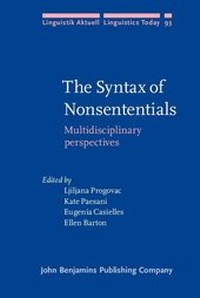
The Syntax of Nonsententials
Multidisciplinary perspectives
1st Edition
Published on 13. September 2006
X, 372 pages
978-90-272-9335-0 (ISBN)
Description

This volume brings the data that many in formal linguistics have dismissed as peripheral straight into the core of syntactic theory. By bringing together experts from syntax, semantics, pragmatics, philosophy of language, language acquisition, aphasia, and pidgin and creole studies, the volume makes a multidisciplinary case for the existence of nonsententials, which are analyzed in various chapters as root phrases and small clauses (Me; Me First!; Him worry?!; Class in session), and whose distinguishing property is the absence of Tense, and, with it, any syntactic phenomena that rely on Tense, including structural Nominative Case. Arguably, the lack of Tense specification is also responsible for the dearth of indicative interpretations among nonsententials, as well as for their heavy reliance on pragmatic context. So pervasive is nonsentential speech across all groups, including normal adult speech, that a case can be made that continuity of grammar lies in nonsentential, rather than sentential speech.
More details
Other editions
Additional editions
Ljiljana Progovac | Kate Paesani | Eugenia Casielles-Suarez
The Syntax of Nonsententials
Multidisciplinary perspectives
Book
09/2006
John Benjamins Publishing Co
€132.50
Shipment within 10-15 days
Persons
Content
- The Syntax of Nonsententials
- Editorial page
- Title page
- LCC data
- Table of contents
- Preface
- Introduction
- 1. Background: Defining and describing nonsententials
- 2. Goals of the current volume
- 3. Volume overview
- Notes
- References
- Toward a nonsentential analysis in generative grammar
- 1. Introduction
- 2. Early arguments for an ellipsis analysis
- 3. Early arguments for a nonsentential analysis
- 4. Mixed analyses
- 5. Data and sentential/nonsentential analyses in Minimalism
- 6. Conclusion
- Notes
- References
- The syntax of nonsententials
- 1. Introduction
- 2. Outline of the proposed analysis
- 3. Sentence and Tense
- 4. Noun Phrase, Determiners, and Case
- 4.1. DP as a theoretical construct
- 4.2. Tense, Case, and article omission
- 4.3. What is Default Case?
- 5. Small clauses in current syntactic theory
- 6. Tense, Time, assertion, and the role of context
- 6.1. The role of context
- 6.2. When assertion is not available
- 7. Conclusion
- Notes
- References
- Small structures''
- 1. Introduction
- 2. Fragment answers
- 2.1. Evidence for ellipsis in fragments
- 2.2. Evidence for movement in fragments
- 3. Discourse-initial (?) fragments
- 3.1. Discourse-initial fragments
- 3.2. Nonelliptical varia
- 4. Conclusion
- Note
- References
- Neither fragments nor ellipsis
- 1. Introduction
- 2. Merchant's proposal and its advantages
- 2.1. The [E] feature and movement
- 2.2. The limited ellipsis strategy
- 2.3. Advantages
- 3. Empirical objections
- 3.1. An empirical problem about [E]
- 3.2. An empirical problem about movement
- 3.3. Two empirical problems about limited ellipsis
- 4. A methodological objection: "Fragments'' and simplicity
- 5. Concluding remarks
- Notes
- References
- Big questions, small answers
- 1. Introduction
- 2. The elliptical view
- 3. The nonelliptical view
- 4. The sluicing view
- 5. Toward a phrasal analysis of small answers
- 6. Conclusions and further issues
- Notes
- References
- Extending the nonsentential analysis
- 1. Introduction
- 2. An overview of special registers
- 2.1. Absence of Tense
- 2.2. Absence of Determiners
- 2.3. Absence of Subjects
- 2.4. Absence of Objects
- 2.5. Summary
- 3. The (non)sentential nature of special registers
- 4. The syntax of nonsententials in special registers
- 4.1. A root small clause analysis
- 4.2. The Tense-Case correlation and the absence of objects in cooking recipes
- 5. Expressing time in special registers
- 6. Conclusion
- Notes
- References
- The narrowing acquisition path
- 1. Expressive small clauses
- 2. Small clauses in adult English
- 3. Small clauses in child English
- 4. A note on expressive content
- 5. When speaking expressively, we're all children
- 6. Self-directed disapprobation cross-linguistically
- 6.1. Auf Deutsch
- 6.2. Op Afrikaans
- 6.3. Po-Russki
- 6.4. Nihongo-De
- 6.5. General thoughts on variation and interfaces
- 7. The acquisition of expressive small clauses
- 8. Analysis of self-disapprobation small clauses
- 8.1. A meeting at the interface: Type theory
- 8.2. Expressive composition
- 9. Analysis of incredulity small clauses
- 10. Summary and conclusions
- Notes
- References
- Nonsententials and second language acquisition
- 1. Introduction
- 2. Background
- 3. Early L2 acquisition data: The Basic Variety
- 4. Learner language and native adult nonsententials
- 5. Nonsentential grammar and theories of L2 acquisition
- 6. Teacher talk
- 7. Conclusion
- Notes
- References
- How language adapts to the brain
- 1. Overview
- 2. Variability of symptoms
- 3. Theories of agrammatism as a variable phenomenon
- 4. Evidence for the temporal-window hypothesis
- 5. Adaptation
- 5.1. Corrective adaptation is responsible for nonfluency
- 5.2. Preventive adaptation is responsible for syntactic and morphological symptoms
- 5.3. Agrammatic speech has all the grammatical features of normal ellipsis
- 5.4. Distributional properties of types of nonfinite constructions are highly similar in agrammatic speech, child language, and normal ellipsis
- 5.5. Employment of ellipsis is task dependent
- 6. Conclusion
- Notes
- References
- Appendix
- Adaptation in other disorders: Dyslexia, stuttering, and movement disorders
- Nonsententials and agrammatism
- 1. Introduction
- 2. Syntactic deficits associated with agrammatic production
- 3. Theoretical accounts of agrammatic production
- 3.1. Absence of hierarchical structure (Caplan)
- 3.2. Tree pruning in production
- 3.3. Processing in the temporal-window and adaptation theory (Kolk)
- 4. Extending Kolk: Syntactic structure and adaptation theory
- 4.1. Nonsentential grammar
- 4.2. Nonsentential utterances in agrammatic production
- 4.3. Full-grammar versus nonsentential utterances
- 4.4. Summary of the nonsententials approach
- 5. Conclusion
- Notes
- References
- Reduced syntax in (prototypical) pidgins
- 1. Introduction
- 2. Structural characteristics of pidgins
- 3. Processes of pidginization
- 3.1. The role of "foreigner talk''
- 3.2. The role of L1 influence
- 3.3. The role of language universals
- 4. Pidgins and second language acquisition
- 4.1. The basic variety
- 5. Stages of development in pidginization and early IL
- 5.1. Stage 1 pidgins and ILs
- 5.2. Stage 2 pidgins and ILs: The syntax
- 5.3. Pidgin and IL structures as small clauses
- 5.4. The role of pragmatics in the interpretation of pidgin/IL utterances
- 6. Conclusion
- Notes
- References
- Copula variation in Guyanese Creole and AAVE
- 1. Introduction
- 2. The copula in Rural Guyanese Creole
- 3. Urban Guyanese Creole and the present-tense copula
- 4. Copula variation in Urban Guyanese Creole
- 5. Guyanese Creole and the nonsentential analysis
- 6. Copula variation in AAVE
- 7. AAVE, Guyanese Creole, and the nonsentential analysis
- 8. Discussion
- Notes
- References
- Epilogue
- 1. Nonsententials, individual variation, and multiple grammars
- 2. Why nonsententials: A historical perspective
- 2.1. Tracking (root) small clauses through acquisition and history
- 2.2. Where do root small clauses and other nonsententials come from?
- 3. Elliptical versus nonsentential approaches
- 3.1. Island effects
- 3.2. Case cross-linguistically
- 3.3. Preposition stranding
- 4. Some remaining issues and future prospects
- 4.1. The role of (pragmatic) context
- 4.2. Word order in nonsentential utterances
- 4.3. Parataxis and embedding
- Notes
- References
- Index of languages
- Index of names
- Index of subjects
- The series Linguistik Aktuell/Linguistics Today
