

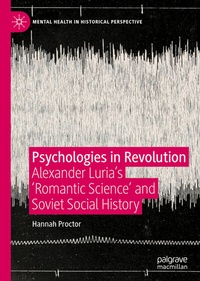
Psychologies in Revolution
Description

This book situates the work of the Soviet psychologist and neurologist Alexander Luria (1902-1977) in its historical context and explores the 'romantic' approach to scientific writing developed in his case histories. Luria consistently asserted that human consciousness was formed by cultural and historical experience. He described psychology as the 'science of social history' and his ideas about subjectivity, cognition and mental health have a history of their own. Lines of mutual influence existed between Luria and his colleagues on the other side of the iron curtain, but Psychologies in Revolution also discusses Luria's research in relation to Soviet history - from the October Revolution of 1917 through the collectivisation of agriculture and Stalinist purges of the 1930s to the Second World War and, finally, the relative stability of the Brezhnev era - foregrounding the often marginalised people with whom Luria's clinical work brought him into contact. By historicising science and by focusing on a theoretical approach which itself emphasised the centrality of social and political factors for understanding human subjectivity, the book also seeks to contribute to current debates in the medical humanities.
More details
Other editions
Additional editions
Person
Hannah Proctor is a Wellcome Trust Research Fellow at the Centre for the Social History of Health and Healthcare at the University of Strathclyde, UK, and has previously held positions at the ICI Berlin (Germany), University of Leeds (UK) and Birkbeck (UK), where she also completed her PhD.
